
 Pandemonium Attachment: F84 Engineering’s “Triple Bike”…
The earliest motorcycles weren’t much more than bicycles with internal combustion engines attached. In fact, William S. Harley’s initial idea in 1901 was to motorized a bicycle, and some of the earliest Harley-Davidson prototypes were referred to as “motor-bicycles.” The predecessors of these early gas-powered motorcycles were the steam velocipedes of builders like France’s Michaux-Perreaux (1868) and America’s Sylvester Roper (1869).
 The connection between the bicycle and motorcycle is highlighted in one of our favorite quotes from the early days of motorcycling:
“A motorcycle is a bicycle with pandemonium attachment, and is designed for the especial use of mechanical geniuses, daredevils and lunatics.” –George Fitch, Atlanta Journal-Constitution, 1916
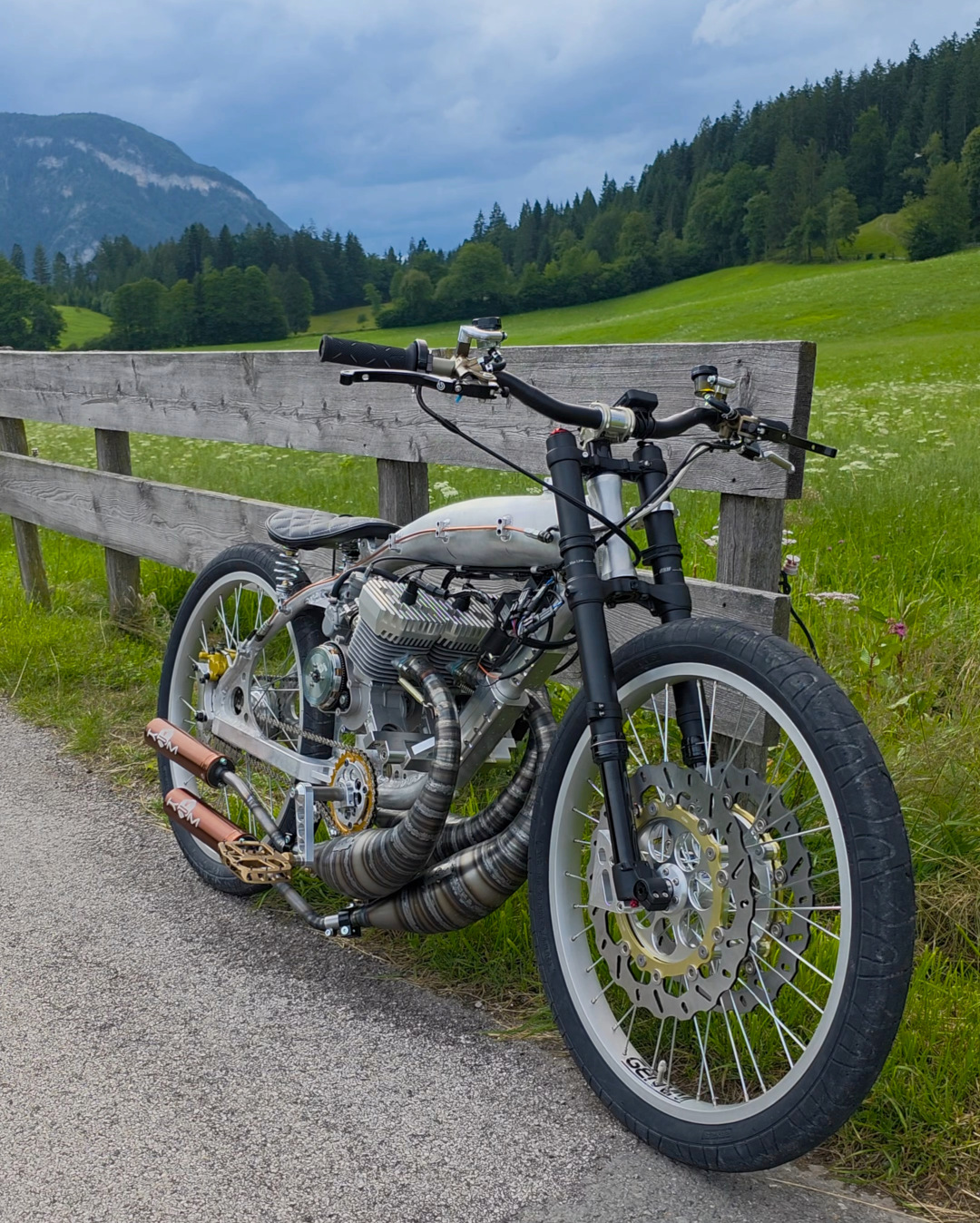
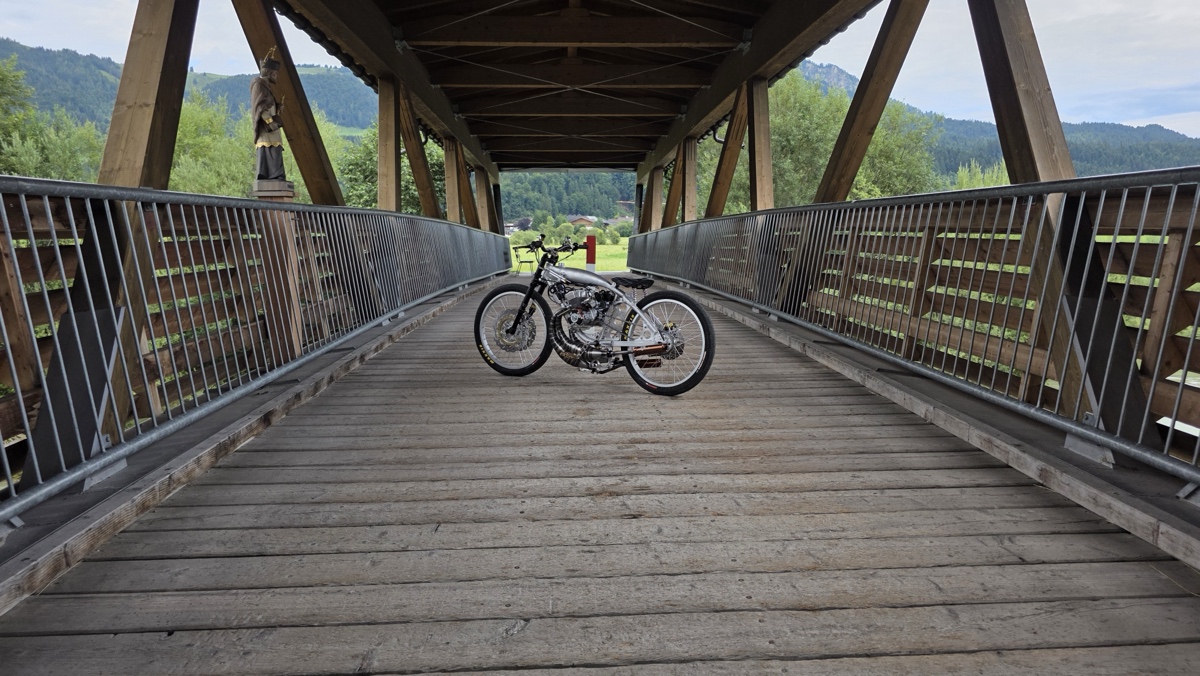
 That assessment seems as relevant today as ever. Though we haven’t met our new friend Florian Hauser of F84 Engineering in person, his three-cylinder two-stroke “Triple Bike” certainly demonstrates a heady combination of mechanical genius, daredevilry, and even a touch of lunacy.
 Florian built his first motorized bicycle when he was 14, tuned his first moped to hit 75 mph when he was 15, and currently rides an Aprilia RSV4 superbike. He owns a 700cc minibike and has built a two-stroke V-twin boardtracker, but the “Triple Bike” is his most complex project to date — a complete ground-up one-off custom frame and engine build.
It all began with Florian’s desire to build a three-cylinder two-stroke engine after seeing one in a little Mobylette.
“I personally think the 2-stroke engine is much cooler than the 4-stroke engine because it has much more character (except for a V12 4-stroke, which you can’t really compare). I also wanted to build a 3-cylinder engine for a bicycle. So I invested a lot of money in my workshop and bought a lathe and milling machine.”
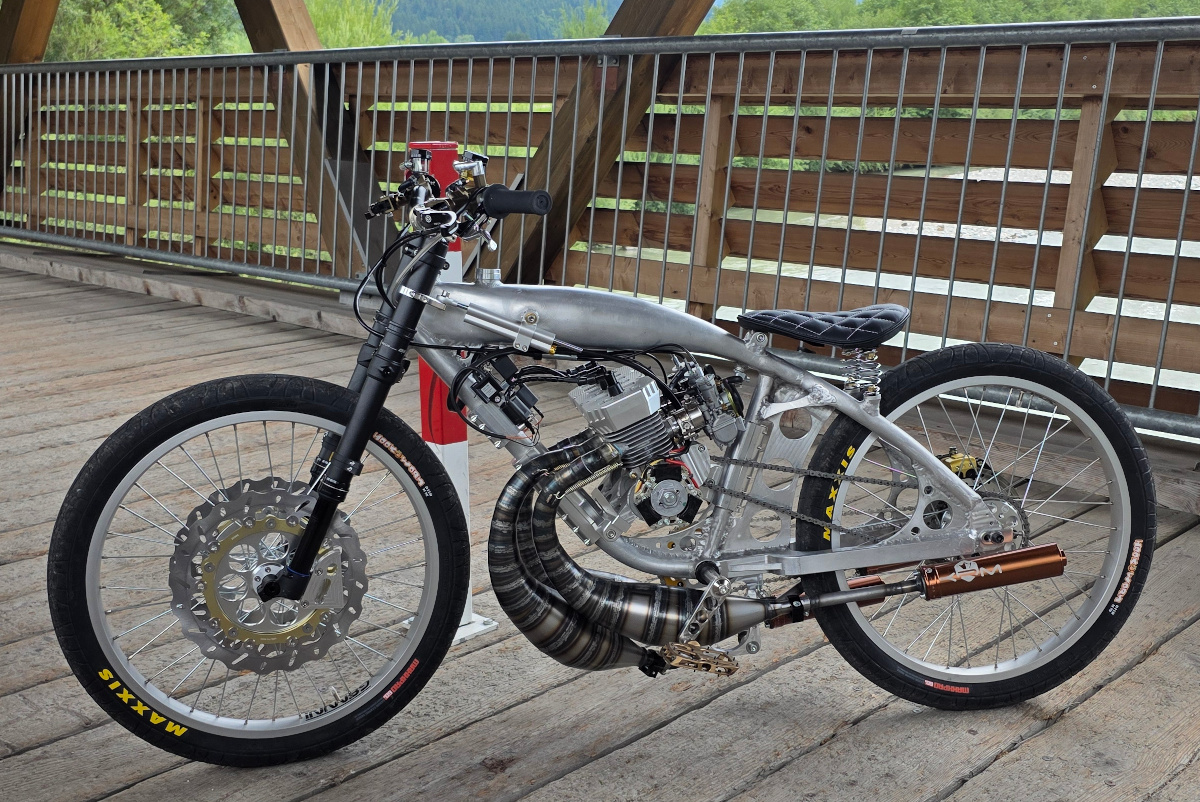
With the help of a friend with a 5-axis CNC milling machine, Florian created the engine from scratch, basing the design on a trio of cheap single-cylinder engine kits — but far improved. Everything is custom-fabricated:
“Almost everything, from the crankshaft to the engine housing, the drive shaft, basically the entire engine. The complete engine mount, the frame reinforcements, part of the exhaust, the complete crankset — the list goes on.”
Florian learned CAD in the process, as well as how to operate his lathe and milling machine, and the bike is a master class in form-follows-function design.
“It can only look like that because it has to work that way.”
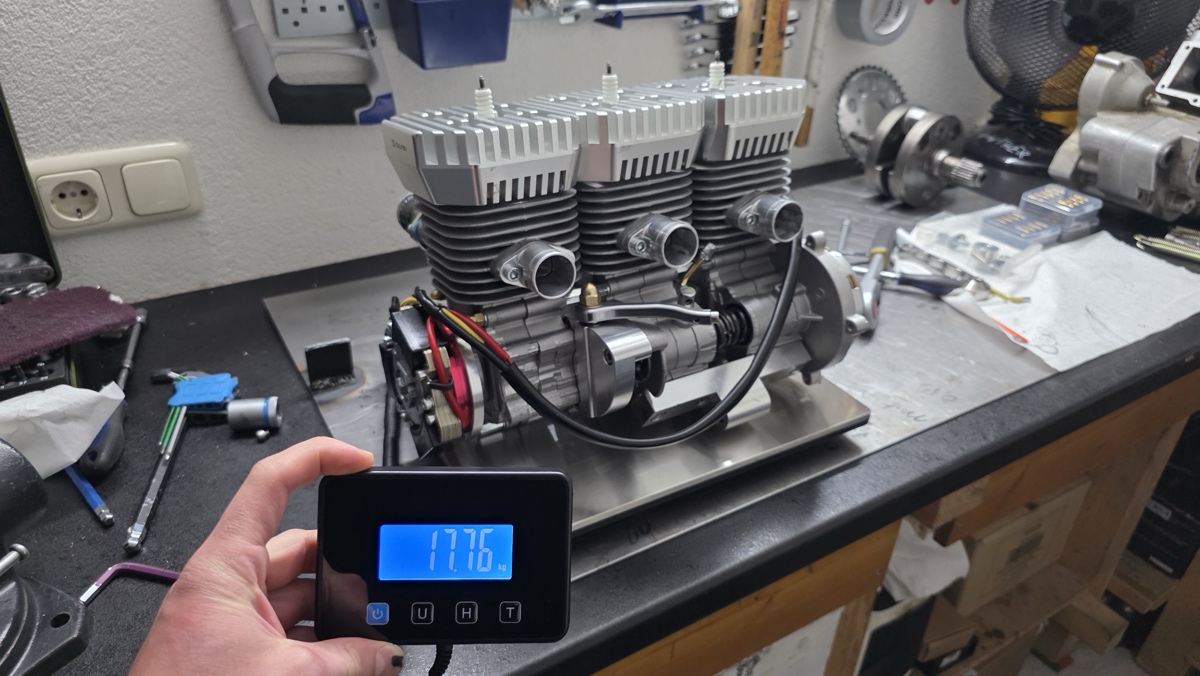
The 255cc triple-cylinder engine weighs under 40 pounds, and Florian has yet to weigh the whole bike itself — but it has to be light! He says the bike handles and cruises even better than some smaller single-cylinder machines.
“The bike isn’t slow, but it’s not so fast that you can’t ride it. Simply a relaxed cruiser.”
Florian learned an incredible amount during the build, and it’s just the beginning. He wants to build engines and motorcycles full-time, and he’s already at work on an even more extreme build — “one of the most extreme motorcycles ever.” We can’t wait to see it…
Below is our full interview with Florian, and be sure to follow him on YouTube and/or Instagram for in-depth videos on how he creates these stunning machines.
Two-Stroke Triple Bike: Builder Interview

• Please tell us a bit about yourself, your history with motorcycles, and your workshop.
I built my first motorized bicycle when I was 14. At the time, I also had a few pocket bikes and was always keen on a motorized two-wheeler of any kind. My father built me a small garden shed where I tinkered with things. When I was 15 and able to get my moped license, I bought a 50cc moped and tuned it over the next three years. I had so many different tuning cylinders and exhausts installed that I can’t even count them all. But since I was riding on public roads, I couldn’t go too overboard, so the largest cylinder was 90cc and the moped went 120 km/h.
Then I had a Puch Maxi, which I wasn’t keen on because something was always breaking. I also always had a motorized bicycle because I simply enjoyed riding it, tinkering with it, and tuning it. Then I bought a supermoto. A Husaberg FS570, and I rode it for two years until I got caught by the police. The bike wouldn’t pass the MOT, so I had to sell it. Then I didn’t have a motorcycle for about four years because I wasn’t that keen on riding them anymore. But then, by chance, I rode a Ducati Streetfighter V4S, and I liked it so much that two weeks later, I bought a 2015 Aprilia RSV4. I love this bike more than anything and don’t want to sell it anymore.

Then I saw a video of a Mobylette with a 3-cylinder, 2-stroke engine. I personally think the 2-stroke engine is much cooler than the 4-stroke engine because it has much more character (except for a V12 4-stroke, which you can’t really compare). I also wanted to build a 3-cylinder engine for a bicycle. So I invested a lot of money in my workshop and bought a lathe and milling machine. Luckily, my colleague, who has a 5-axis CNC milling machine at work, was able to help me with some important parts. Without him, the triple bike wouldn’t exist. In the beginning, he also made the drawings in a CAD program until I could do it myself. I learned a lot from building it. The bike is just the beginning. I’m already working on a new project, but the triple bike seems like a joke because what I want to build will be one of the most extreme motorcycles ever.
• What’s the make, model, and year of the donor bike?
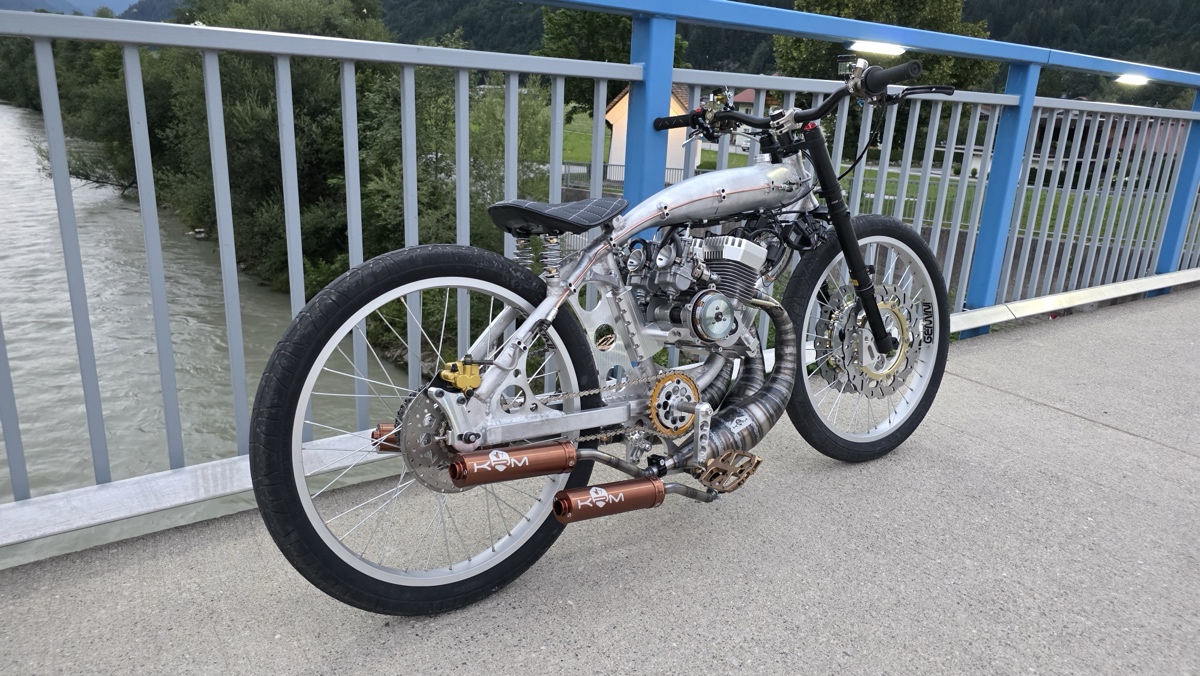
There is no donor motorcycle. The engine is a completely in-house development. This also applies to most of the frame. I’ve uploaded many YouTube videos showing exactly how I build and develop everything. The engine was based on three bicycle engine kits that you can buy on Amazon. They weren’t exactly the same as the ones on Amazon, but significantly better. I got the ignition from a Kawasaki H2 750.

• Why was this bike built?
I built it because I really wanted to build it. To show what I could do and to attract attention, since I want to start my own business. I want to build engines and motorcycles full-time. And also it’s my hobby.

• What was the design concept and what influenced the build?
Nothing, I didn’t take any inspiration from anywhere. It’s all my own development and built around the idea I had in mind. And a lot of it is form follows function. It can only look like that because it has to work that way.

• What custom work was done to the bike?
Almost everything, from the crankshaft to the engine housing, the drive shaft, basically the entire engine. The complete engine mount, the frame reinforcements, part of the exhaust, the complete crankset—the list goes on.
• Does the bike have a nickname?
The Triple Bike.
• Any idea of horsepower, weight, and/or performance numbers?
Unfortunately, I haven’t weighed the bike yet, but it’s certainly not light. The motor alone weighs 18 kg. I haven’t been on a dyno yet. I’m guessing around 15-25 hp.
• Can you tell us what it’s like to ride this bike?
Riding it is actually quite relaxing. Due to its slightly higher weight, it sits very well on the road, and the pedal system I developed works very well. This gives you plenty of legroom next to the motor. The bike isn’t slow, but it’s not so fast that you can’t ride it. Simply a relaxed cruiser.
• Was there anything done during this build that you are particularly proud of?
The way it looks as a whole. I’m proud of it. I’m also very proud of the engine because now I know that my technical understanding works not only in theory but also in practice. Now, of course, I would build it completely differently. Everything would be made from billet aluminum and not as extremely complex as it is now, but I’ve also learned a lot.

• Was there anything done during this build that you are particularly proud of?
My colleague who milled all the billet parts for me and gave me a good price. Without him and the parts he milled, this bike wouldn’t exist.
Follow the Builder
YouTube: @f84engineering
Instagram: @f84_engineering
Facebook: F84 Engineering
TikTok: @f84_engineering


Here is an article about rebuilding the world’s first motorcycle. (Note the author’s name….)
Website is currently down due to wrong information from Weebly, so I have to rebuild the whole thing from scratch….
Oops, here is the url to that story about rebuilding the world’s first motorcycle:
https://magazine.cycleworld.com/article/1974/5/1/rebuilding-the-worlds-first-motorcycle
Denco destroyr or the Kawasaki water buffalo were just the same. Rzs included. I also ride an rsv4 and countless race gixxer 1ks. Been 210 giggling. Great light bikes those two strokes. Like my CR500s. Just giggling. Anyways cool read thanks for my memories