

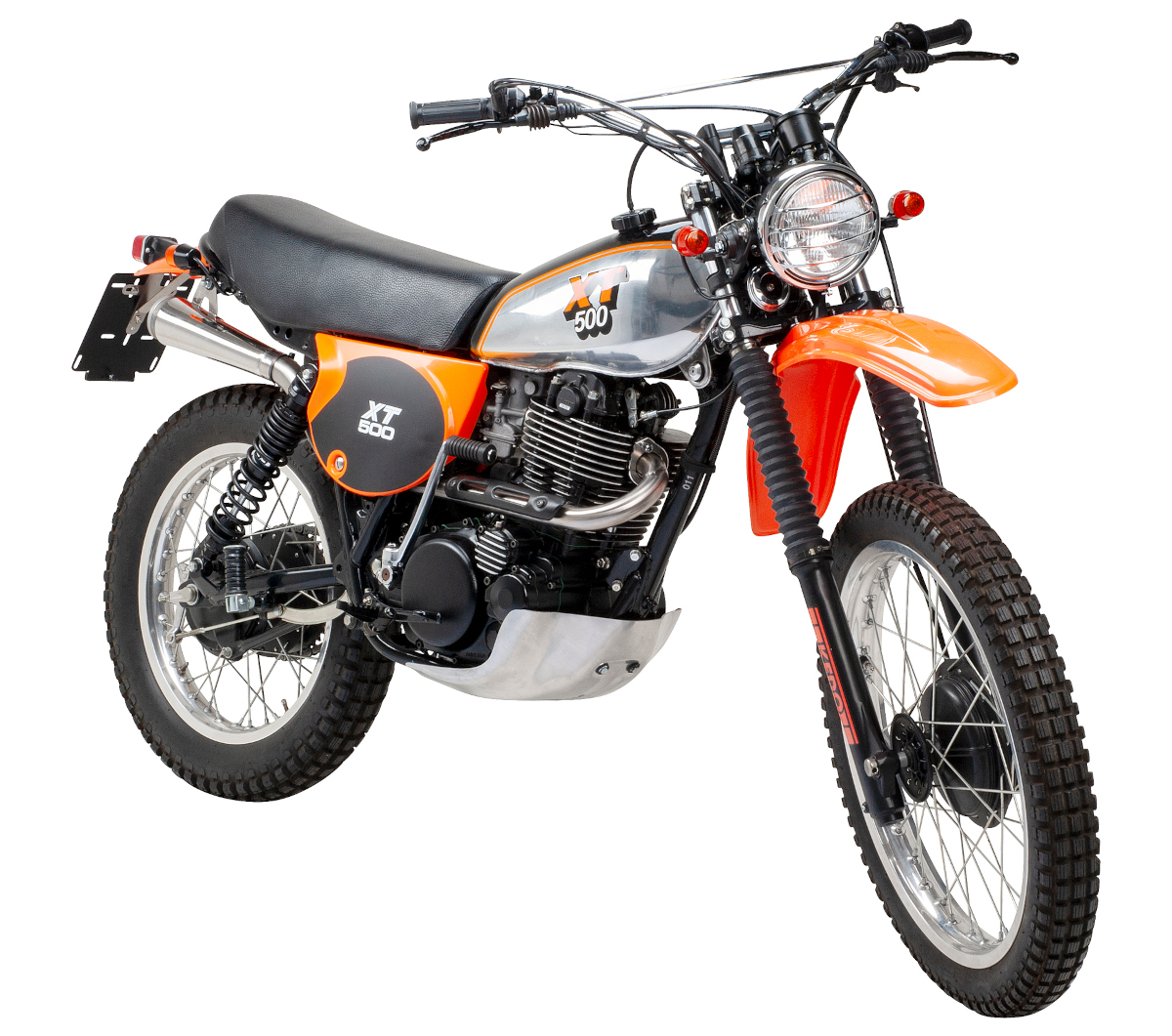
The Yamaha XT500 isn’t just a motorcycle—it’s a legend. Launched in the late 1970s, it helped define the dual-sport segment with its potent single‐cylinder engine, lightweight design, and rugged versatility. Whether tackling forest trails or winding country roads, the XT500 offered true freedom, simplicity, and raw character in an era when many bikes were becoming overly complex.
Styling & Feel

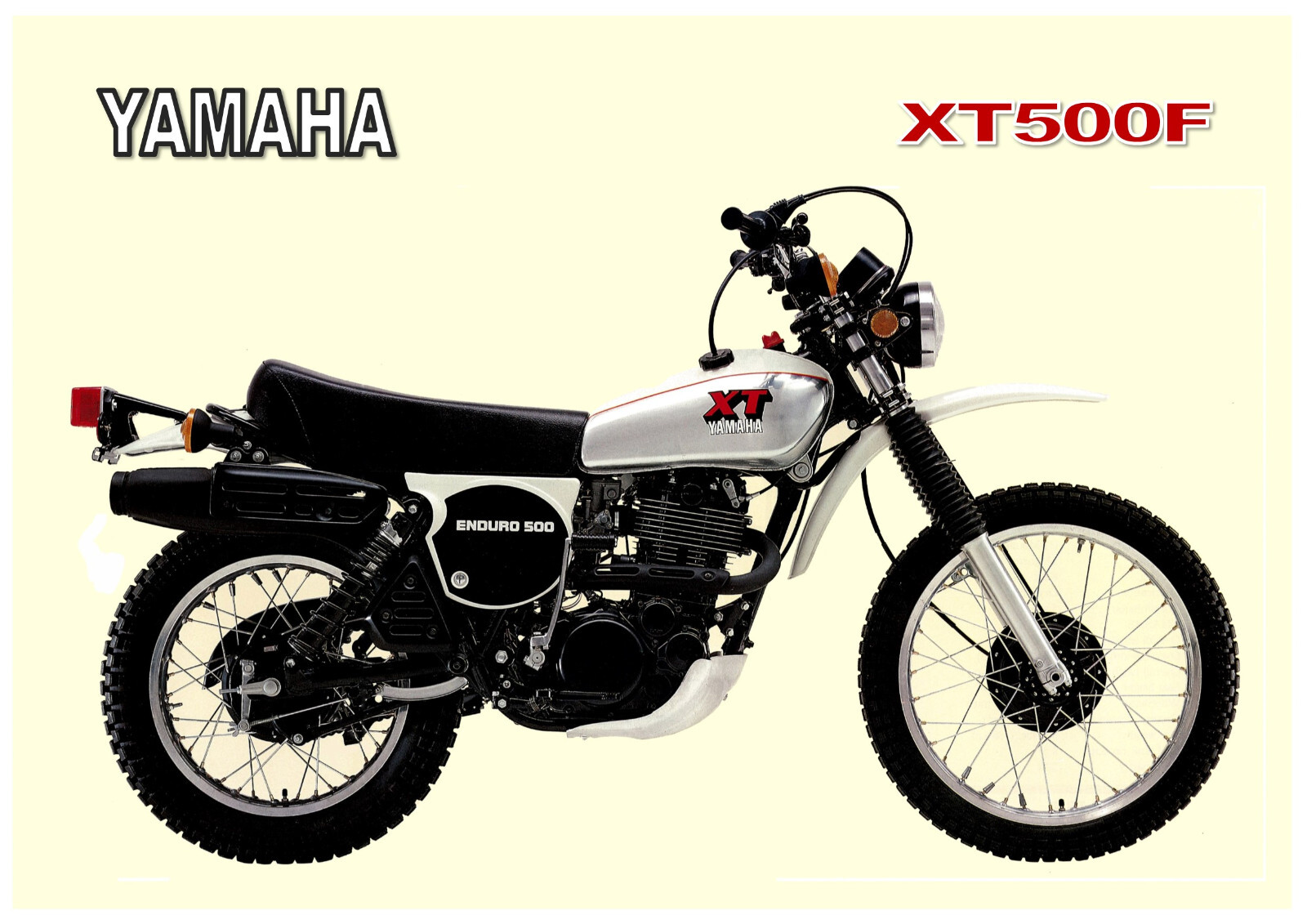
The XT500’s styling remains iconic. A tall stance, high-mounted exhaust, large ribbed tank, and narrow seat give it a purposeful dual-sport silhouette. The round headlamp, slim bodywork, and minimalist decals make it instantly recognizable. On the road or off it, the bike feels light, agile, and connected. You don’t ride it—you feel it.
Despite being decades old, the XT500’s design still resonates in modern retro and scrambler bikes. The lean form, exposed engine, and purposeful geometry speak to a time when design was about function and character. Saddle up, twist the throttle, and you’ll appreciate how every detail contributes to the ride.
Performance & Handling
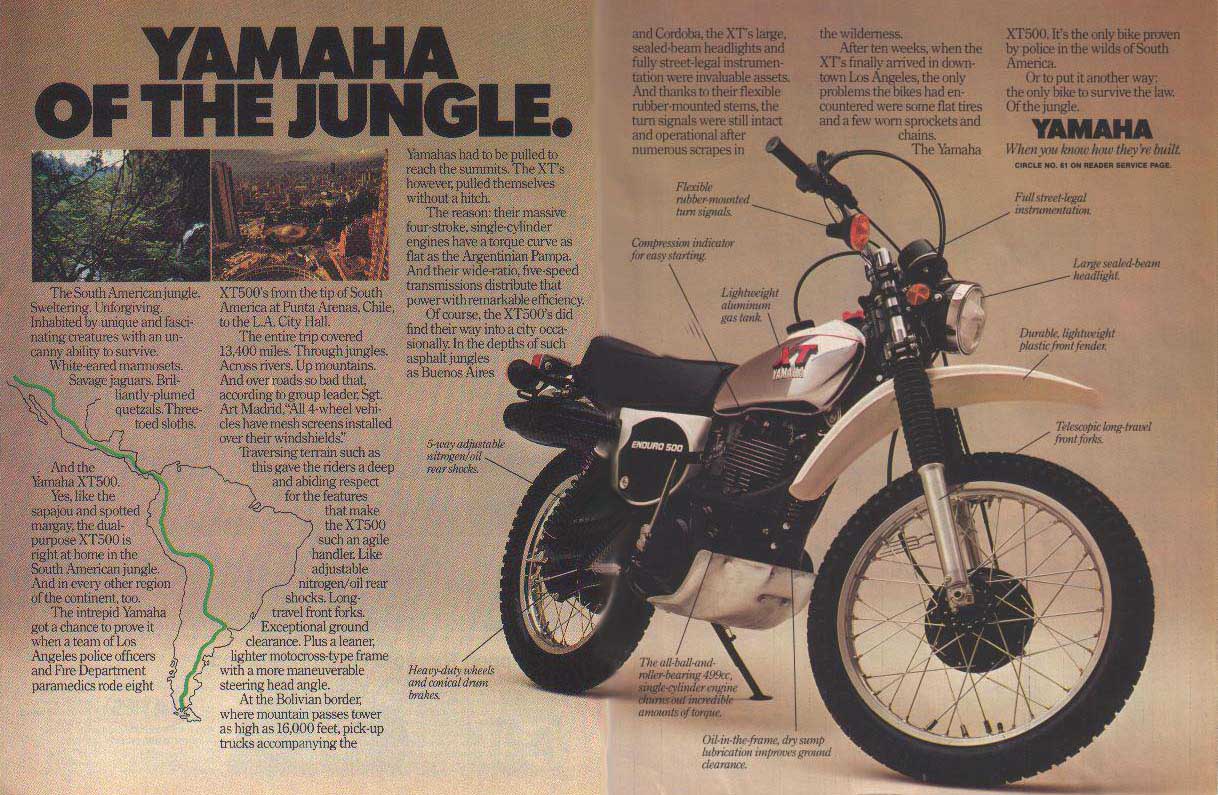
Under the tank lies a 499 cc air-cooled single-cylinder engine with a 5-speed gearbox. The power output (~33–35 hp, depending on market) and torque (~32 lb-ft) might seem mild by today’s standards—but the bike’s light weight (~330 lbs) and flexible delivery made it anything but slow in its day.
Handling is one of the XT500’s strengths. Its tall seat height and long-travel suspension gave it off-road capability, while the simple, uncluttered chassis rewarded committed riding on pavement. The tall, narrow tyres and high ground clearance encouraged spirited lines and allowed for dirt detours without fear.
The engine character is part of the charm: a broad, punchy mid-range that invites you to play rather than stress about revving. It’s raw, mechanical, and alive in a way many modern bikes aren’t.
Everyday Usability
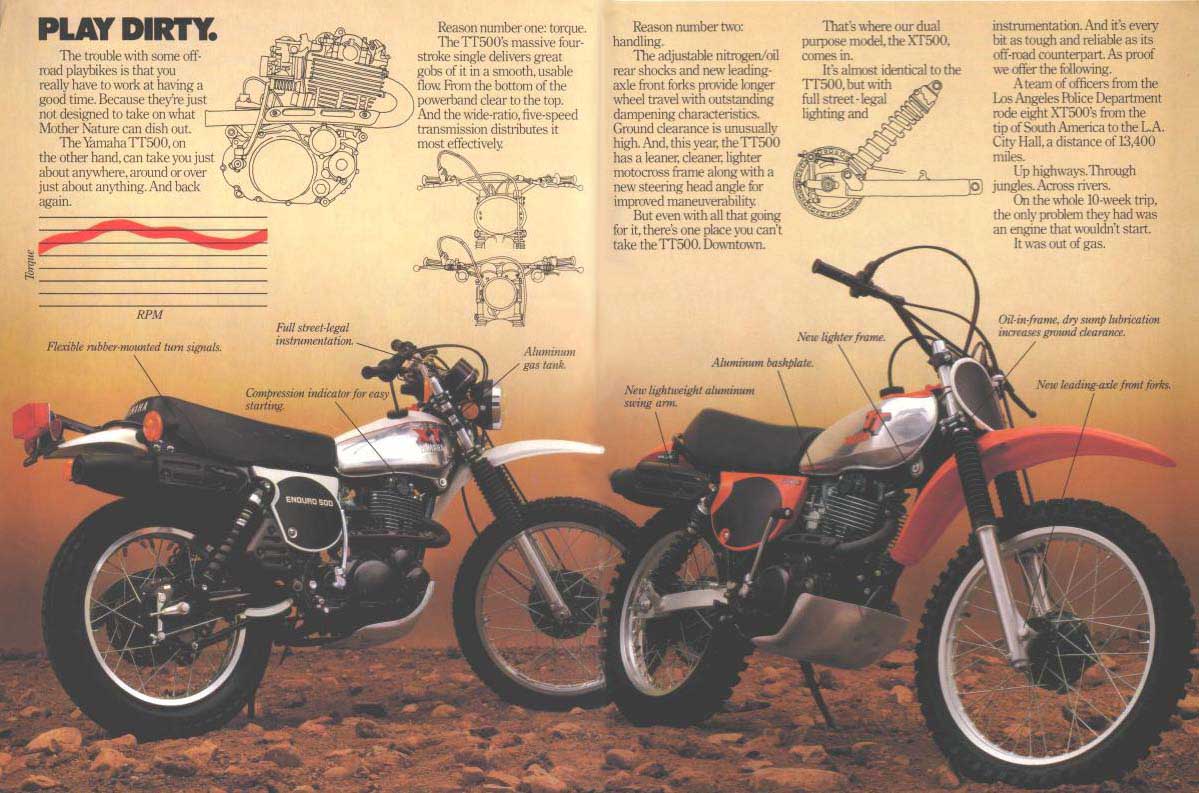
While the XT500 undeniably has rugged roots, it works well on roads too. It’s light enough to handle city traffic, narrow enough to thread through lanes, and responsive enough for small back-road blasts. The simplicity means easier maintenance, fewer electronics to worry about, and a bike that’s forgiving for newer riders.
That said, if your priority is ultra-modern comfort—like high wind protection, advanced electronics or top-end braking—you might prefer something more contemporary. The XT500 is about character, not luxury. But if you want a genuine classic with purpose and soul, it delivers.
Who It’s Best For…
Ideal for riders who:
- Appreciate vintage motorcycles with real, mechanical feel
- Want an iconic bike with dual-sport roots and retro appeal
- Are comfortable with minimal electronics and a more analog experience
Less ideal for riders who:
- Need advanced rider aids (ABS, traction control) or ultra-high performance
- Plan heavy touring with large windscreens and luggage out of the box
- Prefer ultra-quiet, refined engines with minimal vibration
XT500 in Pop Culture
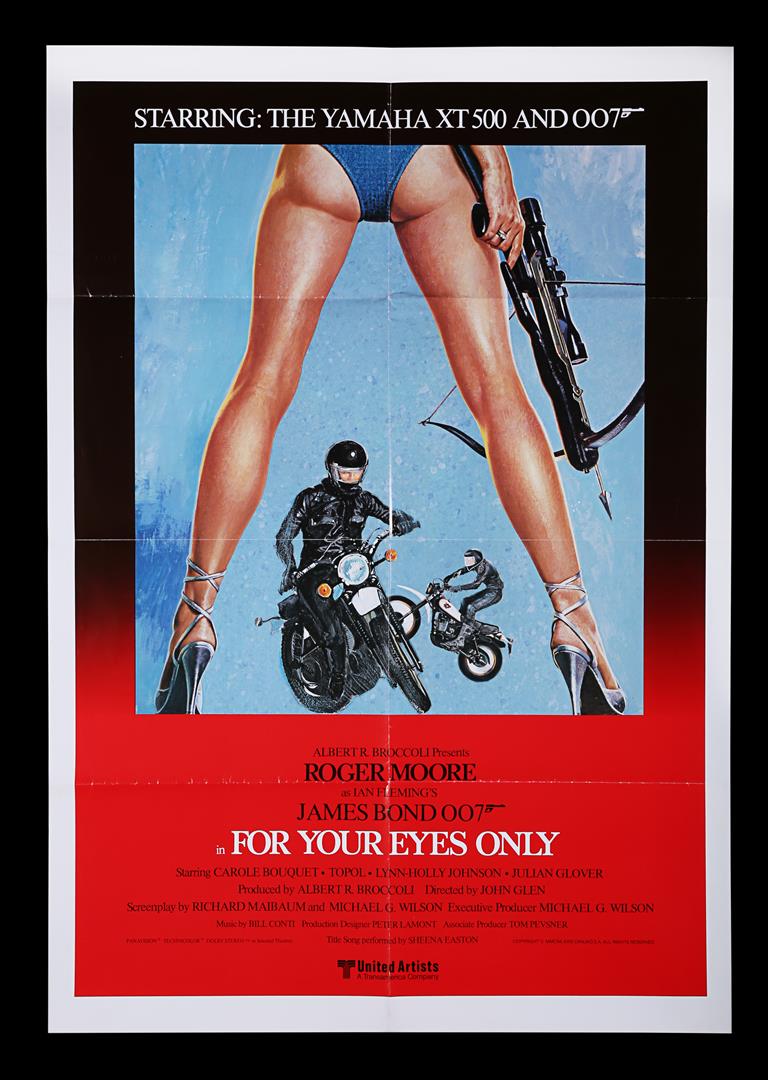
Few motorcycles have made as much cultural impact as the Yamaha XT500. In the late 1970s and early ’80s, it became an icon of the adventure and enduro movement, appearing in magazines, films, and ads around the world. Riders admired its rugged reliability and globe-trotting capability, and it quickly became a symbol of freedom, exploration, and minimalist motorcycling.
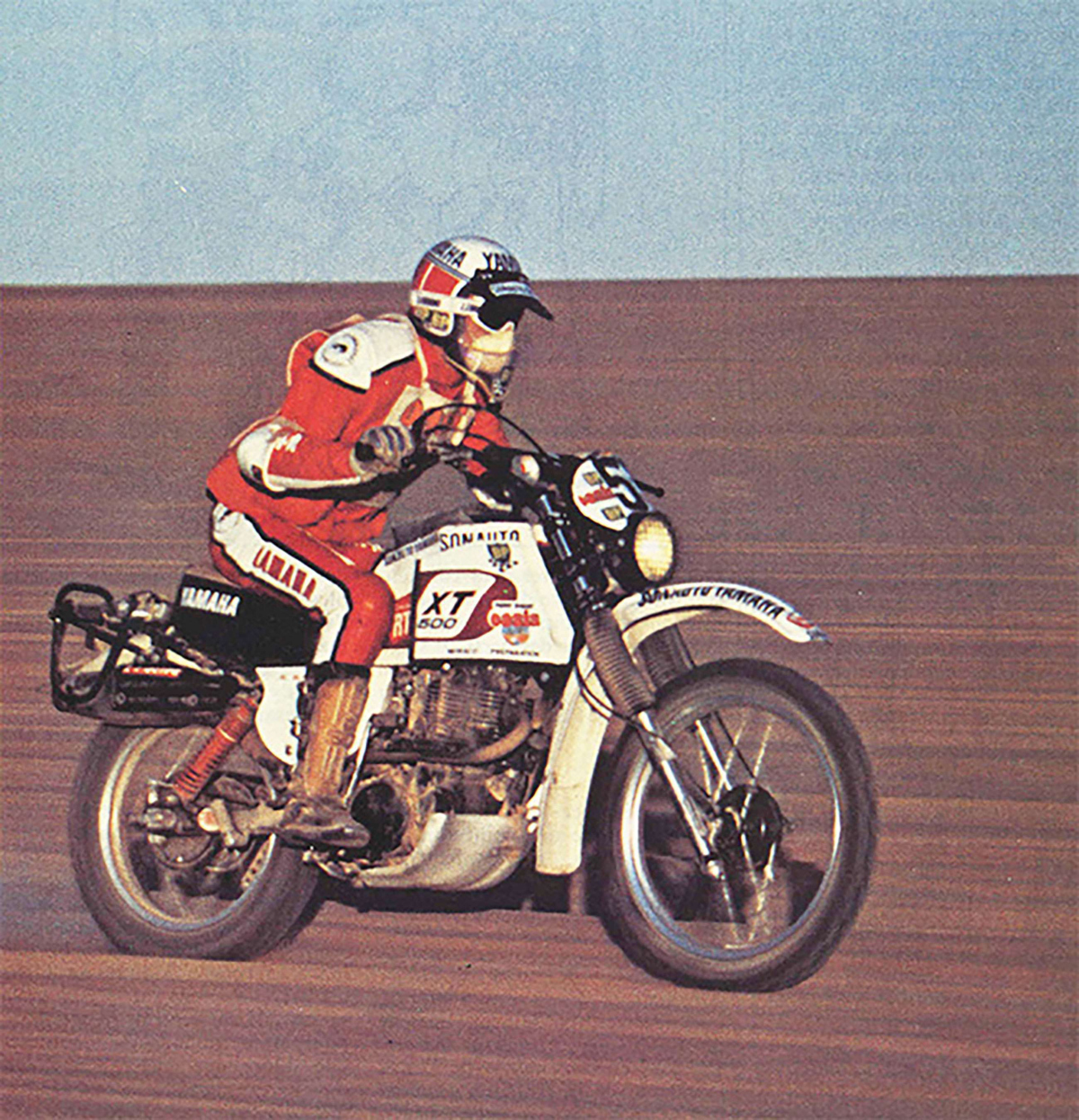
The XT500’s fame also reached racing legend status: it played a major role in the early years of long-distance rally racing, including victories in the original Paris-Dakar Rally. Its success helped define the reputation of Japanese dual-sports as tough, trustworthy machines capable of crossing deserts, mountains, and everything in between.
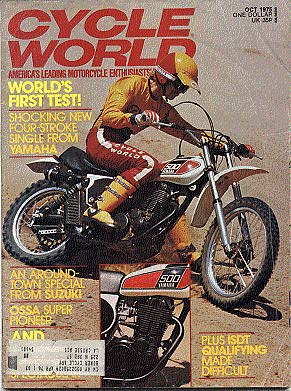
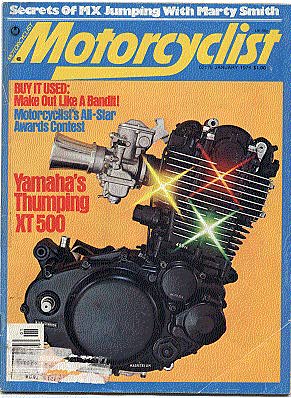
Even today, custom builders, retro enthusiasts, and adventure riders reference the XT500 as a design benchmark — its silhouette still inspires modern scramblers, trackers, and dual-sports across the industry.
XT500 vs. SR500 (Comparison)
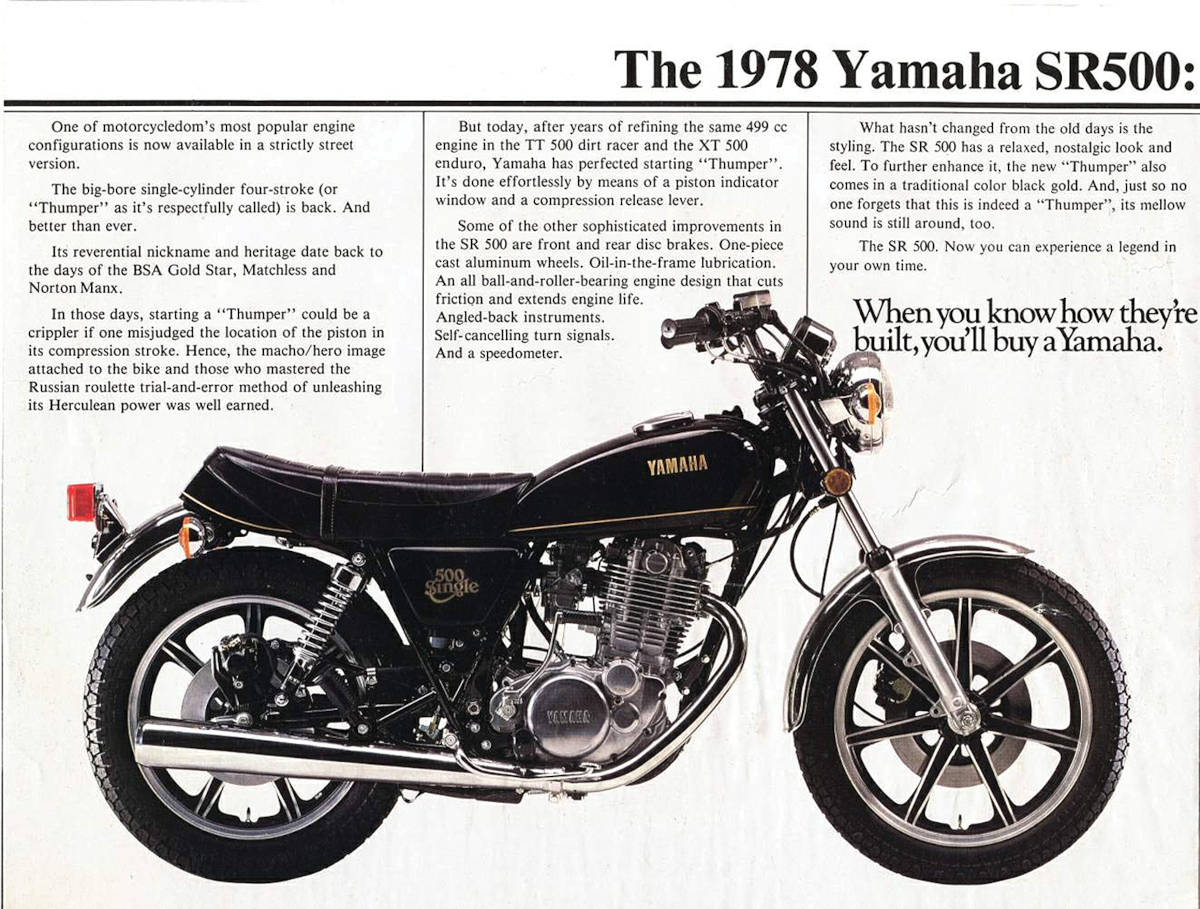
The XT500 and SR500 share a close family bond — both powered by Yamaha’s legendary 500cc single — but they serve very different purposes.
Purpose & Design
- XT500: Built as a dual-sport capable of tackling trails, dirt tracks, and rough terrain. Tall suspension, high exhaust, and off-road ergonomics define its character.
- SR500: Designed as a lightweight, classic street motorcycle. Lower seat height, street tires, and vintage roadster styling make it better suited for paved riding.
Riding Experience
- XT500: Feels adventurous and playful off-road, with long-travel suspension and a more upright, commanding riding position.
- SR500: More refined on pavement, with a smoother feel, lower center of gravity, and sharper on-road manners.
Character & Personality
- XT500: Rugged, purposeful, and iconic in the dual-sport world.
- SR500: Simple, timeless, and elegant — beloved by café racer and custom builders for its clean lines and mechanical purity.
Which One to Choose?
- Pick the XT500 if you want a classic dual-sport with real off-road capability and vintage adventure heritage.
- Pick the SR500 if you want a lighter, simpler, street-focused thumper with endless custom potential.
Both bikes share Yamaha’s bulletproof 500cc single and beloved old-school charm — but the XT aims for the trail, while the SR lives for the street.
XT500 Buyer’s Guide (What to Look For)
Looking to buy a Yamaha XT500 today? These bikes are now decades old and considered collectible classics, so it’s worth knowing what to watch for before you commit. Here are the key things to consider:
Engine Condition
The XT500’s air-cooled single is famously durable, but poor maintenance can take a toll over time. Look for:
• Easy starting (especially when cold)
• Minimal smoke from the exhaust
• Smooth idle without excessive rattling
• Clean oil and maintenance records, if available
A well-tuned XT500 should thump confidently without sounding harsh or metallic.
Kickstart System
The XT500 uses a kickstarter only — no electric start.
Make sure:
• The kickstart engages cleanly
• The compression release works properly
• The seller demonstrates a proper start sequence
If it’s difficult to start, it may be a tuning issue, valve issue, or carburetor problem.
Carburetor & Fuel System
Many XT500s have sat unused for years. Check for:
• Clean, rebuilt carburetors
• No fuel leaks
• A tank free of rust or sediment
A properly serviced carb makes a massive difference in rideability.
Frame & Suspension
Inspect the frame welds and mounting points for cracks, repairs, or bends — particularly if the bike was used off-road.
Also check:
• Fork seals for leaks
• Rear shocks for age-related sag
• Steering head bearings for notchiness
Suspension parts wear over decades but are replaceable.
Electrical System
Classic wiring can deteriorate. Look for:
• Clean, untangled harnesses
• Functional lights, horn, and indicators
• Consistent charging from the stator
Many XT500 owners upgrade wiring with modern connectors — a bonus if done cleanly.
Exhaust & Bodywork
Original XT500 exhausts and side covers are becoming rare and expensive.
Check for:
• Cracks in the high-mounted exhaust
• Heat damage
• Correct heat shields
• Intact, original bodywork
Reproductions exist, but original pieces add collector value.
Documentation & Originality
A bike with matching numbers, OEM parts, and service records is worth more.
Custom builds are common — nothing wrong with that — but originality influences price.
Final Buying Tip
A well-maintained XT500 is incredibly rewarding to own and ride. These bikes are tough, simple, charismatic machines — but age means careful inspection is essential. Take your time, buy from knowledgeable owners when possible, and prioritize bikes with good mechanical health over cosmetic perfection.
Yamaha XT500 Specs
(Typical specification for the standard-era XT500, values may vary by market and year.)
Engine: 499cc air-cooled single-cylinder
Power: ~33–35 hp
Torque: ~32 lb-ft (≈43 Nm)
Transmission: 5-speed manual
Weight (dry): ~330 lbs (≈150 kg)
Frame: Tubular steel cradle
Suspension:
• Front: Telescopic fork, long travel
• Rear: Twin shocks, long travel
Brakes:
• Front: Single disc or drum (variant dependent)
• Rear: Drum brake (in many early models)
Seat Height: ~33–34 in (~840-860 mm)
Fuel Capacity: ~2.6 gal (~10 L)
Wheelbase: ~55–56 in (~1,400-1,420 mm)
Summary
The Yamaha XT500 remains a benchmark in both the dual-sport and retro-motocycle world. Its simplicity, character, and historic significance give it timeless appeal. For riders who value authenticity and vintage soul, it’s a superb choice. While it may not match today’s tech-rich bikes, it offers something far rarer: genuine connection, honesty, and a ride that stays with you long after you stop.
Yamaha XT500 Customs
The XT500 is one of our favorite platforms for customization. Here are some of the builds we’ve recently featured…
 Ultra Lightweight 500: TT-Powered Yamaha XT500 Street Tracker - From Eric Dean Design: Yamaha XT500 Meets Suzuki TL1000R… The street-legal Yamaha XT500 and its off-road sibling, the TT500, quickly made a name for themselves in the late 1970s. Not only did they win […]
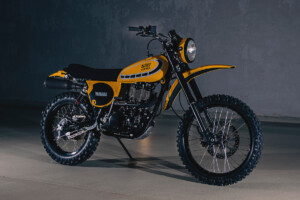 Electric Boogie: Yamaha XT500 Restomod - Electric Start, Air-Cooled: Motogadgets’ 1980 Yamaha XT500… By the early 1970s, the big single-cylinder four-stroke off-roader was thought a species all but extinct. After all, the great British 500 singles like the BSA B50 […]
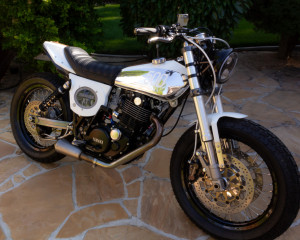 Torakusu XT: Yamaha XT500 Street Tracker - Jean-Michel Atlan’s street tracker, reimagined 40 years later… In 1877, Japanese entrepreneur Torakusu Yamaha, the third son of a samurai of the Kishu-Tokugawa family, founded Nippon Gakki Company in order to manufacturer reed organs. Torakusu’s […]
 Junkyard XT: Yamaha XT500 Scrambler - Junk to Jewel: Resto-modded XT500 from Workshop43… The Yamaha XT500 remains one of our favorite single-cylinder motorcycles of all time. The big air-cooled enduro won the inaugural Paris-Dakar Rally, swept the podium in the second […]
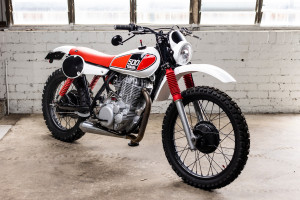 Streamlined XT: 1980 Yamaha XT500 - Black Cycles Australia builds a streamlined XT for Retromotive… If you’ve been following BikeBound for any length of time, you know we’re big fans of the Yamaha XT500. Not only did the 500cc single win […]
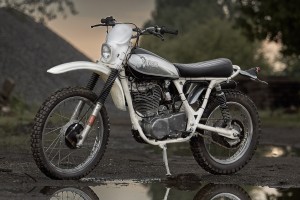 Yamaha “SRXT500” Vinduro by 86 Gear - From Street to Scrambler… By 1971, BSA and Matchless had both gone out of business, and with them the British 500 singles whose torque and character had proved perfect for such a wide variety of […]
 Torque Monster: Yamaha HL500 by Se7en Six Collective - “This motor effortlessly lifts the front in 3rd while ploughing 3-inch furrows at the rear…” The Yamaha HL500 — aka the “Aberg Yamaha” — is one of the most fascinating motocross bikes of the 1970s. […]
 Queen of Dakar: ZZ Moto’s 1981 Yamaha XT500 Resto - The Yamaha XT500 is one of our favorite bikes of all time. The twin-shock, four-stroke single-cylinder enduro came out in 1976, a street-legal version of the TT500 introduced a year earlier. Yamaha USA had realized […]
 A Real Thumper: Yamaha XT500 Resto by 86 Gear Motorcycles - “It is a real thumper. Lots of low end torque. Raw and real.” If you’ve been following BikeBound for very long, you’ve probably heard us sing the praises of the Yamaha XT500. It’s hard […]
 Yamaha TT500 VMX by Beeton Fabrications - An HL500-inspired vintage motocross racer from Down Under… It may seem hard to believe today, but by the mid-1970s, the four-stroke thumpers that once ruled the dirt were all but dead. Both BSA and Matchless […]
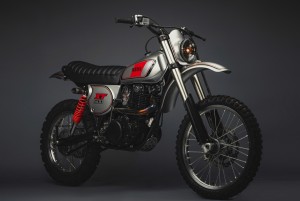 Dirt Road Ripper: Yamaha XT500 by MotoRelic - “Foot down and elbows up! Braaap!” The Yamaha XT500 is one of the most successful dual-purpose machines of all time, a big-bore four-stroke that proved itself in professional desert racing and on thousands of miles […]
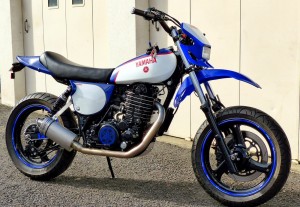 Supermoto Agricole: Yamaha XT500 by Y.C. Design - A “rural supermoto” from an elite French firefighter… The Yamaha XT500 is one of our favorite vintage Japanese motorcycles, and one of the greatest multipurpose bikes ever created. We’ve seen a varied assortment of customized […]
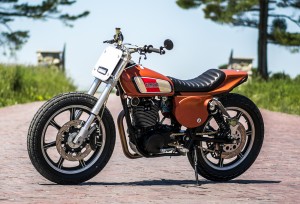 Project X-Tracker: Yamaha XT500 Street Tracker - A BMX-inspired street tracker…with bicycle rack! The Yamaha XT500 is one of motorcycling history’s great success stories, and one of our favorite bikes of all time. The twin-valve four-stroke enduro won the Paris-Dakar Rally in […]
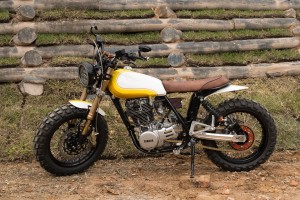 Yamaha XT500 Scrambler by Bikes Popayán - The Yamaha XT500 is one of our favorite 4-stroke dual-sports / enduros of all time. Introduced in 1976, the XT500 single competed in the big African rally raids, winning the first-ever Paris Dakar Rally in […]
 Twin Yamaha XT500 Customs by Red Clouds Collective - The Yamaha XT500 is one of the most beloved enduros of all time. Introduced in 1976, it was the first big four-stroke “thumper” from Japan — a 27-horsepower big single brute that was stone-ax reliable, […]
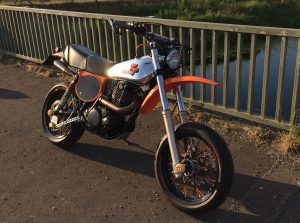 Yamaha TT500 Retromotard by Man Cave Motorcycles - Soulful SuMo: Yamaha TT500 “Retromotard” built for bumpy fen roads… Adam Beeston of Man Cave Motorcycles is our favorite type of builder. The description on his social profile says it all: “Lifelong bike-mad Fenman modernising […]
 Yamaha TT500 Street Tracker by VZMC Customs - A nostalgic trip back to the 70s with an iconic, competition-only TT500… It’s always a thrill to feature the first bike from an upstart builder, particularly when it’s as staggering and well-executed as this Yamaha […]
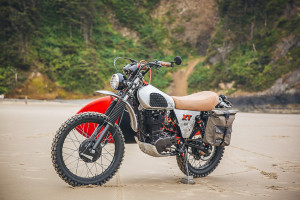 Yamaha XT500 Surf Scrambler by Project Moto - The Yamaha XT500 is one of the great all-around motorcycles ever built. Introduced in 1975, it was the proto-thumper, spawning generations of bulletproof four-stroke big-bore singles that could thread the urban jungle, rip the backroads, […]
 Yamaha XT500 Supermoto by Random Cycles - The Yamaha XT500 was introduced in 1975, and it quickly rose to supremacy among enduro/adventure bikes, winning African rallies like the Paris-Dakar and Paris-Abidjan-Nice, as well as motos in the 500cc Motocross World Championship. The […]


