
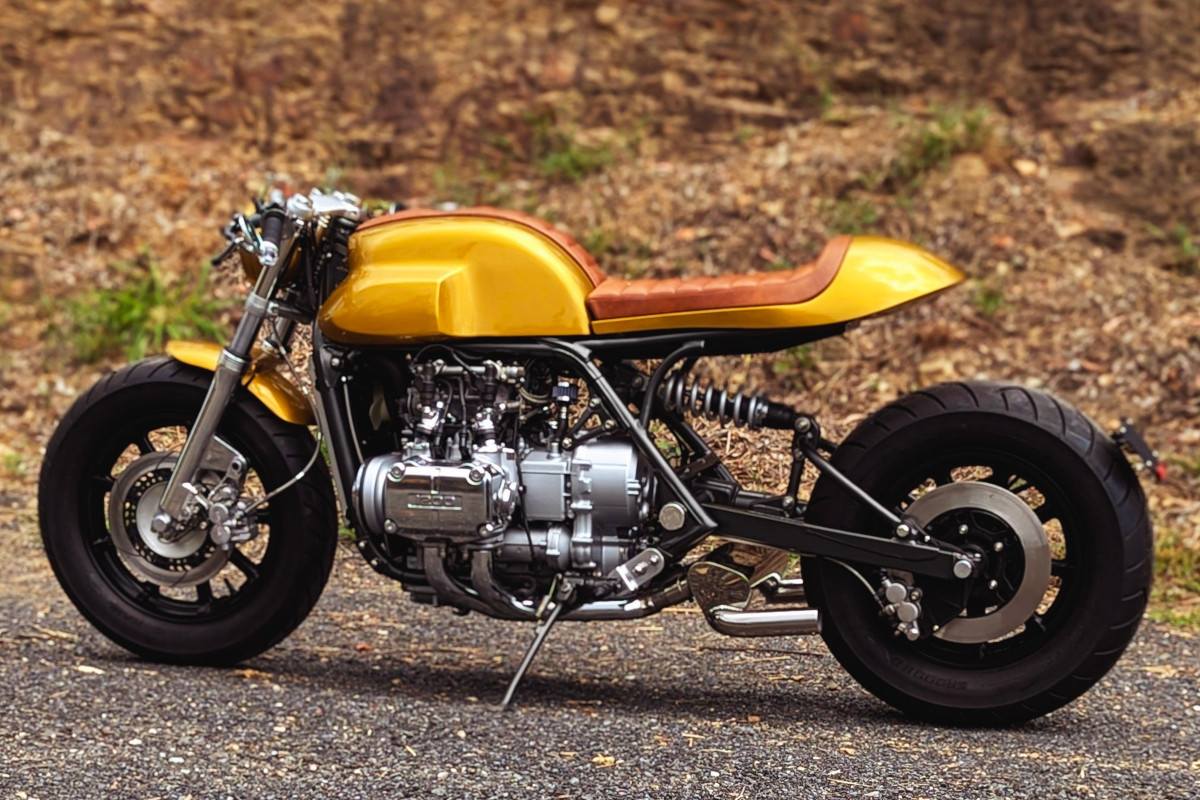
 Aspencade to Café: Black Cycles Australia’s Goldwing Cafe Racer…
Today we think of the Honda Goldwing as the quintessential big touring bike — a roadgoing La-Z-Boy loaded with creature comforts of every kind, capable of crossing whole continents with stately aplomb. However, the original GL1000 was actually born naked into the world in 1974, boasting a brand-new 999cc flat-four engine with 80 brake horsepower on tap — about the same as the Kawasaki Z1.
 In fact, although Honda engineers had focused on midrange torque over maximum performance, the original GL1000 Goldwing was the second-fastest production bike on the market at the time of its arrival!
“Its straight-line performance was second only to the Kawasaki Z1, the premier superbike of the day…with 1975 magazine tests showing it ran the quarter-mile in 12.9 seconds from a standing start…and a trap speed of 104.5 mph.” –Rider
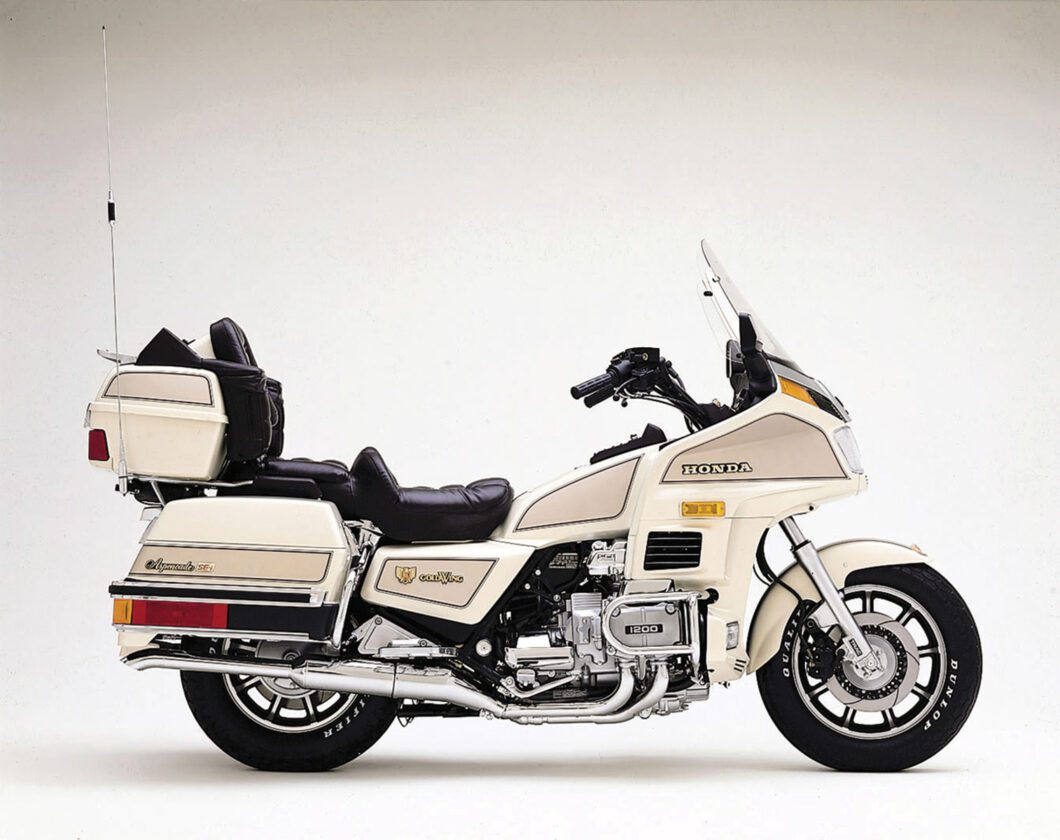
 Of course, the Goldwing’s size and displacement grew substantially over time. In 1983, the GL1200 arrived with an 1182cc flat-four. The Aspencade became the top of the line model, a luxurious full-dress tourer with all the accoutrements of the Interstate plus more storage, a larger seat, two-tone paint, Panasonic sound system, digital dashboard, and more. Weight was up to a monumental 743 pounds…dry!
Over the years, however, keen-eyed custom builders have looked past the Goldwing’s massive exterior to find the ancestral naked bike still buried all the baggage, just waiting to be unleashed.
 The bike you see here began life as an ’86 GL1200 Aspencade “fuelie” — one of the rare limited edition models to come with Honda’s proprietary “Programmed Fuel Injection” (PGM-FI).
“Although the full-throttle and quarter-mile performance are not perceptibly improved by the injection system, the lower-rpm and around-town performance is noticeably smoother and more responsive than on last year’s carburetor-equipped GL1200.” –Cycle World, 1985
 The owner, Peter, an engineer, had begun the project himself, and actually done a lot of solid work before taking the bike to our buddy Noel Muller of Black Cycles Australia, who was able to take the bike to the next level. Peter had stripped the bike down, shaped his own aluminum fuel tank and tail section, cut and rebuilt the subframe, and even done his own mono-shock conversion.
 Noel says Peter did a great job with the bodywork as a first-timer, but he ended up reshaping or reworking many of the elements to harmonize better with the design.
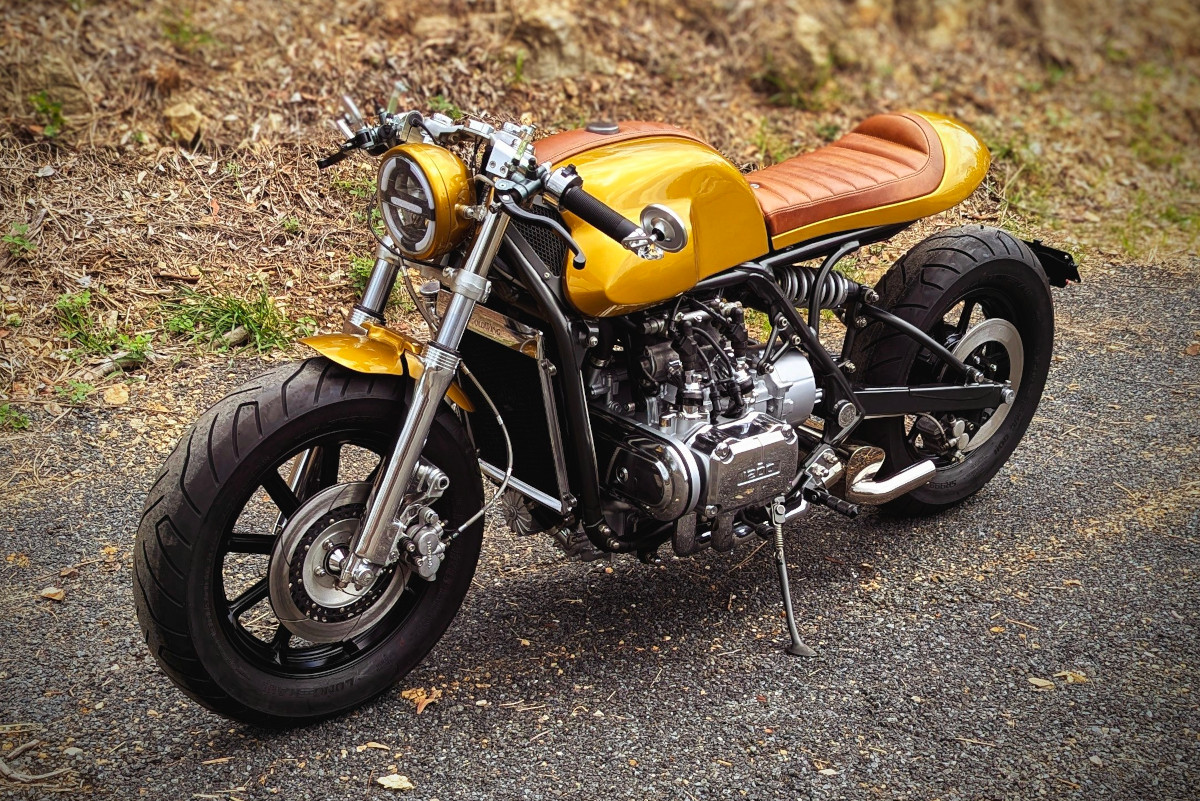
“I felt the overall ‘flow’ of the design was off a little, so I chopped two inches from the height of the fuel tank, then stretched it rearwards softening the arc and adding the side ‘lumps’ to the lower front. I then built another aluminum tail piece and seat from scratch.”
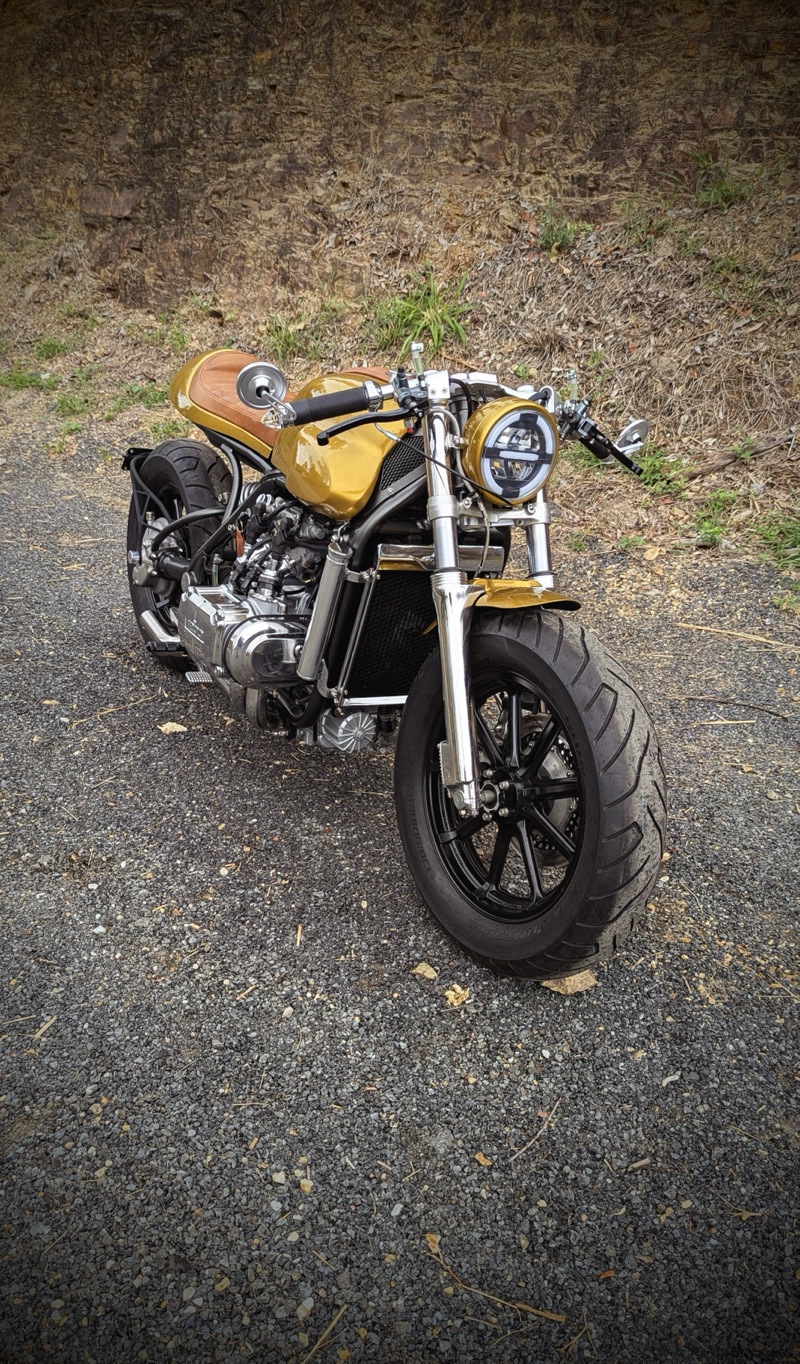
 With the bodywork sorted, Noel went on tackle the rest of the build. He gives us the full rundown below, but highlights include converting the air-ride forks to conventional oil (thanks to XXX Rated Suspension), refurbished brakes with Hel lines, handmade front fender, modified OEM top triple fitted with Motogadget gauge mount and clip-on bars, Carmans Auto Trimmers seat with matching leather tank strips, sanded and repainted engine, gold paint custom-mixed and laid down in-house, and a minimalist rewire courtesy of Popbang Classics.
According to Peter, the bike now weights 545 pounds fully fueled, which is an astounding 233 pounds lighter than the reported 778-lb curb weight of the Aspencade from which it was born (though owners have reported over 900 pounds on real-world scales). That means the 94 horsepower of that big flat-four provides that much more propulsion.
We’ve always had a soft spot for the old Wings, and this is one of the best transformations we’ve seen — a fuel-injected “Aspencafé Racer” capable of long rides in much more comfort than your typical café build. Bravo to Noel and Peter for making it happen. Below is a full rundown of the build from Noel himself, along with many more details and points of interest.
In the Builder’s Words…
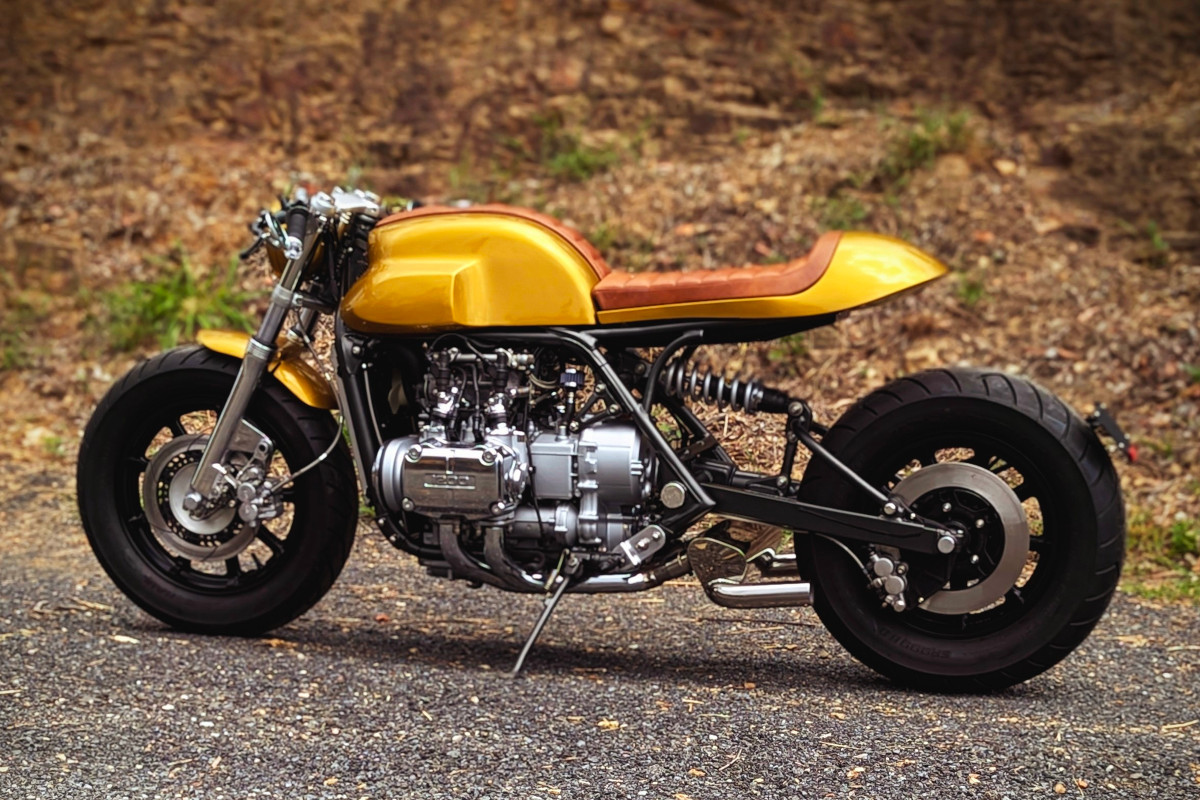
October 2024 Peter (an engineer) asked me to finish his 1986 Honda Goldwing Aspencade project he had started. He’d already stripped the bike down to the bare minimum to achieve a basic “cafe racer” look. He shaped his own aluminum fuel tank and tail piece, chopped the subframe and rebuilt it, and made his own single shock conversion.

So then over to me. Although Peter did a great job shaping and building with aluminum for the first time, I felt the overall “flow” of the design was off a little, so I chopped two inches from the height of the fuel tank, then stretched it rearwards softening the arc and adding the side “lumps” to the lower front. I then built another aluminum tail piece and seat from scratch.

I removed the bar mounts from the top triple tree, welded the remaining holes, and added a mount for the Motogadget mini gauge. Some 1-inch rise clip-ons were added, new switch gear, billet bar end mirrors, and Motogadget bar end indicators.

I welded the aluminum handmade front fender directly to the fork brace for a clean look. The original air ride forks were converted to conventional oil-only by XXX Rated Suspension. Front and rear brakes were completely refurbished and new Hel brake/clutch lines made to suit.

The engine was completely sanded smooth and painted in silver two-pack.

The air idle valve was relocated up under the tank as with the OEM fuel pump (this is a fuel injected model that was only in production around one year, I believe)! The massive air injection (emissions) was ditched as well, making the whole engine much less cluttered.

A lot of the original aluminum on the bike was stripped and polished. Peter actually built the stainless steel muffler himself and I changed the twin tips from 1-inch diameter to 2″ so they could accept baffles and are more in proportion with the rest of the bike now. Wheels were stripped and coated in satin black, and new Shinko tyres were used.

The custom-mixed gold paint was applied here in-house.
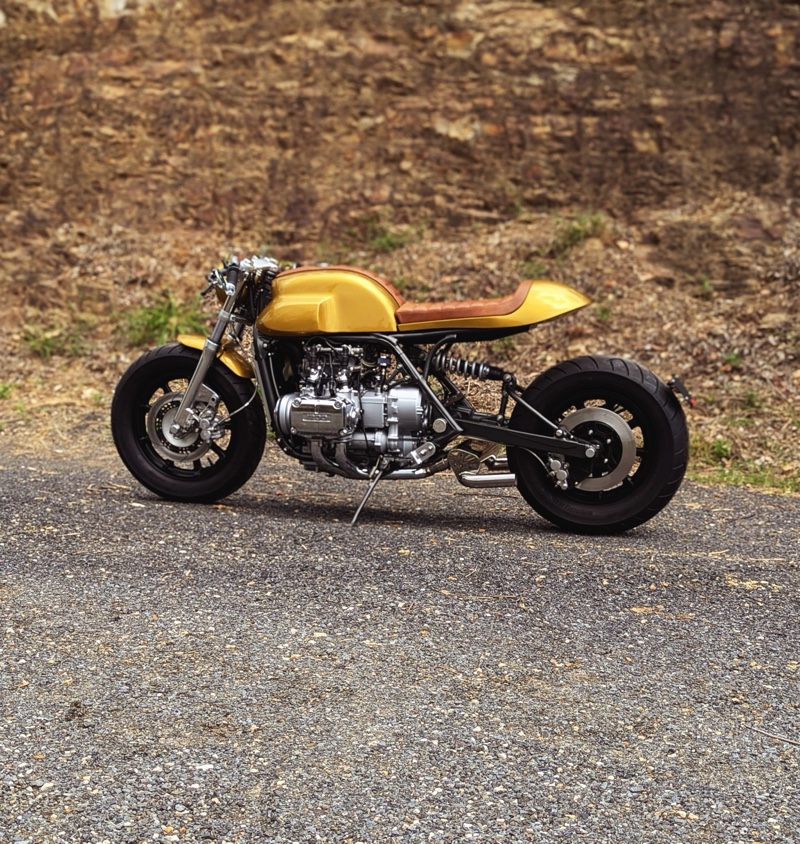
Carmans Auto Trimmers did a great job covering the seat and tank strip with leather supplied by Peter. Lastly it was off to Justin at Popbang Classics to strip the wiring down to the bare minimum.

Overall the bike came up classic and classy with thanks to Peter’s hard work as well!
Follow the Builder
Black Cycles Australia: Facebook | @blackcyclesaustralia
Upholstery: Carman’s Auto Trimmers
Suspension: XXX Rated Suspension
Paint: Popbang Classics
More Black Cycles Builds
 Enduro Brick: BMW K100 Street Scrambler - Black Cycles Australia builds a John Player Brick… The BMW K100 — aka the “Flying Brick” — remains one of the more peculiar designs to roll out of the Bavarian Motor Works factory. Conceived […]
 Stay Gold: Honda GL1200 Goldwing Café Racer - Aspencade to Café: Black Cycles Australia’s Goldwing Cafe Racer… Today we think of the Honda Goldwing as the quintessential big touring bike — a roadgoing La-Z-Boy loaded with creature comforts of every kind, capable of […]
 Harley-Davidson Pan America “Super Scrambler” - Black Cycles Australia scrambles Harley’s adventure bike… In 2020, the Harley-Davidson Pan America arrived as the first all-American adventure bike, packing a 1250cc 150-hp “Revolution Max” V-twin and electronically-adjustable Showa suspension. The motorcycling world was […]
 V-Racer: Harley-Davidson V-Rod Café Racer - The first custom creation to roll out of Donut Garage… In 2002, Harley-Davidson released the V-Rod, the first of the VRSC (V-Twin Racing Street Custom) series — a line of muscle bikes whose 1131cc Revolution […]
 Back from the Shed: Honda CB750K Café Racer - Worth the Wait: CB750 from Black Cycles Australia… For every lovely vintage bike you see cruising the backroads, parked up at the local tavern, or racing the track on Sunday, there are scores of abandoned […]
 Flying Triple: BMW K75 Custom - Three-cylinder Flying Brick from Black Cycles Australia… The BMW K75 was the 750cc triple-cylinder variant of the company’s K series “Flying Bricks” — nicknamed for the distinct layout of their inline engines. The company wanted […]
 Ride the Lightning: Suzuki DR-Z400 Street Tracker - Black Cycles Australia builds a 400cc street tracker… Introduced back in 2000, the Suzuki DR-Z400 remains still one of the most popular dual-sports on the market, boasting an especially strong aftermarket and rider community. While […]
 Speed Train: Harley-Davidson Dyna Café Racer - Big Twin Café Racer from Black Cycles Australia… The Harley-Davidson Dyna Super Glide (FXD) boasted a monster 1450cc Twin Cam 88 V-twin that cranked out 67 hp and a stump-pulling 86 lb-ft of torque at […]
 The Night Scrambler: Nightster 1200 Scrambler - The Scrambler We Wish Harley Had Built… Introduced back in 2007, the Sportster XL1200N Nightster was a blacked-out, lowered version of the regular Sportster — something of a “factory custom.” Though it was mainly an […]
 Dreamy Duc: 1971 Ducati 250 Café Racer - Black Cycles Australia builds a 250cc Ducati café racer… Starting in 1950s, brothers Joseph and Michael Berliner of the Berliner Motor Corporation were the US importers for Ducati and many other European marquees. As the […]
 Super Special Magazine: Issue 37! - We’re thrilled to have two articles in the new issue of Italy’s premier custom motorcycle magazine, Super Special. One is the 1950 Triumph Preunit from Noel Muller of Black Cycles Australia and Justin Holmes of […]
 Steampunk Virago: Yamaha XV1000 Rat Rod - Black Cycles Australia builds a “Steampunk Rat Bike”… The rat bike has a long and storied tradition in the motorcycle world. Rat bikes are generally hard-ridden, uncleaned machines with plenty of rust, patina, road grime, […]
 Italian for Blown: Turbo Ducati 916 “Soffiato” - Black Cycles Australia builds a Turbo Ducati! In 2001, the Ducati Monster S4 was the first of Bologna’s beloved Monsters to receive a liquid-cooled L-Twin heart transplant from the superbike side of the factory, and […]
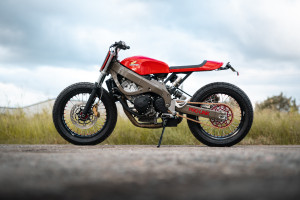 Honda CBR600F4i Street Tracker! - Black Cycles Australia builds a CBR street tracker… Historically, the 600cc sport bike class has remained one of the most competitive segments of the market, where race-replica supersports perform double duty as sharp-edged track weapons […]
 Australian Triumph: 1950 TR5 Bobber - Black Cycles x PopBang Classics build a Pre-unit Bobber… In the first half of the 20th century, the traditional way to build a motorcycle involved bolting together a separate engine and gearbox via a third […]


It’s not bad. I am not a stretched swing arm guy and I woul like a rear fender of sort. But the paint is sweet. These were hot bikes when they came out.
Much work and impressive skills from both builders, and the “massive” loss of weight (it’s frustrating, not to know how many pounds were actually shaved off -easily 100?-) can only be applauded.
I fail to see what the two bulges on either side of the fuel tank add, apart from ugliness.
However overall, a great and worthwhile effort.
She is 545lbs now wet and fully fulled.
Thanks, Peter! And wow, close to 250 lbs lighter than a fueled-up stocker. We’ll update the article!
I wish you would include a sound byte of these bikes you feature.
They all have their own personal sound.