
 Ducati 1098R power, 350 pounds, and hub-center steering…
In 2009, the Ducati 1098R already represented an extreme interpretation of the Italian V-twin superbike. Its Testastretta Evoluzione engine (actually 1198cc despite the model name) had been created with World Superbike competition firmly in mind, producing 180 bhp at 9750 rpm.
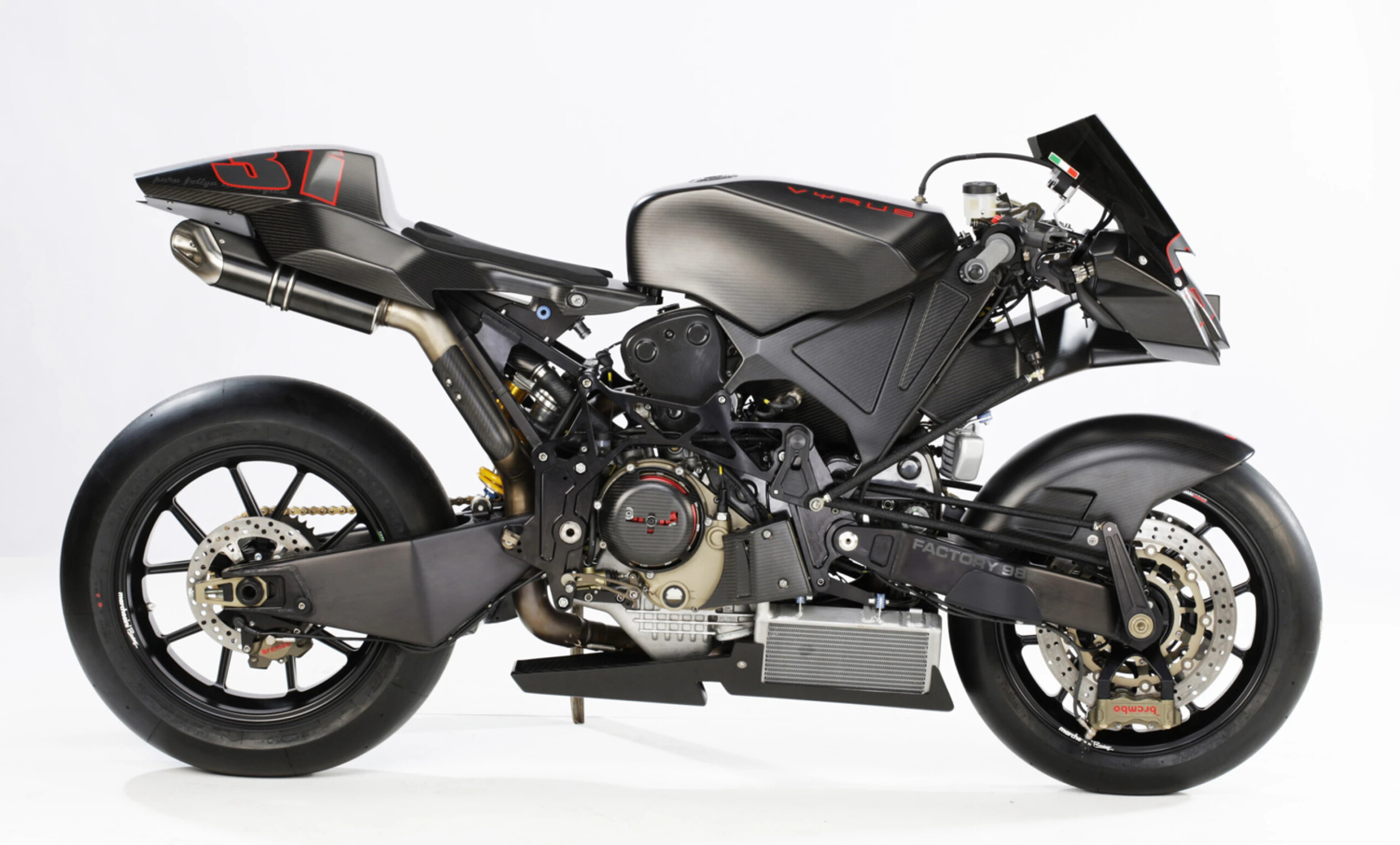
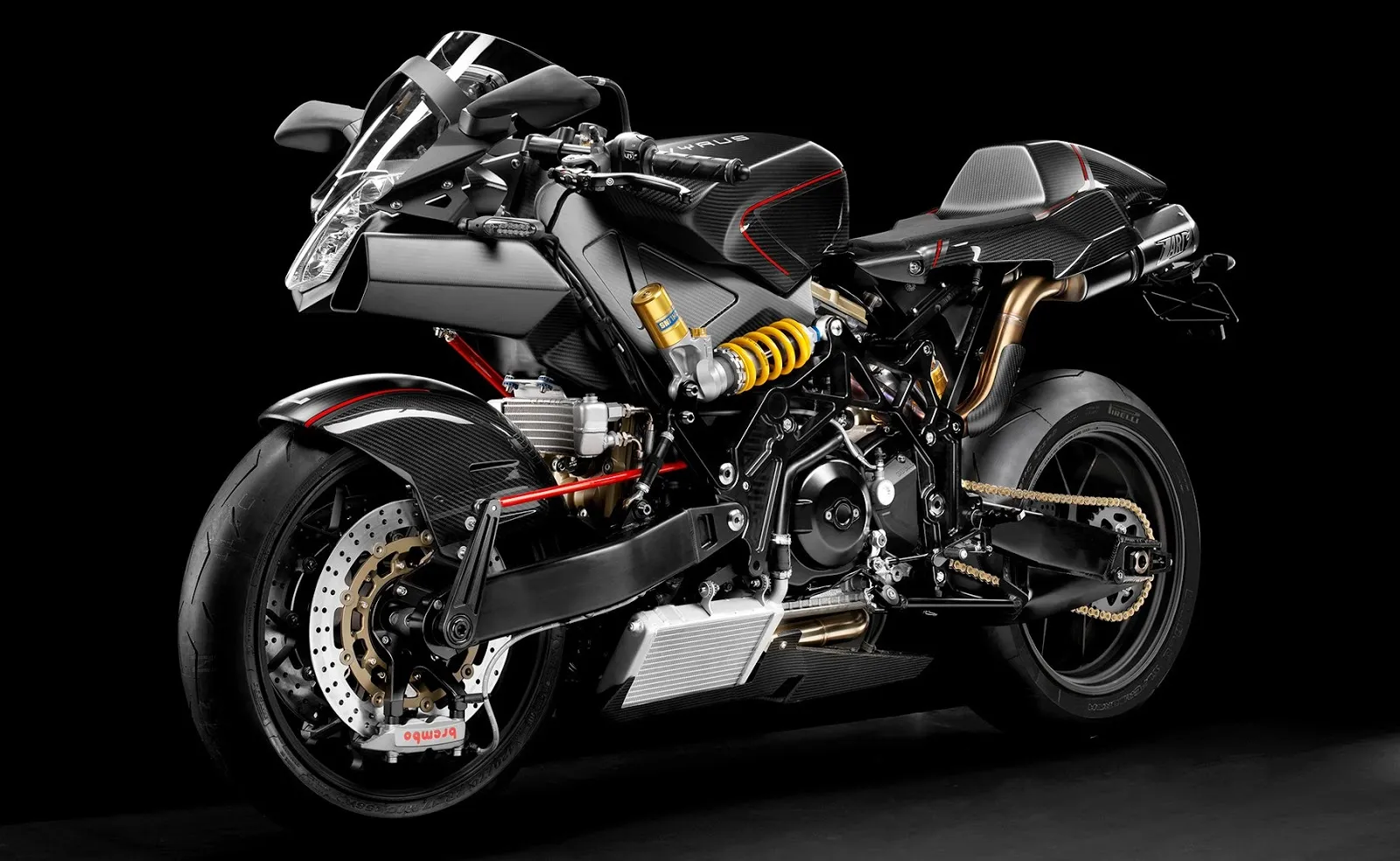
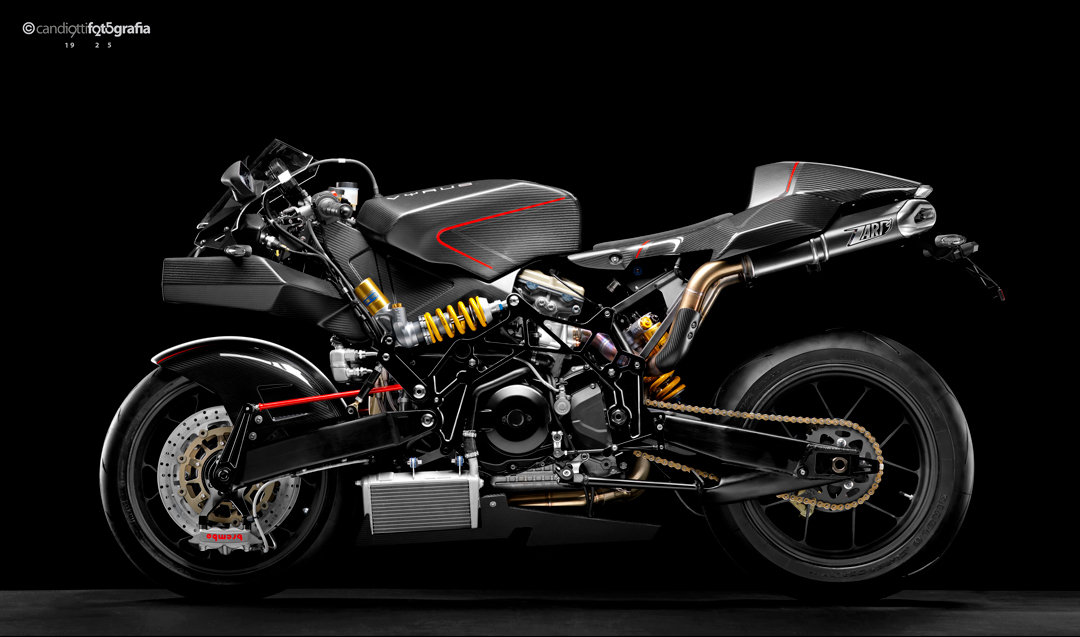
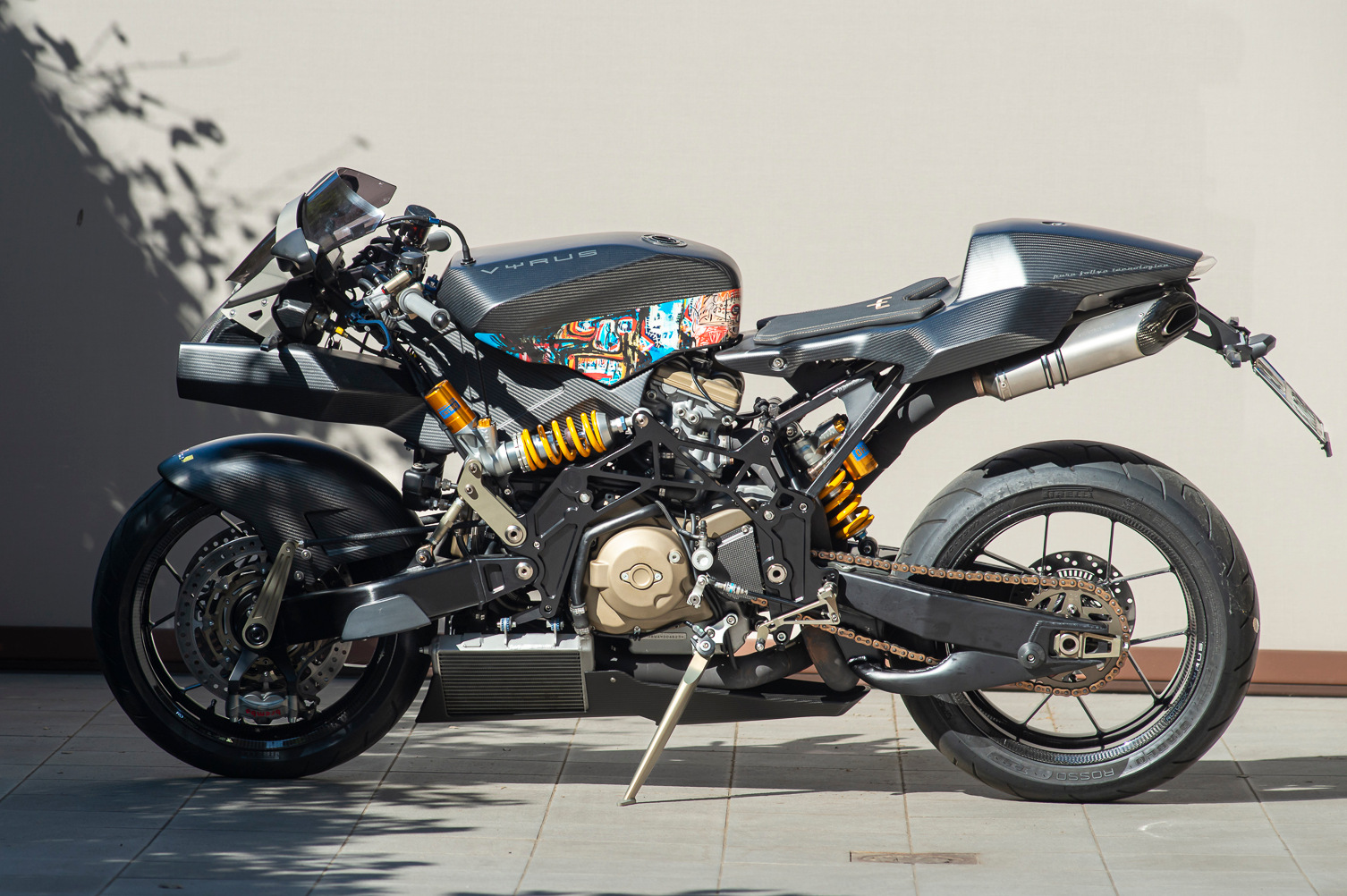
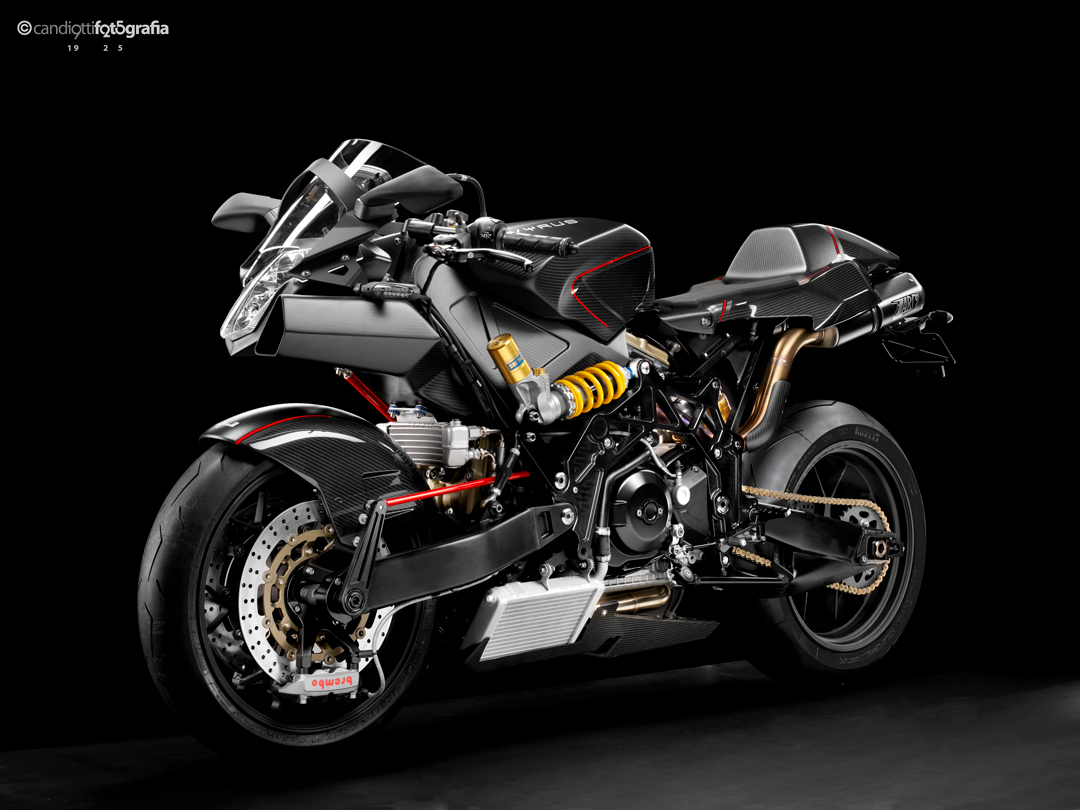
Vyrus — the small Rimini-based workshop of Ascanio Rodorigo — took that WSBK-derived engine and placed it in one of the most radical production motorcycles ever created. The 1098R-powered Vyrus 987 C3 4V weighed a feather-light 350 pounds, but the weight was just the start. The front wheel rode at the end of an aluminum swingarm instead of a conventional telescopic fork, and a pair of machined aluminum Omega-shaped plates effectively replaced the conventional motorcycle frame. Carbon fiber covered what little bodywork the machine possessed.
The result was the Vyrus 987 C3 4V, arguably the most extreme expression yet of Ascanio Rodorigo’s long-running obsession with hub-center steering. The nomenclature followed Vyrus convention: “C3,” sometimes rendered C³, was a stylized reference to cubic centimeters, while “4V” indicated four valves per cylinder. Unlike the original 984, however, the “987” no longer corresponded to actual displacement; the Ducati engine displaced 1198.4cc.
The Vyrus 987 weighed 159 kg / 350 pounds dry and made around 185 bhp in its historical specifications, though more powerful versions were available. A customer-owned 987 tested in 2010 was reportedly making 194 horsepower with Vyrus mapping and a full Zard race exhaust, and Vyrus also offered a 211-bhp supercharged 4VV version (more on that model below).
From Bimota to Vyrus…
The story begins with Bimota and one of the most persistent alternative ideas in motorcycle chassis design. Hub-center steering had existed in various forms long before Bimota, but the Italian company’s Tesi brought the concept into the modern superbike world. The name itself came from Pierluigi Marconi’s university thesis, which explored an alternative to the conventional telescopic fork.
Ascanio Rodorigo had his own long history around Bimota. He began working in the Rimini motorcycle scene as a young man and spent time at Bimota during the Massimo Tamburini era before establishing his own engineering operation in 1985. Years later, through ARP, he began developing his own evolution of the Tesi concept.
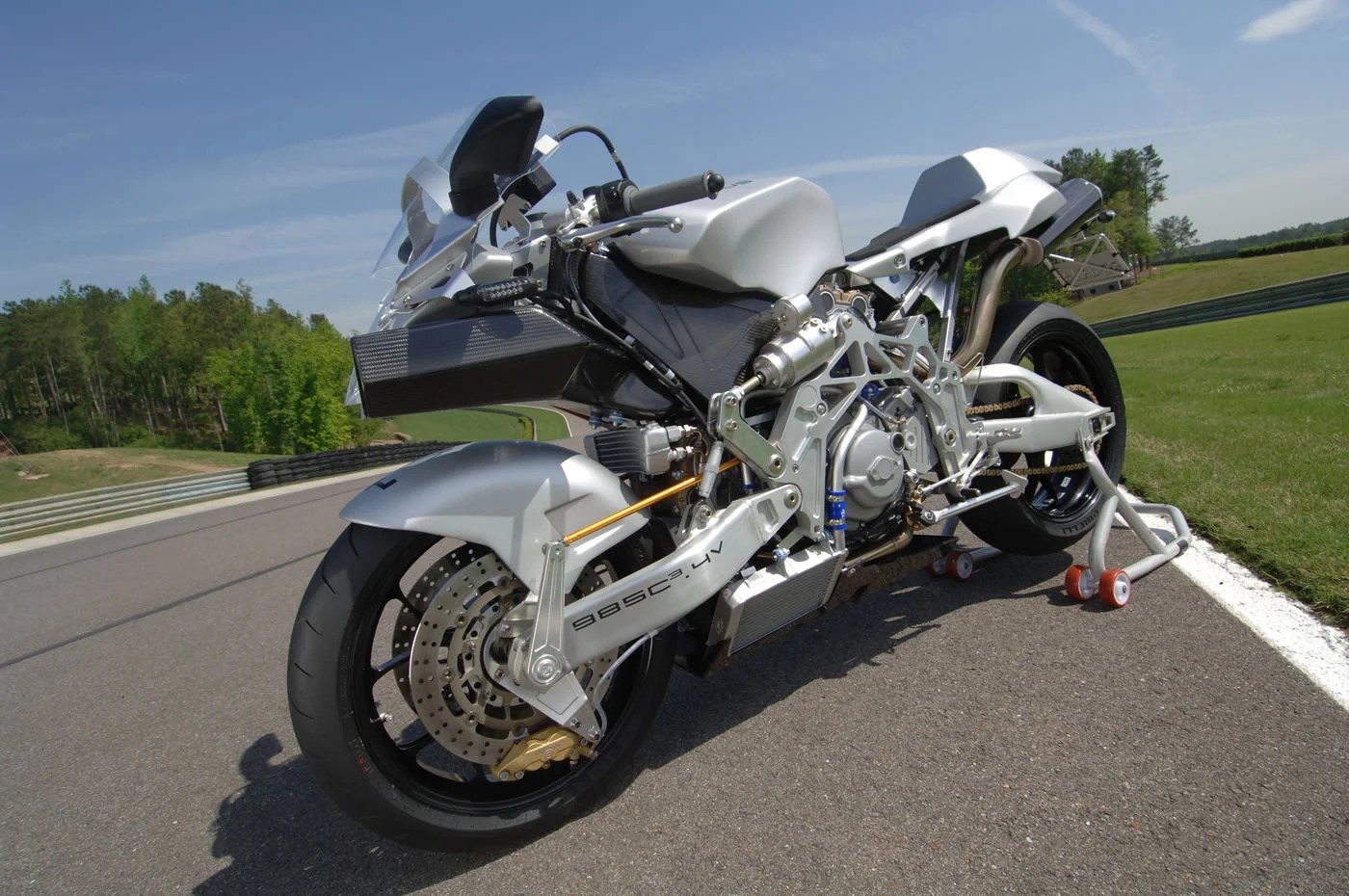
Rodorigo eventually took the basic architecture in his own direction. The first motorcycle bearing the Vyrus name appeared in the early 2000s, powered by an air-cooled Ducati twin. It retained the visual signature that would define the company: an exposed engine positioned between front and rear swingarms, with no telescopic fork and little resembling a conventional frame.
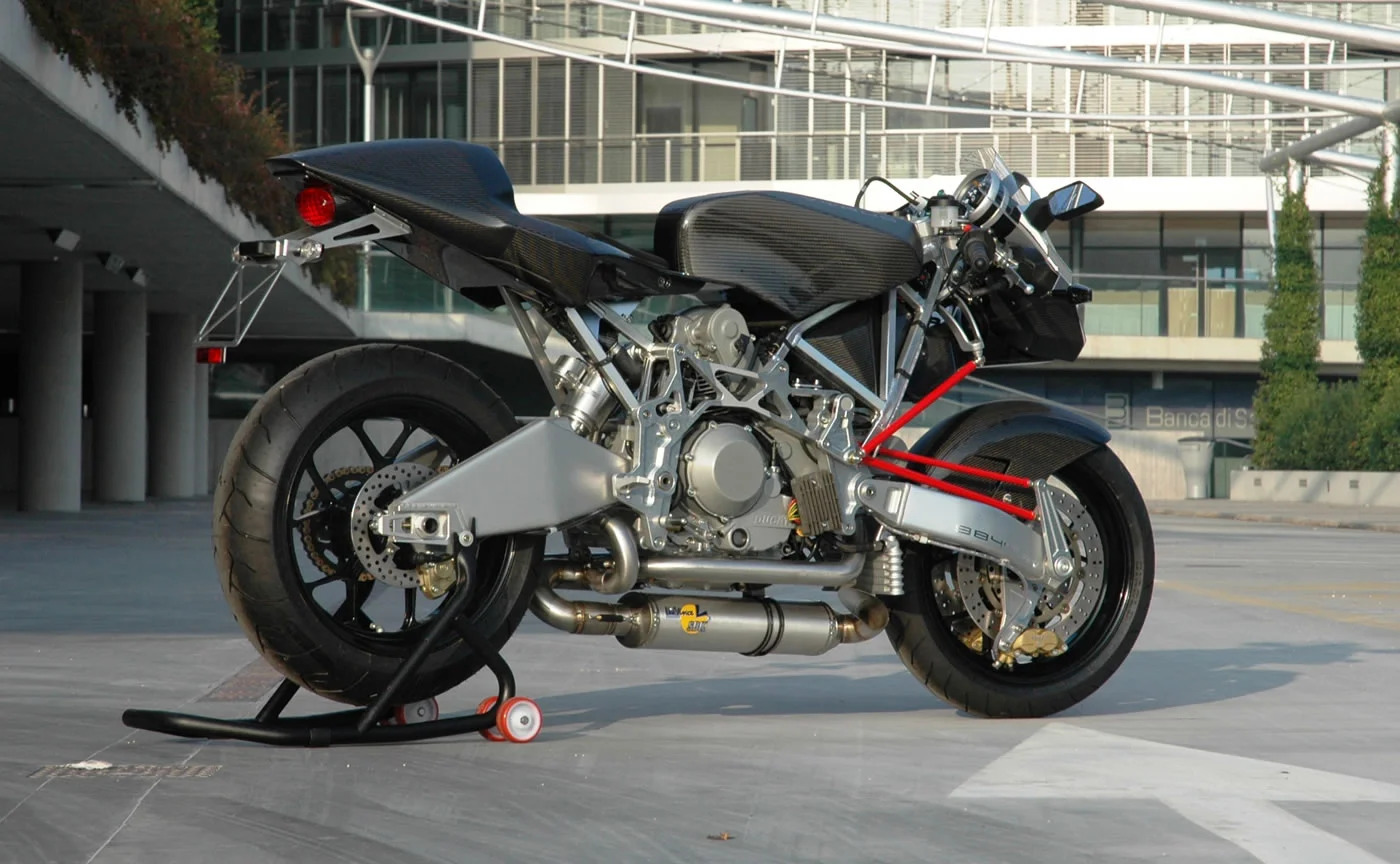 The small Rimini-area workshop subsequently developed increasingly powerful Ducati-engined versions. The 984 used an air-cooled two-valve engine, while the 985 adopted the liquid-cooled 999R Testastretta. Then came the 987.
Ducati 1098R Power
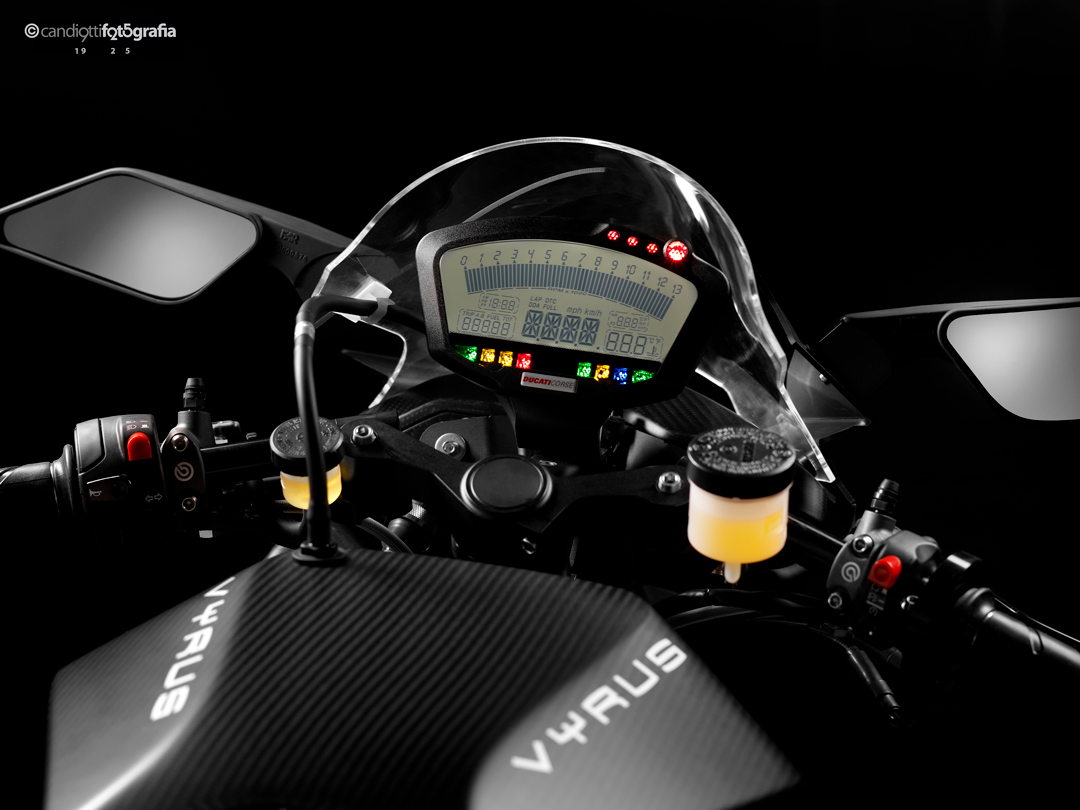 For the new machine, Vyrus turned to one of the most serious Ducati engines then available: the powerplant from the 1098R. Despite the Ducati’s name, the 1098R actually displaced 1198cc. The liquid-cooled 90-degree L-twin used four desmodromically operated valves per cylinder and represented the racing-focused end of Ducati’s Testastretta Evoluzione family.
Exactly how much power a 987 made depended on specification. Vyrus’s current historical page lists 165 bhp for the model, but period reports commonly quoted approximately 184 horsepower. That discrepancy is less surprising when you consider how Vyrus built its motorcycles. These were tiny-volume, individually specified machines, and customers could choose different exhausts, electronics, wheels, and other equipment.
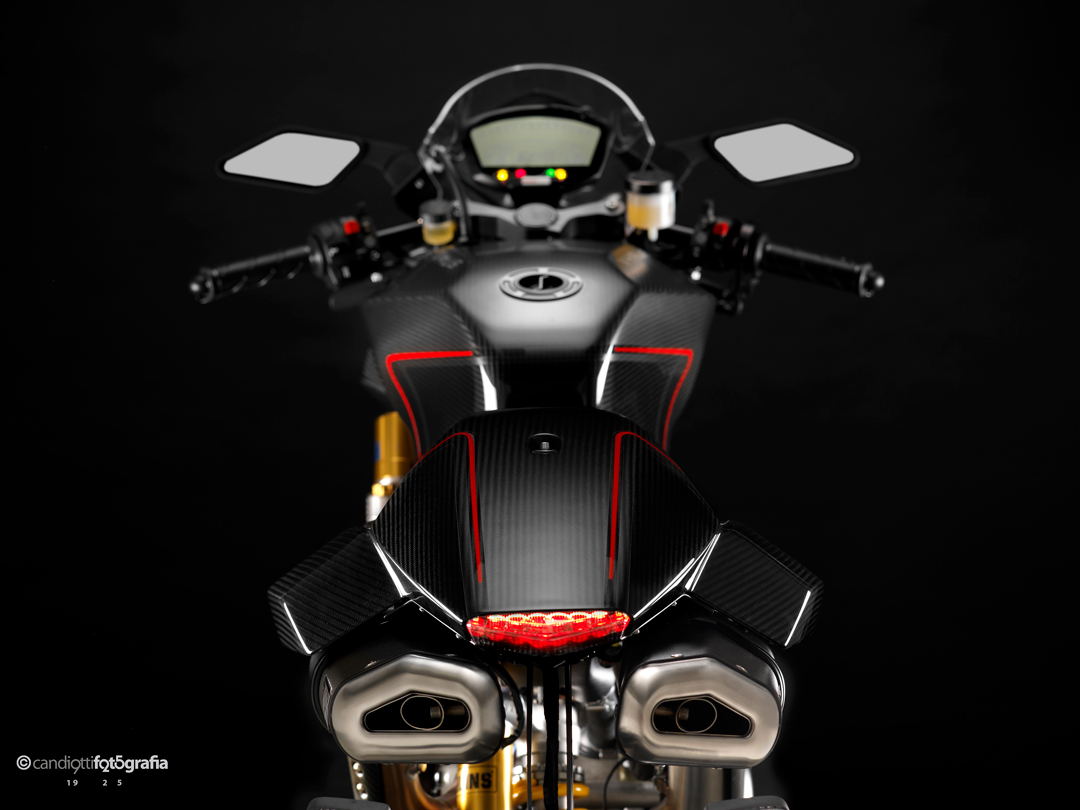
The customer-owned machine tested by Ultimate Motorcycling went considerably further. Its 1198cc engine used a full Zard race exhaust and Vyrus mapping, which the magazine said added roughly 10 horsepower to the period 184-hp specification, bringing output to approximately 194 hp.
In a motorcycle weighing roughly 350 pounds, that represented an exceptional power-to-weight ratio for 2010. More importantly, Vyrus surrounded the Ducati engine with a chassis unlike almost anything else available.
More Than Just a Strange Front End
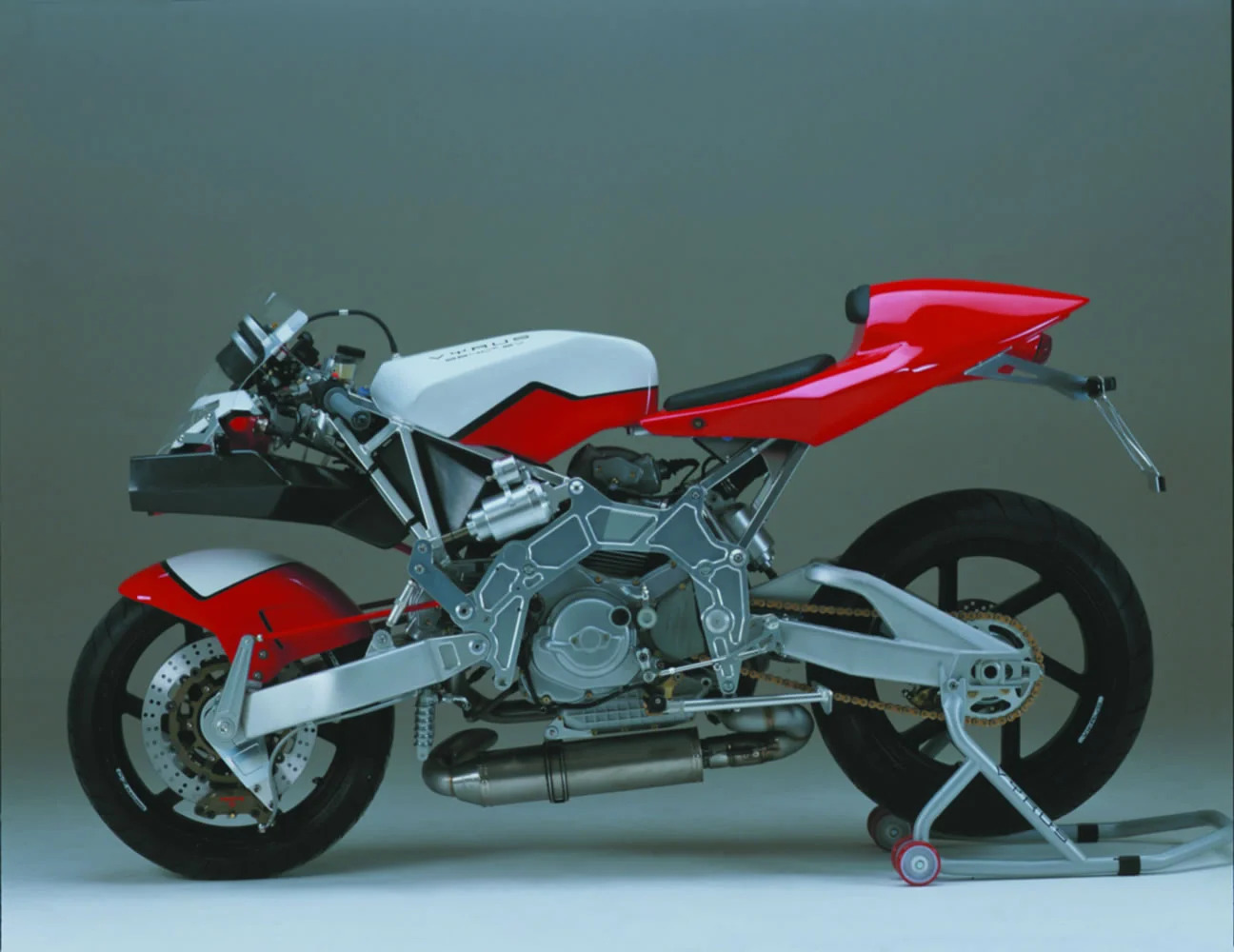
The defining characteristic of every full-sized Vyrus remains its chassis. A conventional motorcycle uses telescopic fork legs both to suspend the front of the machine and to steer the wheel. Under braking, those forks compress, changing ride height and steering geometry while simultaneously absorbing bumps and transmitting steering inputs.
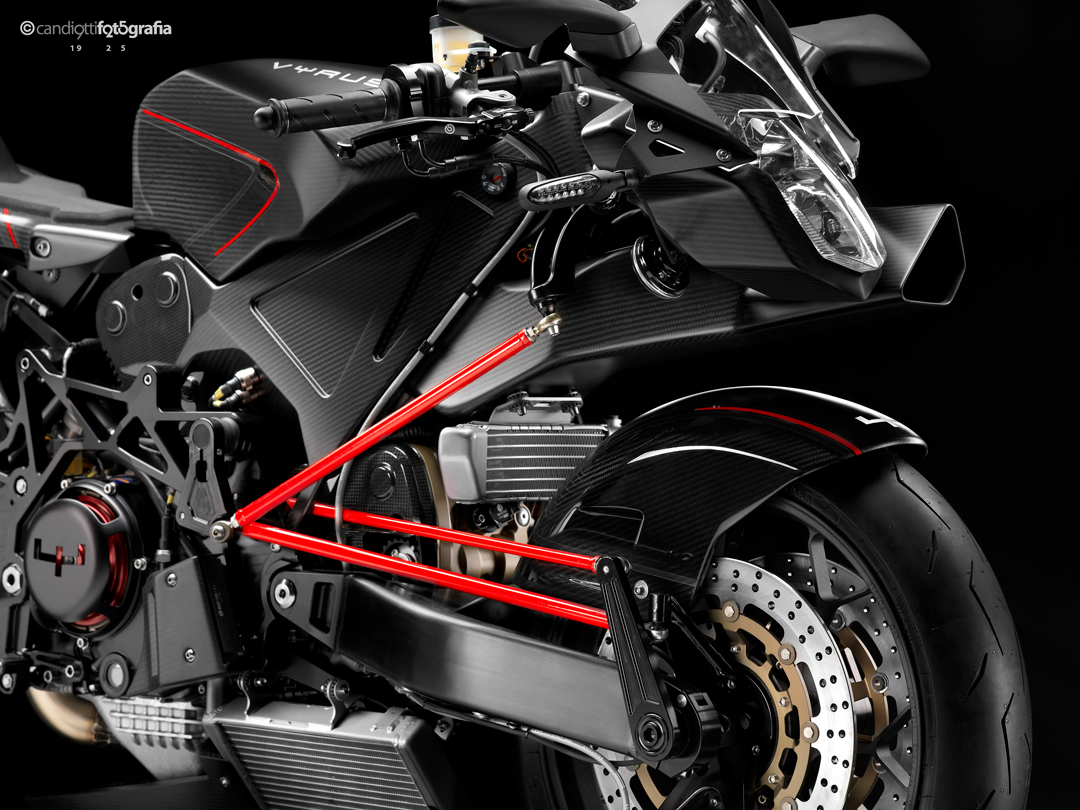
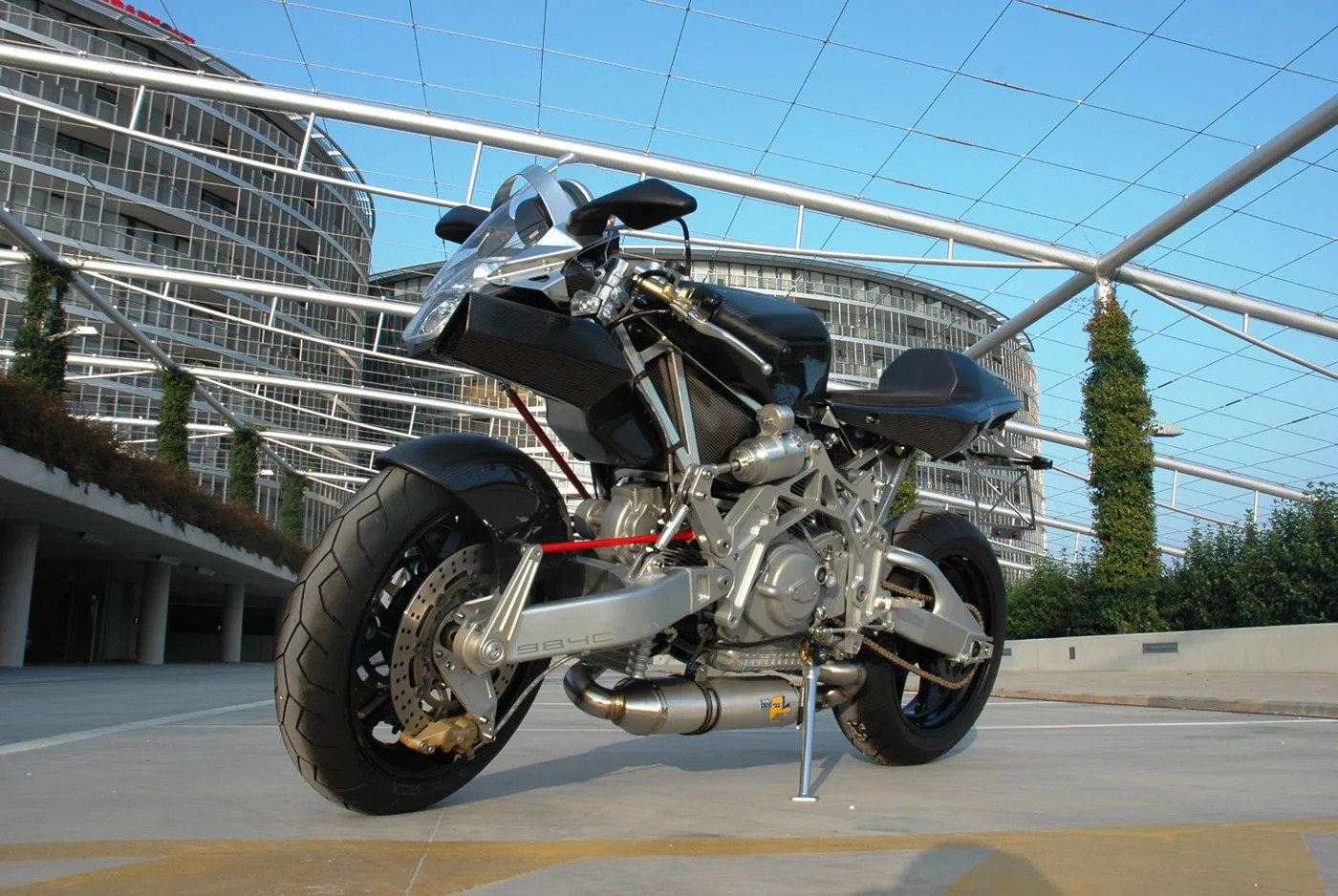
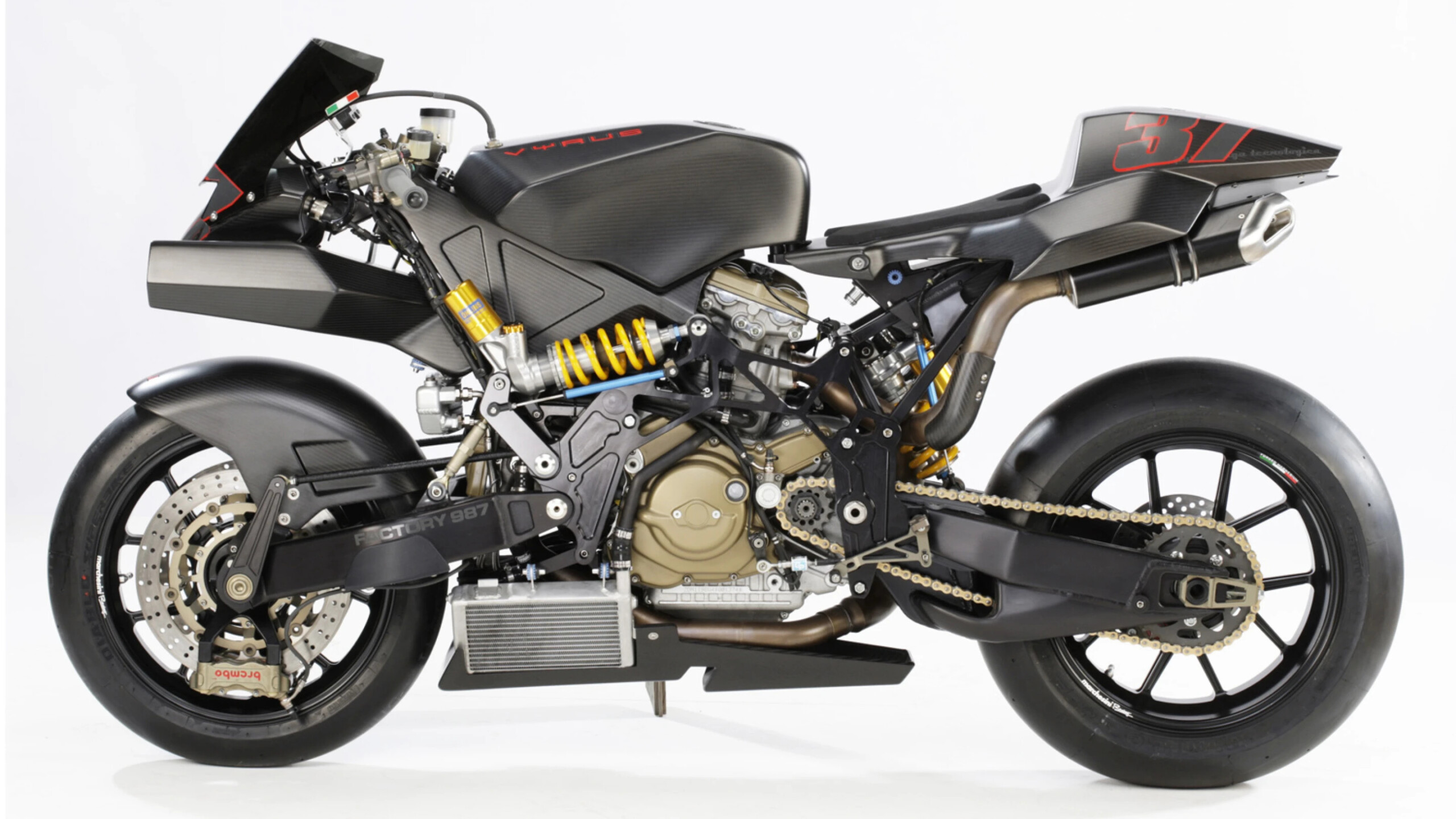
Hub-center steering attempts to separate some of those jobs. On the Vyrus, an aluminum swingarm locates the front wheel much as another swingarm locates the rear. The wheel steers around an axis inside the hub through a system of rods and linkages connected to the handlebars. The suspension unit does not have to turn with the wheel.
One theoretical advantage is reduced brake dive and more consistent geometry under heavy braking. Steering-axis angle and trail can also be altered independently to a degree that would be difficult on a conventional production motorcycle. Vyrus specifies an unusually broad adjustment range for the 987, with steering angle adjustable from approximately 18 to 24 degrees and trail from 80 to 105mm.
There are tradeoffs. Hub-center systems introduce bearings, steering rods, joints, and other components between the rider’s hands and the contact patch. Historically, one criticism has been that those additional linkages can diminish the direct steering feel riders expect from a high-quality telescopic fork. Rodorigo spent years attempting to solve precisely those problems.
Almost No Conventional Frame
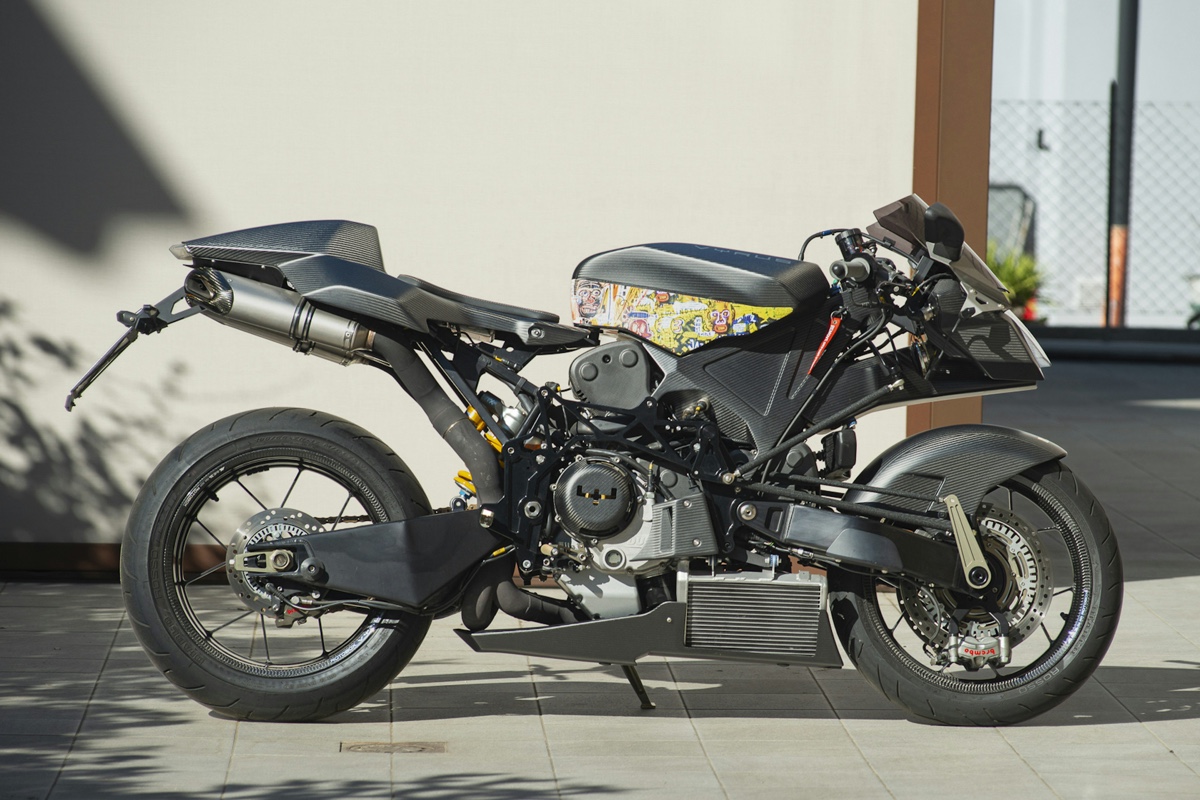
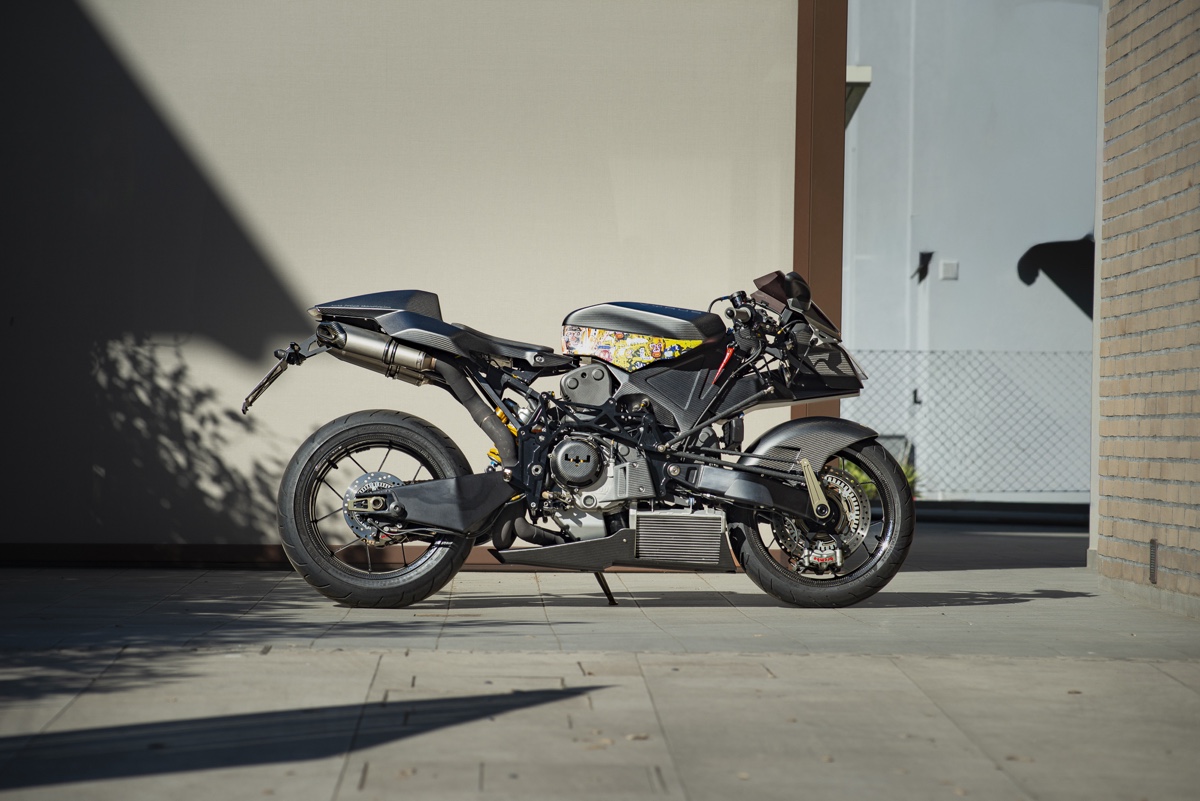
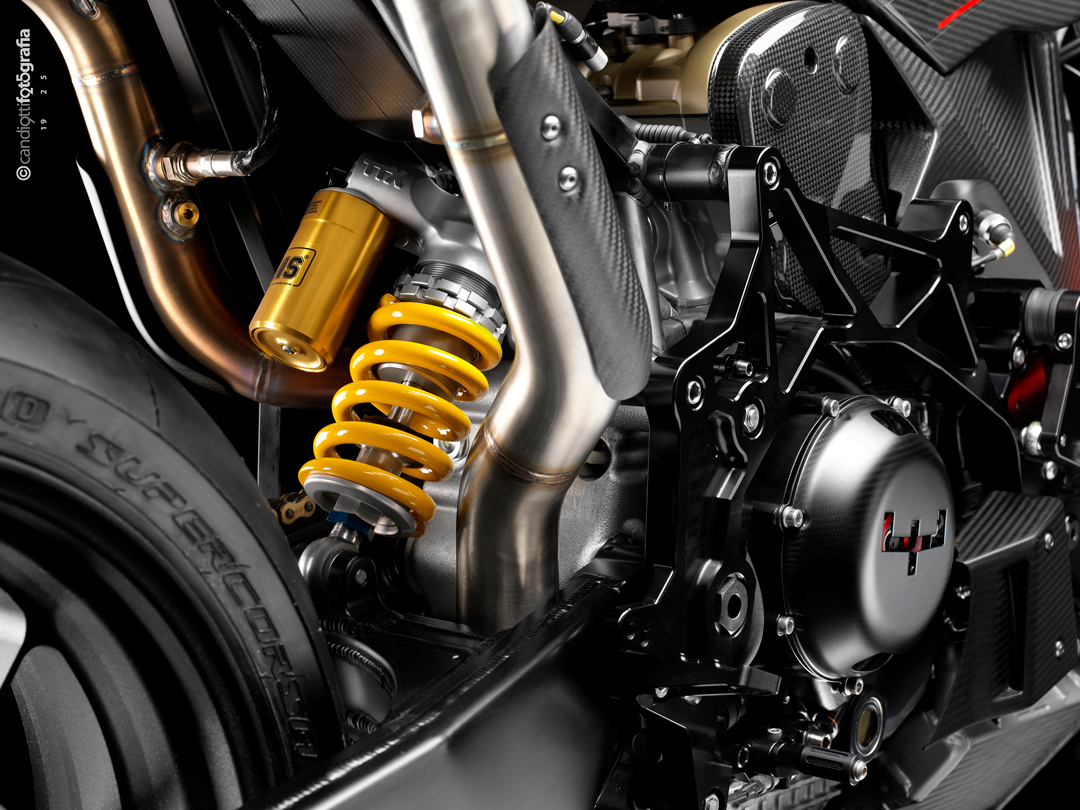
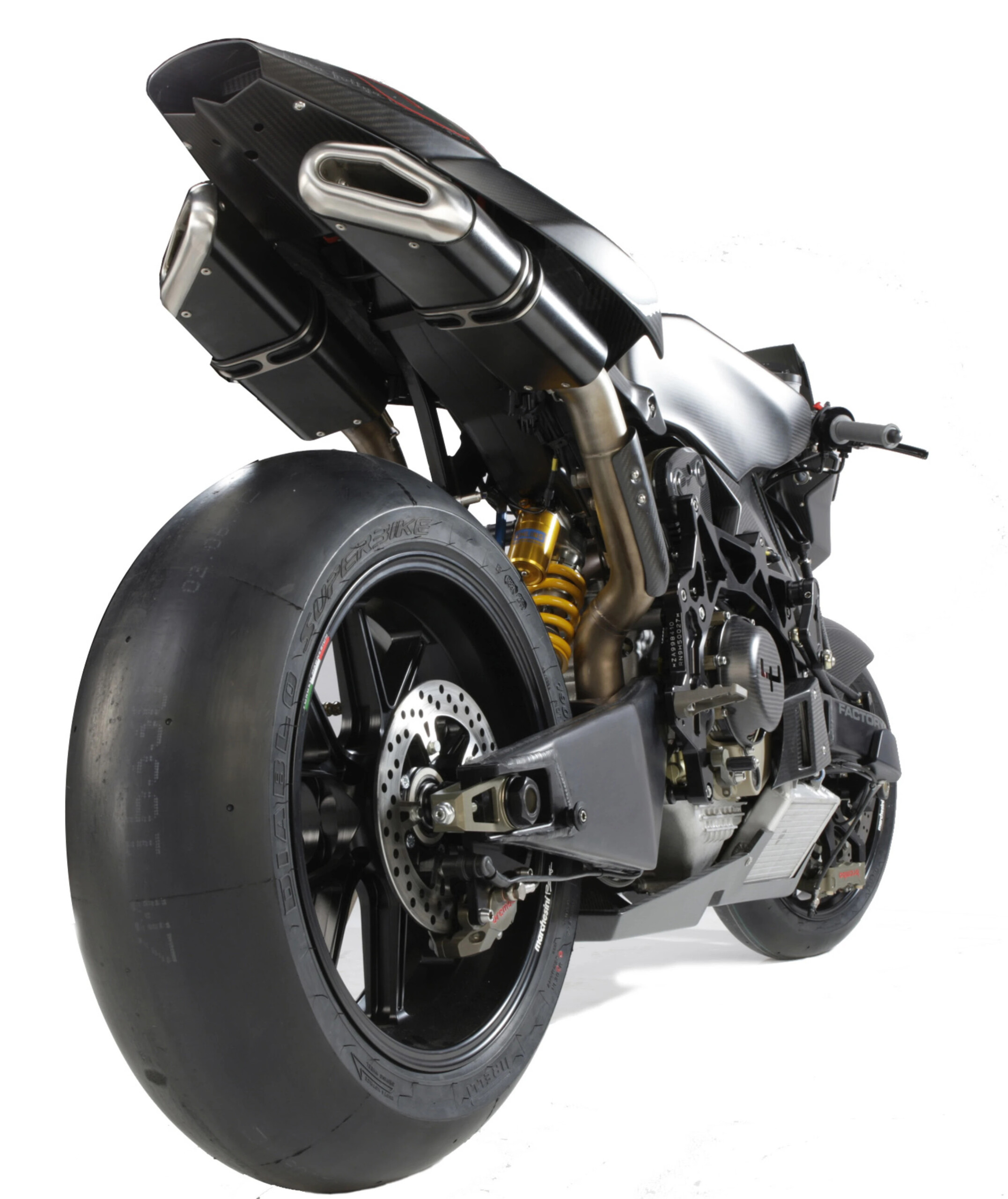
The front suspension also allowed Vyrus to rethink the rest of the chassis. Look closely at a 987 and it becomes difficult to identify anything resembling a normal motorcycle frame. Instead, a pair of CNC-machined aluminum Omega-shaped plates ties the major components together around the engine. Front and rear swingarms attach to this central structure, while the Ducati engine becomes a major structural element in the package.
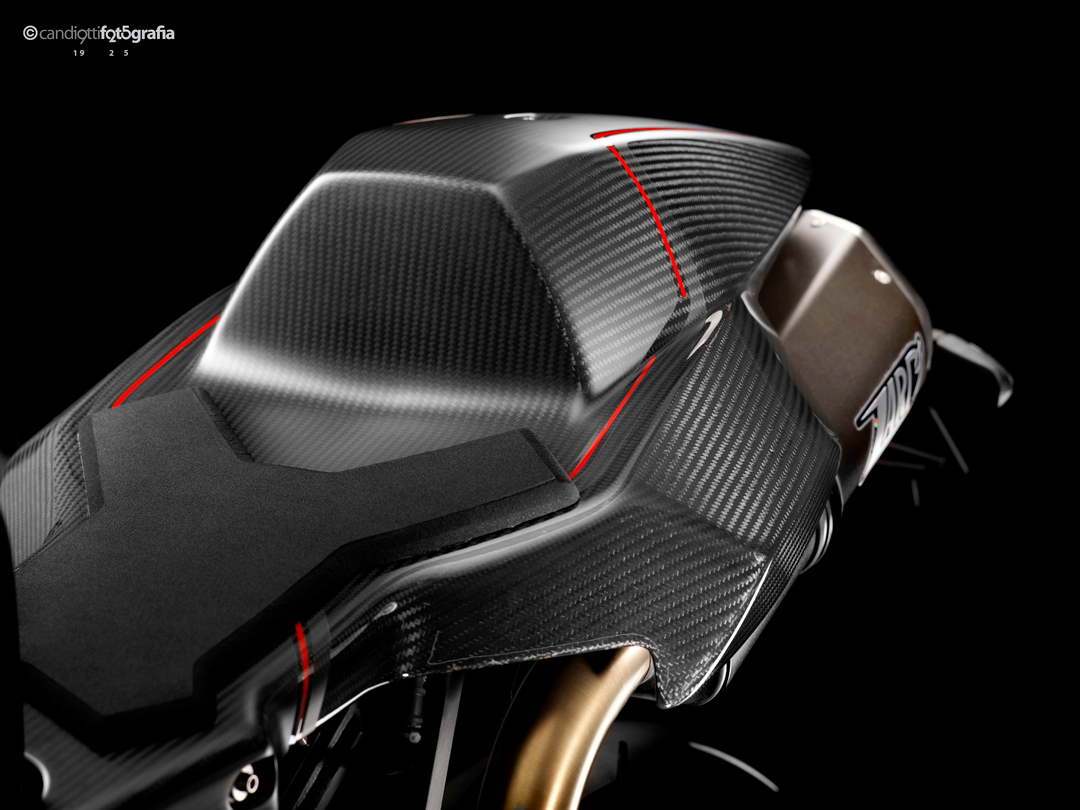
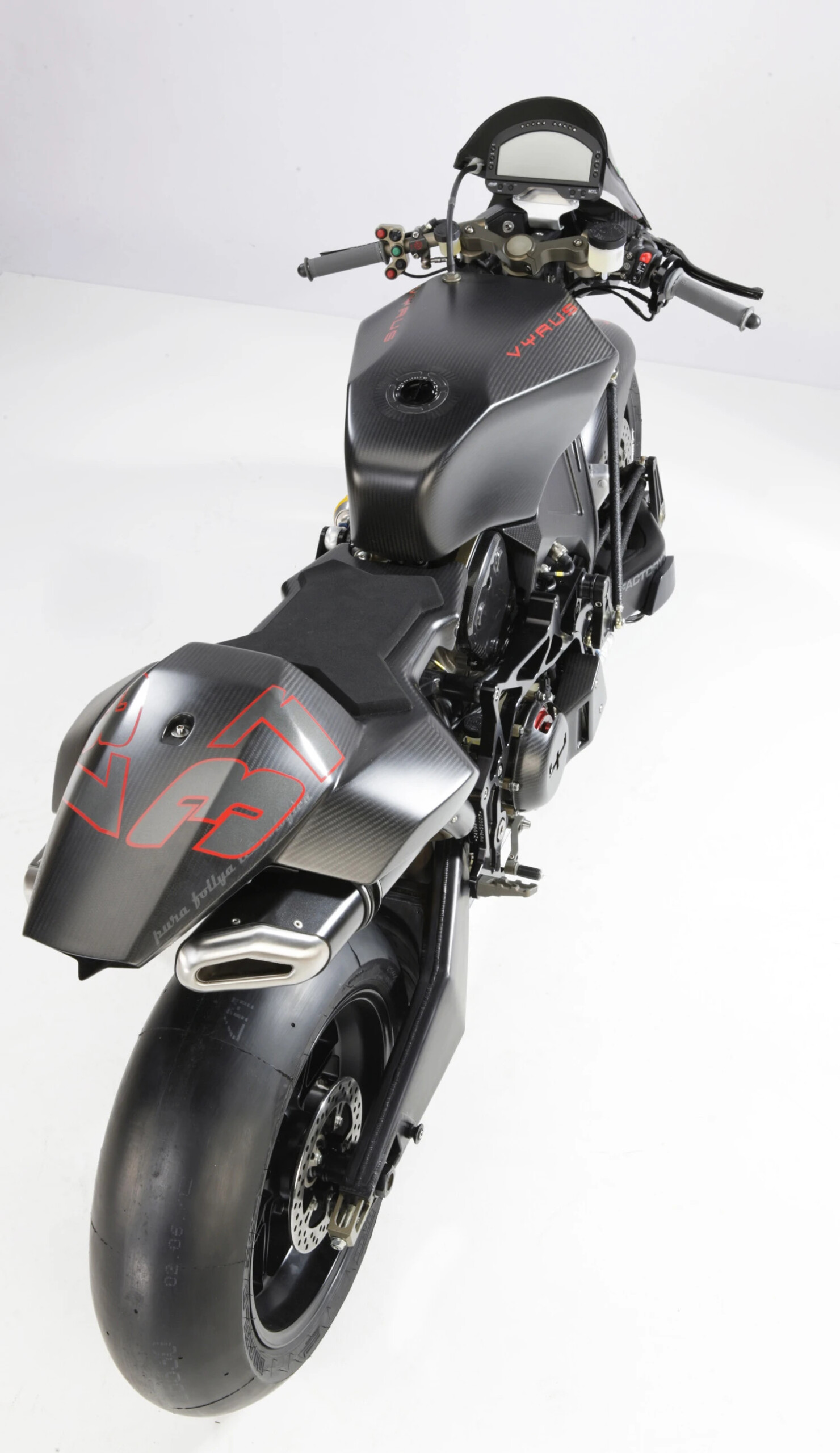
The bodywork is equally minimal. Carbon fiber is used extensively, but there isn’t much of it. The engine, exhaust, swingarms, steering linkages, suspension hardware, and machined components remain deliberately exposed.
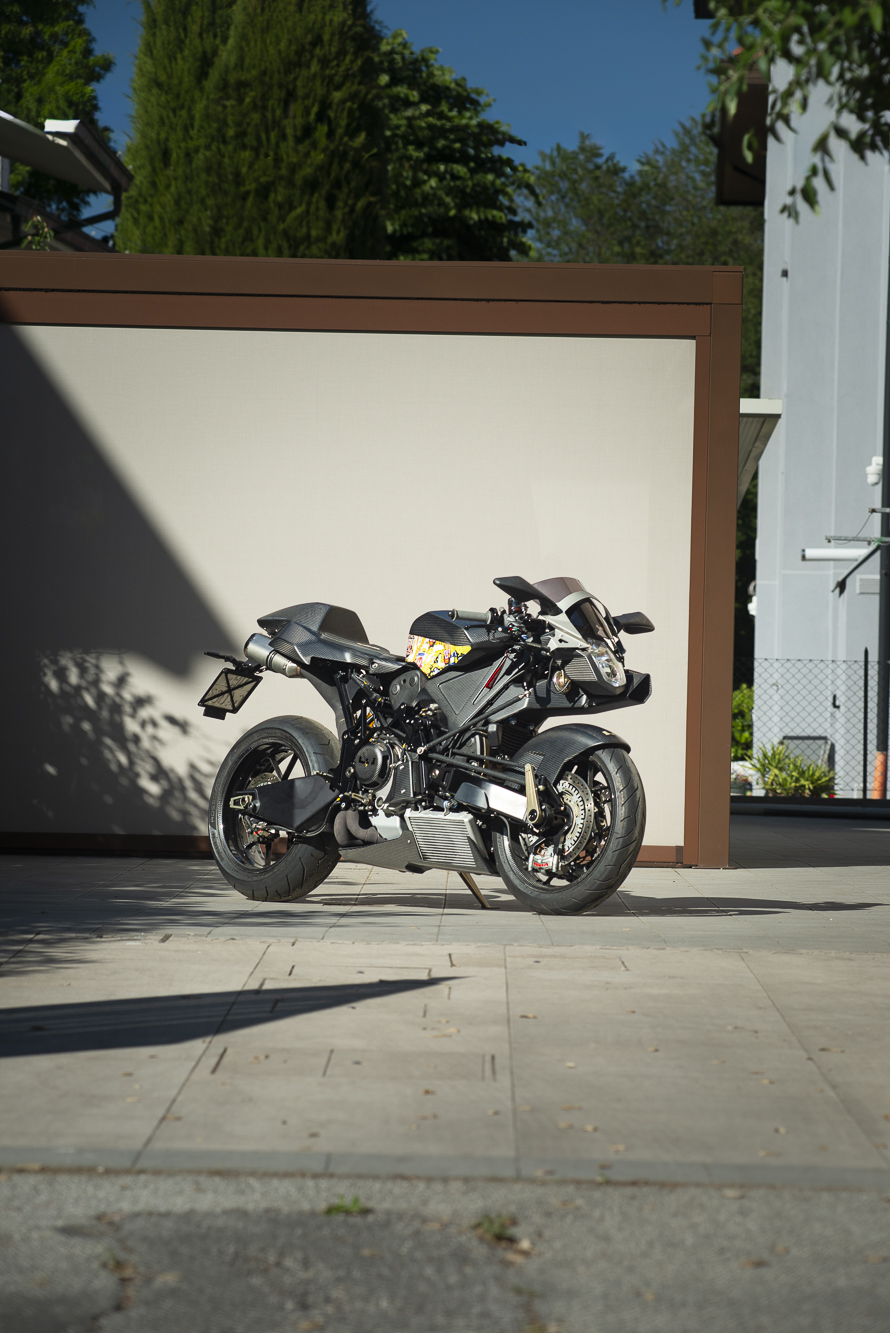
Cooling presented its own packaging challenge. A conventional large frontal radiator is difficult to accommodate with a front swingarm occupying much of the same space, so Rodorigo developed a compact double-radiator arrangement mounted low around the engine.
Everything is packed tightly around the big Ducati twin. That architecture helped Vyrus achieve its strikingly low claimed weight. The company’s historical page lists the 987 at just 159 kg / 350 lb dry and describes production as a mere 25 units.
What’s It Actually Like to Ride?
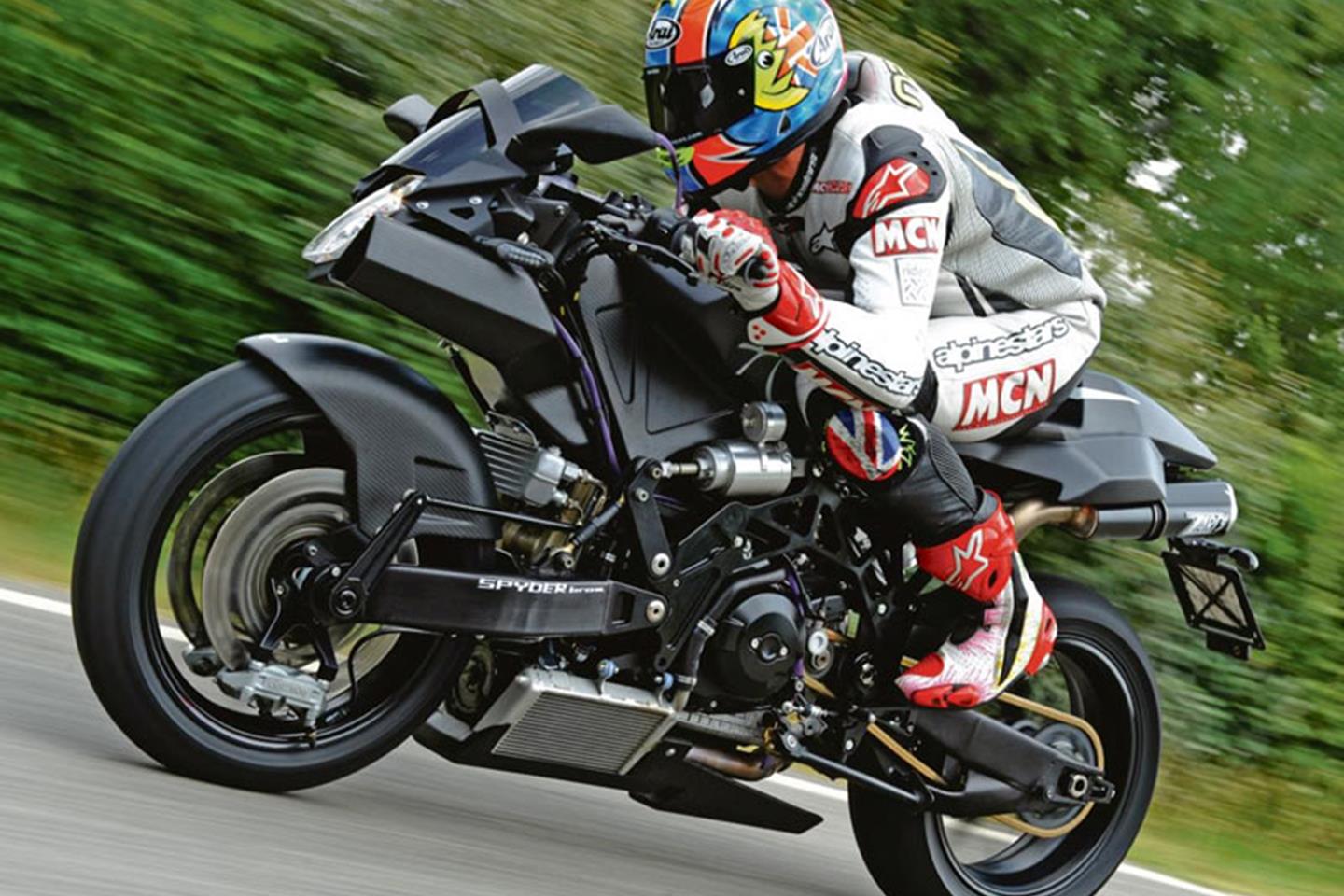
Fortunately, the 987 isn’t merely a motorcycle we know from specification sheets. In 2010, journalist Tor Sagen rode a customer-owned C3 4V directly from the Vyrus workshop near Rimini. The bike was an especially aggressive specification, running 16.5-inch Marvic forged racing wheels, Pirelli Superbike slicks, the Zard race exhaust, and approximately 194 horsepower. It wasn’t even equipped with lights or mirrors for the test.
The acceleration was predictably enormous. Sagen described the 1198cc Testastretta engine as brutal in such a light motorcycle, particularly when he emptied first gear on a short stretch of road.
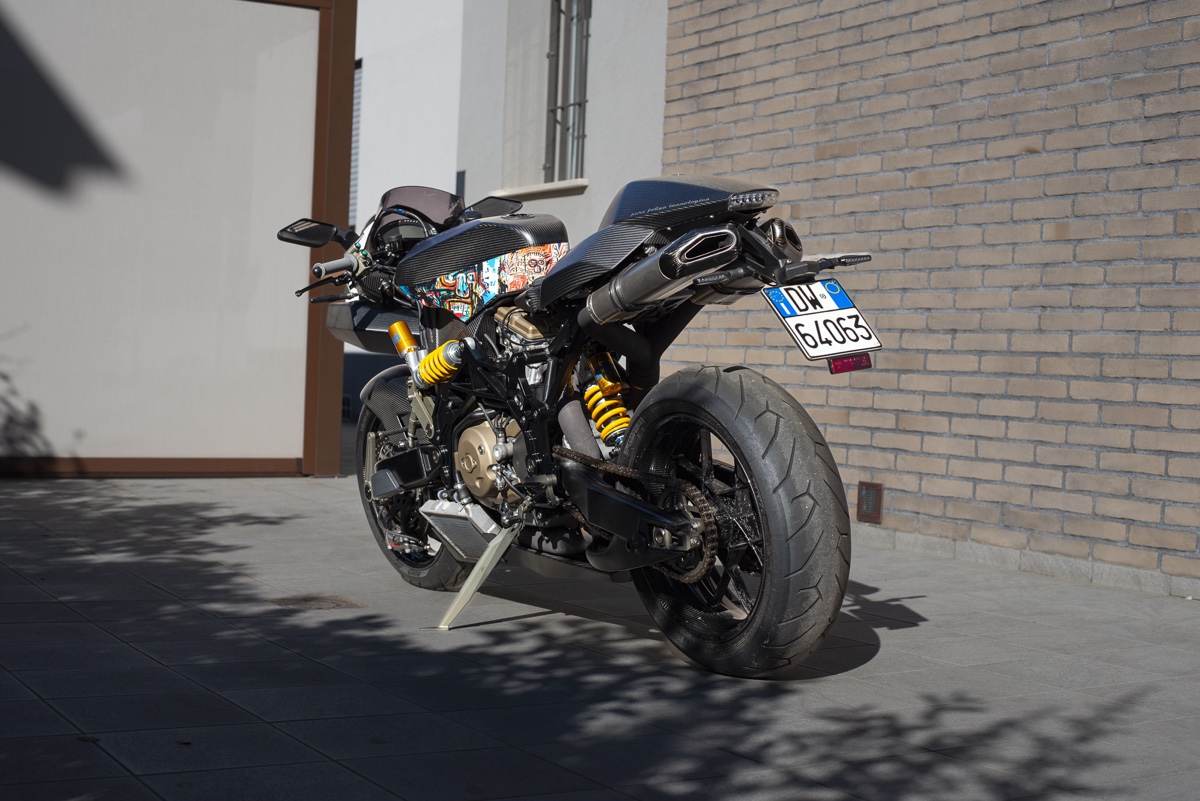
But the more interesting impressions concerned the front suspension. At low speed, the steering felt much heavier than a conventional fork-equipped motorcycle, with little of the effortless side-to-side movement riders expect from a normal front end. The turning radius wasn’t remotely suited to city use.
At speed, however, the same system produced an extraordinary sense of stability. Because braking forces and suspension movement were largely separated, the rider could remain hard on the Brembo monobloc brakes while the front swingarm and Öhlins shock continued dealing with bumps independently. There was no conventional fork diving through its stroke and simultaneously changing the motorcycle’s geometry.
Race-Bike Electronics
Vyrus wasn’t opposed to electronics. Period 987 specifications included a sophisticated traction-control system with adjustable intervention, multiple engine maps, launch control, and a programmable pit-lane limiter. Again, individual motorcycles varied.
The customer bike ridden by Ultimate Motorcycling actually had the traction-control hardware removed despite its 194-hp engine, making that particular test somewhat more adventurous than the standard specification would suggest.
The electronics underline what the 987 was meant to be. This wasn’t a retro exercise built around an eccentric chassis idea from the past. Vyrus was combining hub-center steering with the best Ducati engine and race technology it could obtain at the time.
Built One at a Time…
Vyrus was never Ducati on a smaller scale. It was closer to an engineering atelier. Contemporary accounts describe motorcycles being assembled individually to customer specifications, with buyers able to select materials, finishes, electronics, wheels, exhausts, and other details directly with Rodorigo and the workshop.
One period tester noted that Vyrus didn’t even maintain a conventional press fleet. The 987 he rode belonged to a customer. No two machines necessarily left the workshop in precisely the same configuration. That helps explain why horsepower, weight, pricing, and equipment differ between period reports.
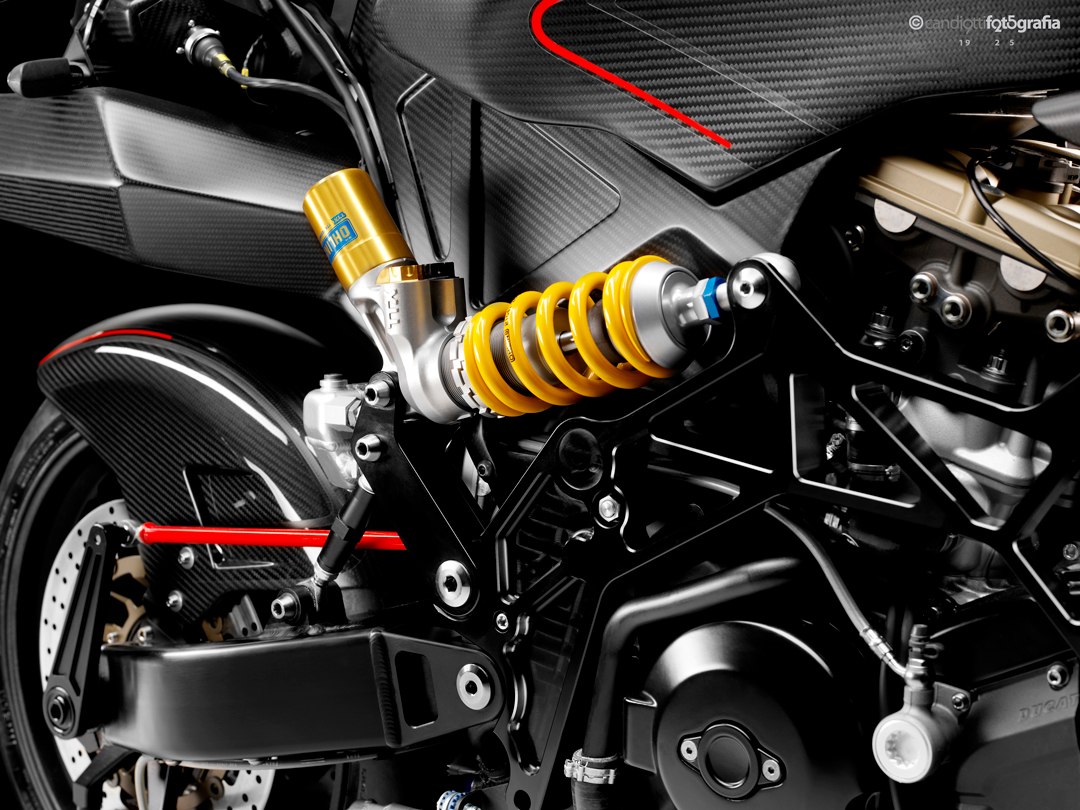
The official historical specification provides a useful baseline: 165 bhp, 159 kg dry, six-speed gearbox, adjustable hub-center front suspension, carbon-fiber intake hardware, 12-liter fuel capacity, and a 1,400mm wheelbase. But a customer could make the motorcycle significantly more extreme. The approximately 194-hp test bike provides a particularly good example.
The 211-HP Supercharged 987
Vyrus also offered an even more extreme supercharged derivative, usually called the 987 C3 4VV or 4V V. Period sources quoted 211 bhp from its Volumex-supercharged 1198cc engine, around 200 Nm of torque, and a dry weight of roughly 154–158 kg depending on the source. Contemporary reporting put the price around €65,000 and described it as “the world’s most powerful production motorcycle.”
Exactly how many supercharged 987s were built is difficult to establish. Period publications described the 4VV as commercially available, and Motorcyclist reported a supercharged 10th-anniversary version for sale in 2012; by 2013, Cycle World said the supercharged model was no longer in production. Vyrus’s present historical archive, however, does not break out a separate 4VV production total. So the safest conclusion is that the supercharged 987 was offered and apparently produced in extremely small numbers, but the number completed remains unclear.
Why Hub-Center Steering Never Took Over
Given the theoretical advantages, it’s reasonable to ask why motorcycles like the Vyrus didn’t render telescopic forks obsolete. The simple answer is that conventional forks became extremely good.
Decades of racing development produced highly rigid fork tubes, sophisticated cartridges, low-friction coatings, electronic damping, refined chassis geometry, and an enormous body of setup knowledge. Engineers learned to minimize many of the telescopic fork’s theoretical shortcomings without accepting the cost and complexity of hub-center steering.
There is also rider familiarity. Motorcyclists understand the way a conventional front end communicates. Brake dive itself provides information about load transfer. Racers and engineers have spent generations learning how to interpret and tune that behavior. Hub-center steering solves several engineering problems but introduces different ones.
Vyrus never needed the entire industry to agree with Rodorigo, however. The company only needed enough customers fascinated by the idea to keep building motorcycles.
The Fastest Vyrus
Viewed strictly through modern performance figures, the 987 has inevitably been overtaken. Current superbikes routinely exceed 200 horsepower. Sophisticated traction control, launch control, six-axis IMUs, electronically controlled suspension, and lightweight construction have become normal at the top of the market.
But none of that makes the Vyrus seem conventional. If anything, the passing years emphasize how unusual it was. Vyrus took the 1198cc engine from Ducati’s 1098R homologation superbike and installed it in a roughly 350-pound machine whose front wheel was suspended from a swingarm and steered through its hub. Instead of surrounding the engine with a traditional frame and fairing, Rodorigo exposed the mechanical architecture and made it the motorcycle’s defining visual feature.
This wasn’t a styling exercise. It represented decades of work on an alternative approach to motorcycle chassis design, first in the orbit of Bimota and later through Rodorigo’s own tiny company.
Vyrus remains active in Italy, and its lineage has continued through machines including the radically styled 988 Alyen. On its own historical timeline, however, the company gives the 987 a simple description: “The fastest Vyrus.” Only 25 were produced. The proposed supercharged version may have generated the biggest headlines, but the motorcycle Vyrus actually built hardly needs it. A Ducati 1098R engine, 350-lb weight, adjustable hub-center steering, and an optional supercharger — it was one of the strangest, most exotic motorbikes ever offered to private customers.
Vyrus 987 C3 4V Specifications
| Model | Vyrus 987 C3 4V |
| Engine | Liquid-cooled 90° L-twin |
| Engine source | Ducati 1098R / Testastretta Evoluzione |
| Displacement | 1198.4cc |
| Bore x stroke | 106 x 67.9mm |
| Compression ratio | 12.8:1 |
| Official historical power | 185 bhp |
| Period reported power | Approx. 184 hp depending on specification |
| Tested race configuration | Approx. 194 hp with Zard exhaust / Vyrus mapping |
| Fueling | Electronic fuel injection |
| Transmission | Six-speed |
| Clutch | Dry clutch |
| Frame | CNC-machined aluminum double-Omega structure |
| Front suspension | Progressive-link Vyrus hub-center system |
| Rear suspension | Direct Vyrus system, aluminum swingarm |
| Caster angle | Adjustable 18°-24° |
| Trail | Adjustable 80-105mm |
| Front tire | 120/70 ZR17 |
| Rear tire | 180-190/50 ZR17 |
| Wheelbase | 1400mm |
| Fuel capacity | 12 liters |
| Dry weight | 159 kg / 350 lb |
| Production | 25 motorcycles |


