
 The Big Single That Brought Paris–Dakar to the Streets…
By the early 1980s, the Paris–Dakar Rally had become something more than a race. It was an obsession, especially in Europe, where images of motorcycles thundering across the Sahara captured the imaginations of riders who dreamed of following those same tracks. The machines themselves were evolving rapidly. Small, lightly modified trail bikes were giving way to purpose-built desert racers with enormous fuel tanks, sophisticated suspension, and engines capable of surviving thousands of miles of punishment.
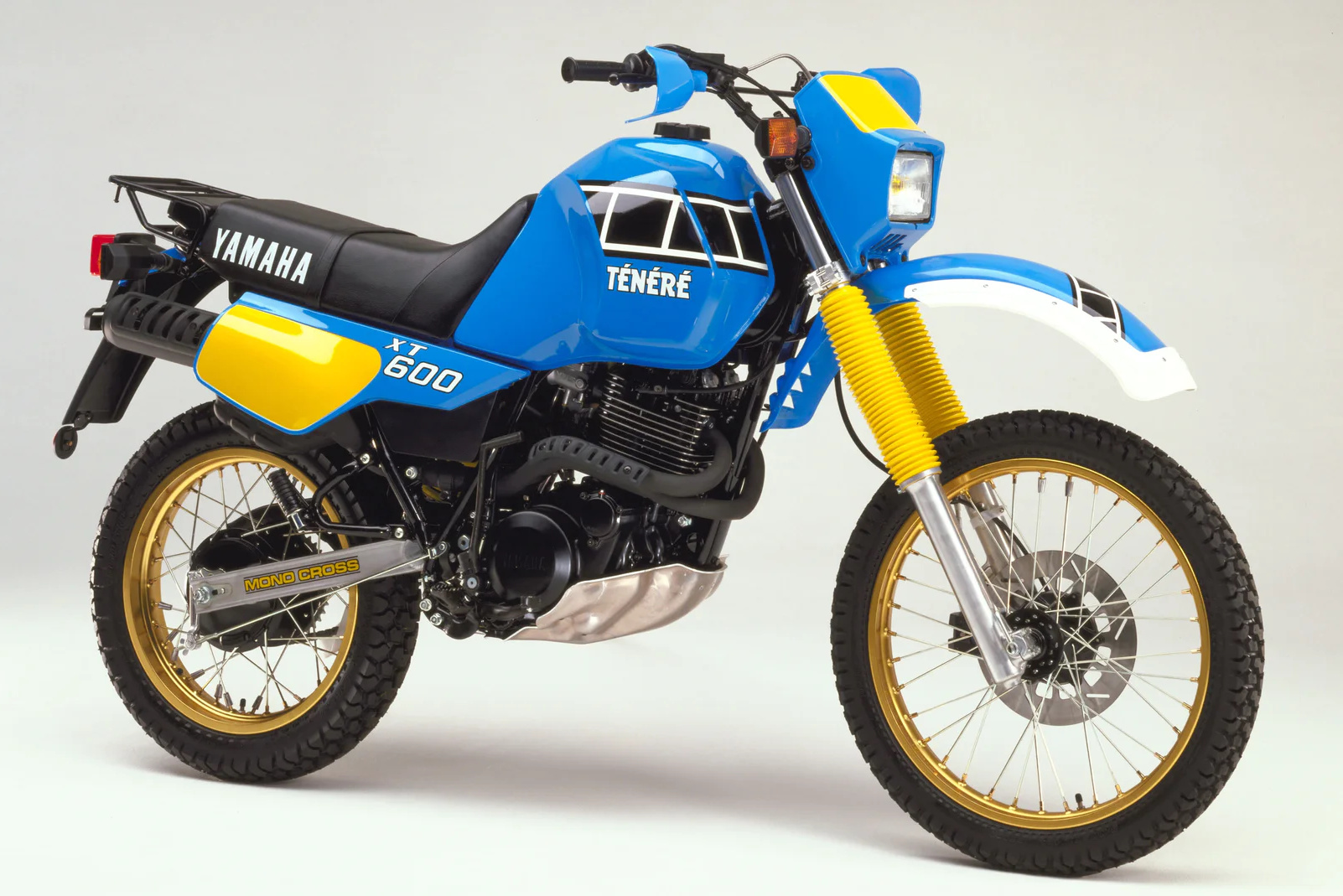
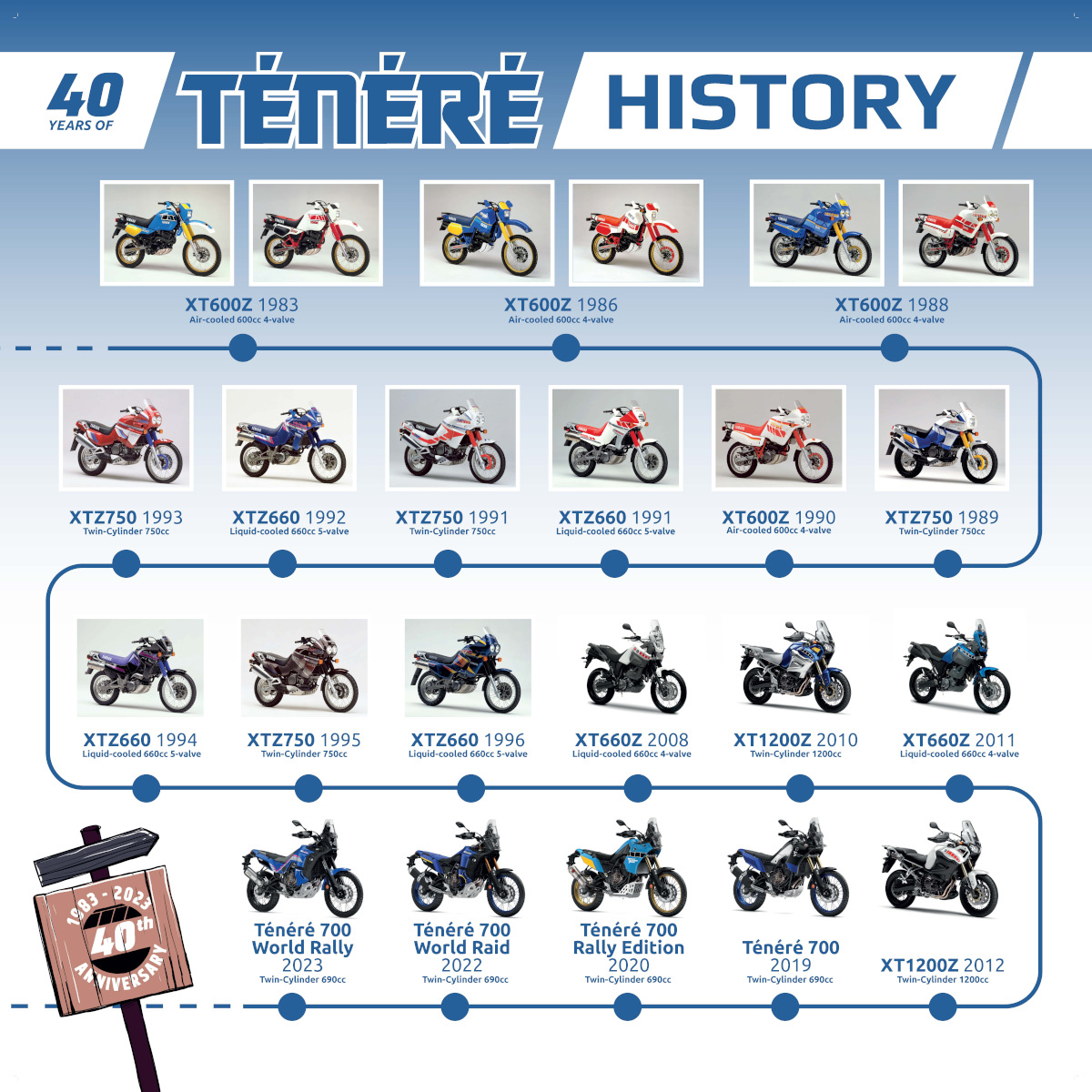
In 1983, Yamaha introduced a motorcycle that brought much of this rally technology to the showroom floor: the XT600Z Ténéré. With its massive fuel tank, air-cooled 595cc single, long-travel Monocross suspension, and unmistakable Paris–Dakar styling, the XT600Z helped establish the template for the modern adventure motorcycle. It also spawned a series of formidable factory rally machines that came tantalizingly close to winning the world’s toughest motorcycle race.
The Ténéré wasn’t simply a motorcycle inspired by Dakar. It was a machine developed because of Dakar — and one that would help make the rally’s spirit of adventure accessible to thousands of ordinary riders.
From the XT500 to the Ténéré
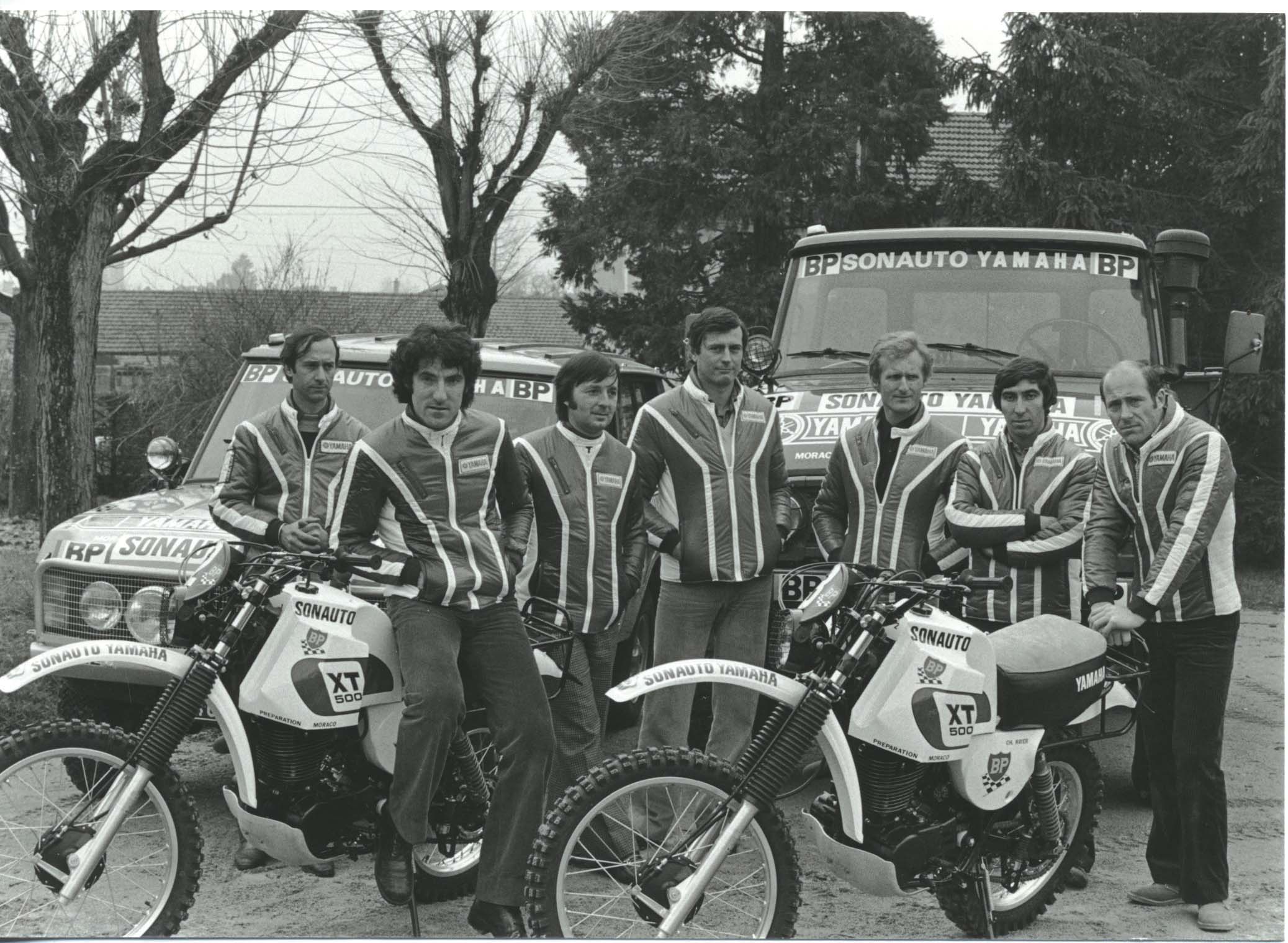
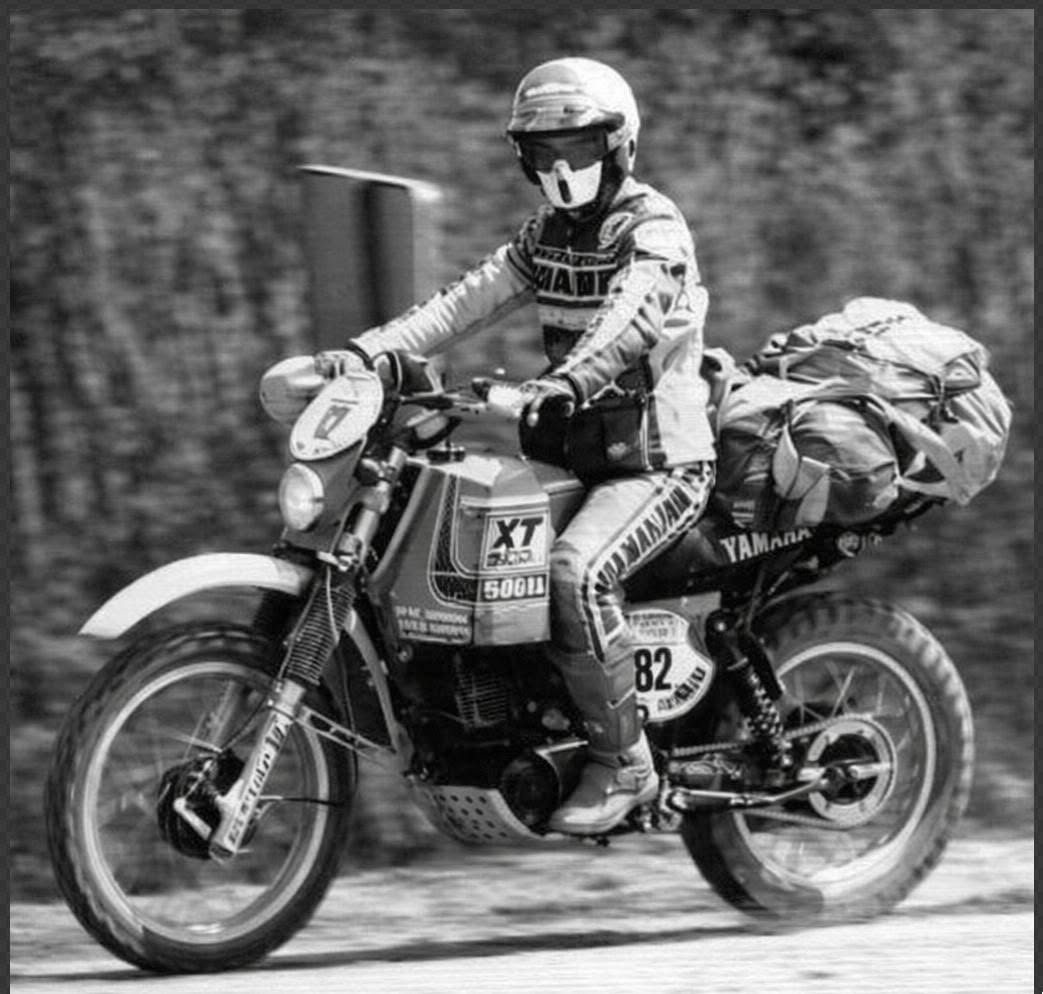
Yamaha’s involvement in the Paris–Dakar Rally began at the very beginning of the event. In 1979, French Yamaha importer Sonauto entered a team of modified XT500 singles in the inaugural Paris–Dakar. Cyril Neveu took the overall victory, with fellow Yamaha rider Gilles Comte finishing second. Neveu repeated his success in 1980, while XT500 riders swept the first four positions.
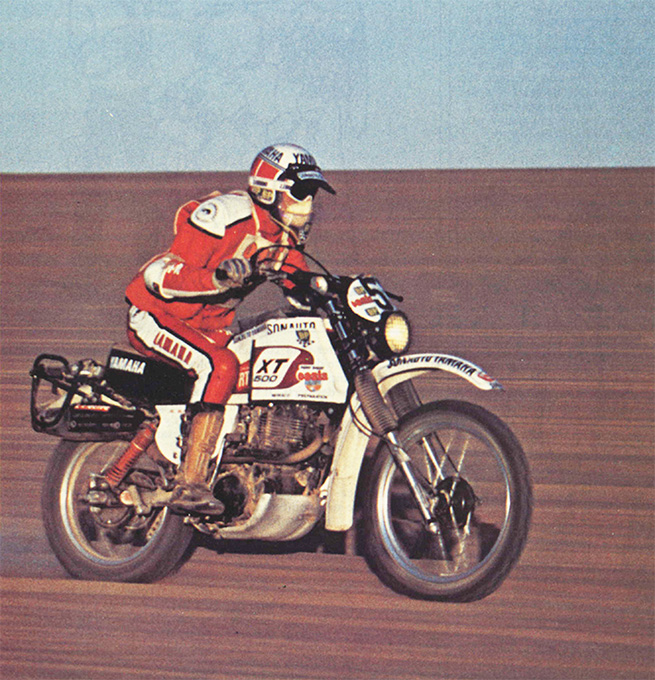
At the heart of Yamaha’s Dakar effort was Jean-Claude Olivier (aka “JCO” or “Mr. Yamaha”), the passionate Frenchman who would eventually become president of Yamaha Motor France. Olivier had participated in the 1977 Abidjan–Nice Rally and recognized the enormous potential of long-distance desert competition, both as a proving ground and as a way to inspire motorcycle buyers.
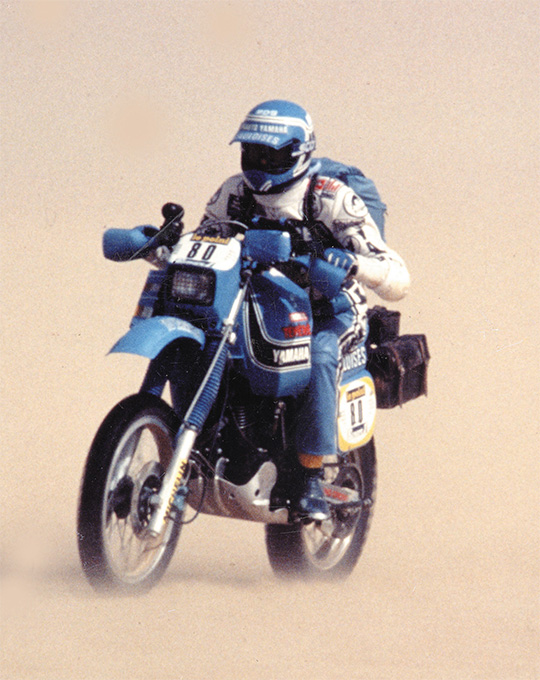
However, Dakar was becoming increasingly competitive. BMW’s powerful boxer twins were beginning to establish themselves as the machines to beat, while competitors such as Honda were developing ever more specialized off-road equipment. Yamaha’s XT500 had earned its reputation for toughness and simplicity, but its relatively modest suspension, braking, and engine performance were becoming limiting factors.
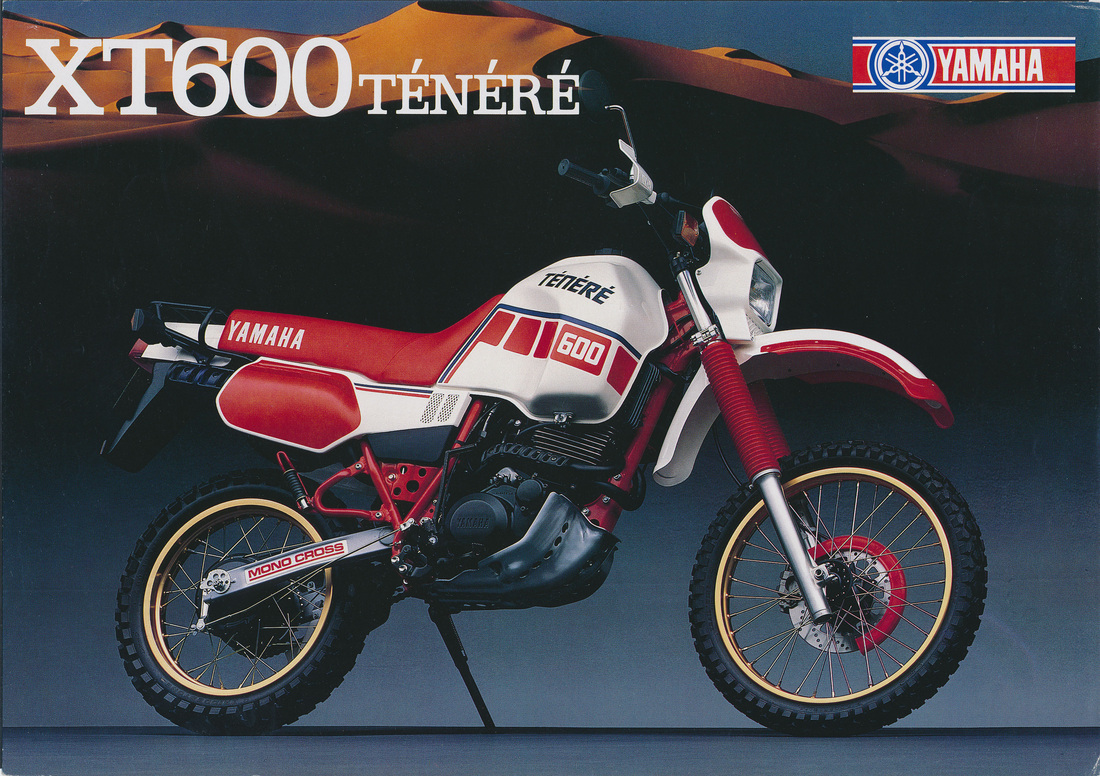 The XT550, introduced in 1982, brought a new four-valve engine and Yamaha’s Dual Intake System (YDIS), but Olivier and the Sonauto team wanted something more ambitious: a production motorcycle incorporating the lessons learned from racing across Africa.
Yamaha’s engineers in Japan answered with the XT600Z Ténéré, unveiled at the Paris Motorcycle Show in autumn 1982 and launched for the 1983 model year. It was named for the Ténéré Desert, a vast and notoriously desolate region of the Sahara in Niger — terrain that had become synonymous with the challenges of Paris–Dakar.
XT600Z: Built for the Desert
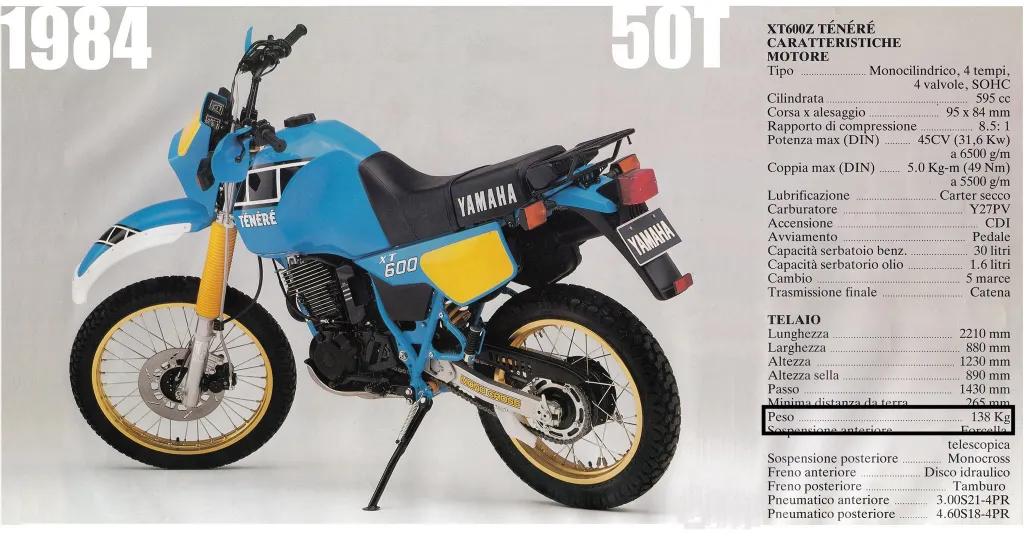
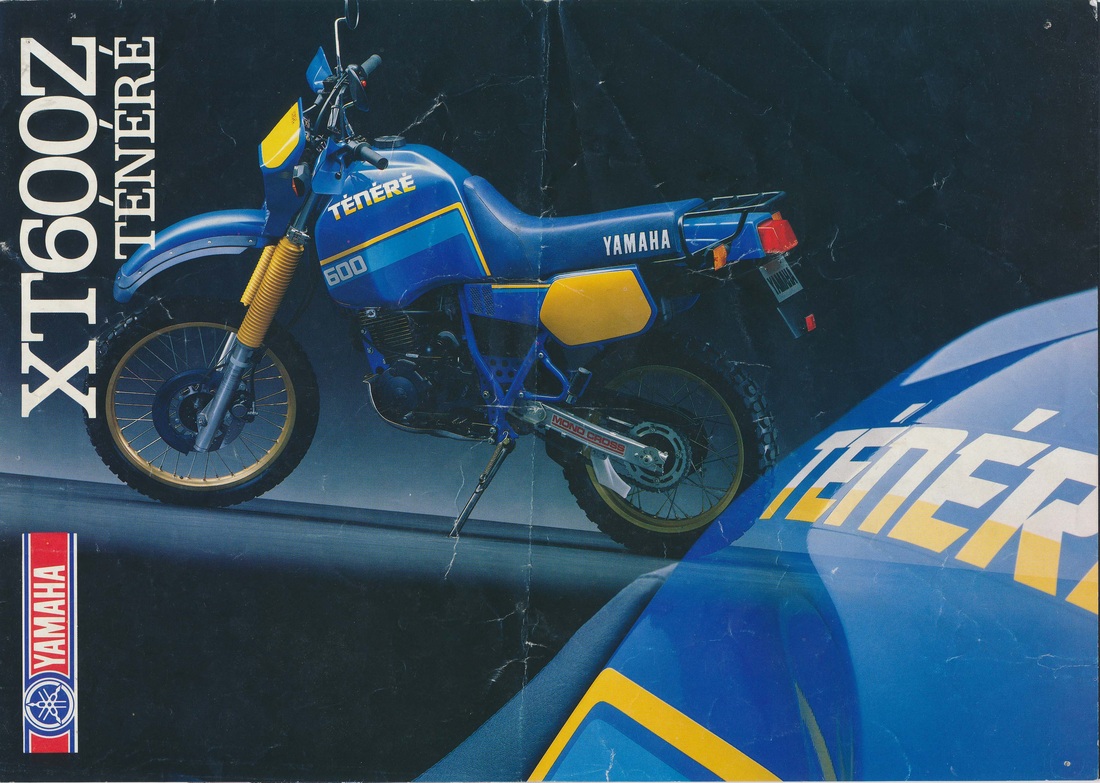 The original XT600Z, known by its 34L model designation, was considerably more than an enlarged XT550. Its engine displaced 595cc, with a 95mm bore and 84mm stroke. The air-cooled, four-stroke single featured a chain-driven single overhead camshaft, four-valve cylinder head, and Yamaha’s unusual YDIS induction system.
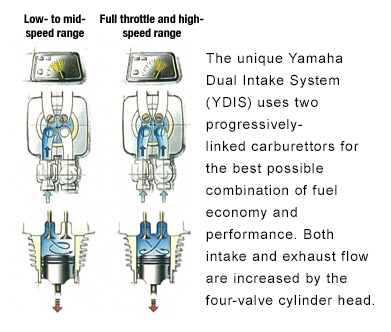
Rather than employing two conventional carburetors operating together, YDIS used a progressively linked arrangement. A mechanically operated primary carburetor handled smaller throttle openings, while a vacuum-operated secondary came into play as demand increased. The idea was to combine strong low-speed response with better high-rpm breathing and fuel economy — an especially useful combination for a machine expected to spend long hours crossing remote desert terrain. Output was approximately 43 PS at 6500 rpm, with 49 Nm of torque at 5500 rpm.
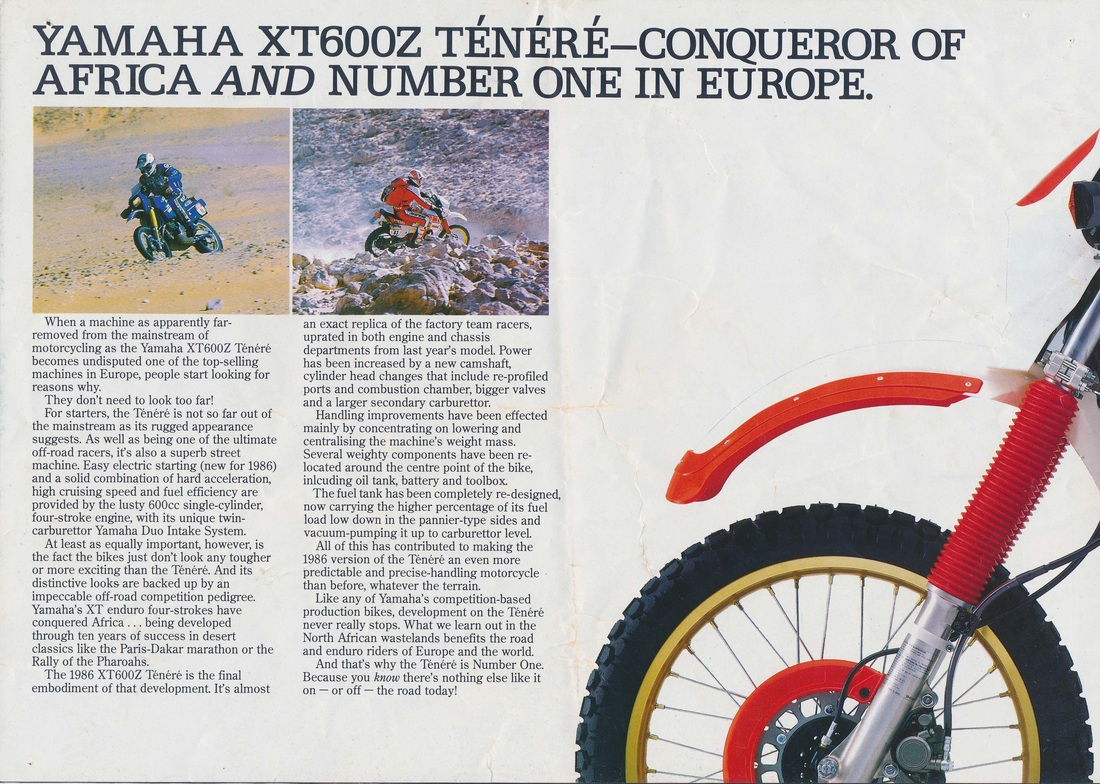
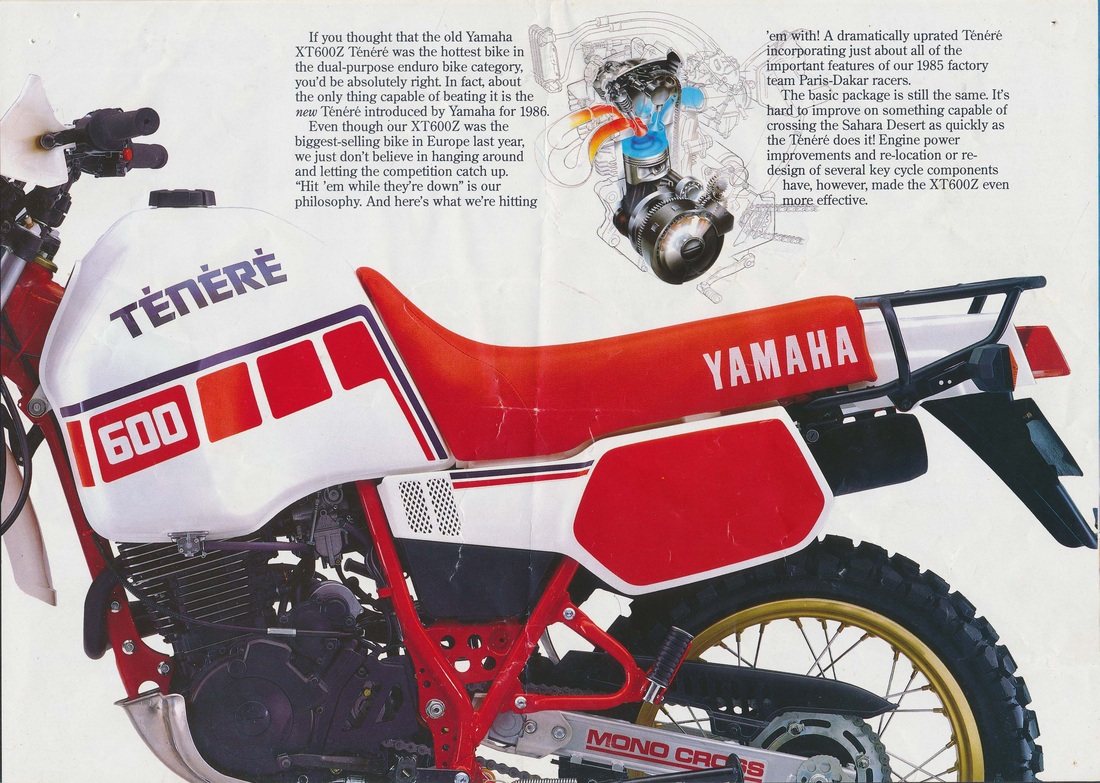
The engine also featured dry-sump lubrication, an oil cooler, a crankshaft balancer, and automatic decompression to make kickstarting the big single more manageable. But the Ténéré’s greatest advances were arguably in its chassis and equipment. The original machine featured:
- 30-liter fuel tank: An enormous capacity for a production enduro, providing the range necessary for serious overland riding.
- Monocross rear suspension: A rising-rate linkage system derived from Yamaha’s motocross development, combined with an aluminum swingarm.
- 41mm leading-axle forks: Air-assisted front suspension intended to cope with rough terrain and substantial loads.
- Hydraulic front disc brake: A significant advance over the drum brakes of earlier big-bore Yamaha trail bikes.
- 21-inch front and 18-inch rear wheels: Traditional off-road dimensions, with lightweight alloy rims.
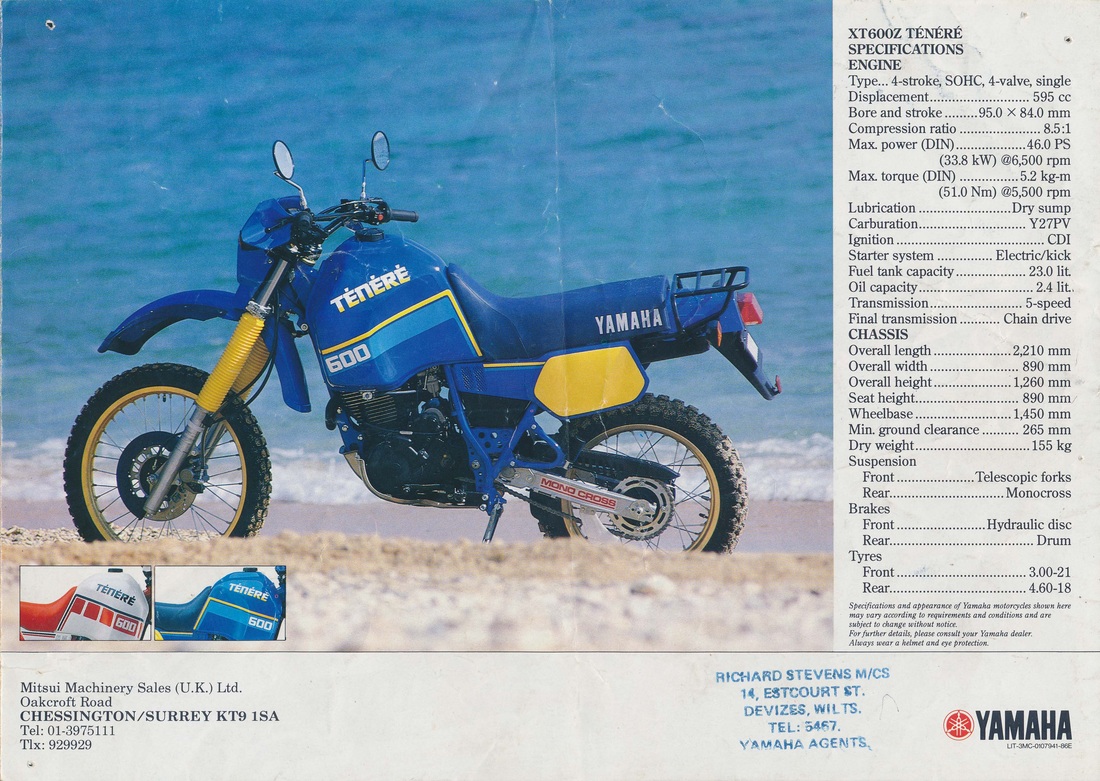 The Ténéré also featured 12-volt electrics, handguards, an engine skid plate, a rear luggage rack, and instrumentation suitable for long-distance road travel. Yamaha quoted a dry weight of just 138 kg (304 pounds) for the original model — remarkably light by the standards of modern adventure motorcycles, though the enormous fuel capacity added considerable weight when full.
The tall 890mm seat, broad shoulders of the tank, and high front fender gave the Ténéré an imposing appearance. In its famous blue-and-yellow or white-and-red color schemes, it looked almost like a Sonauto rally machine that had somehow escaped from the Dakar bivouac. Most importantly, it was a real production motorcycle. A rider could buy one from a dealer, strap on some luggage, and set off toward Africa.
1985: Yamaha’s Great Dakar Challenge
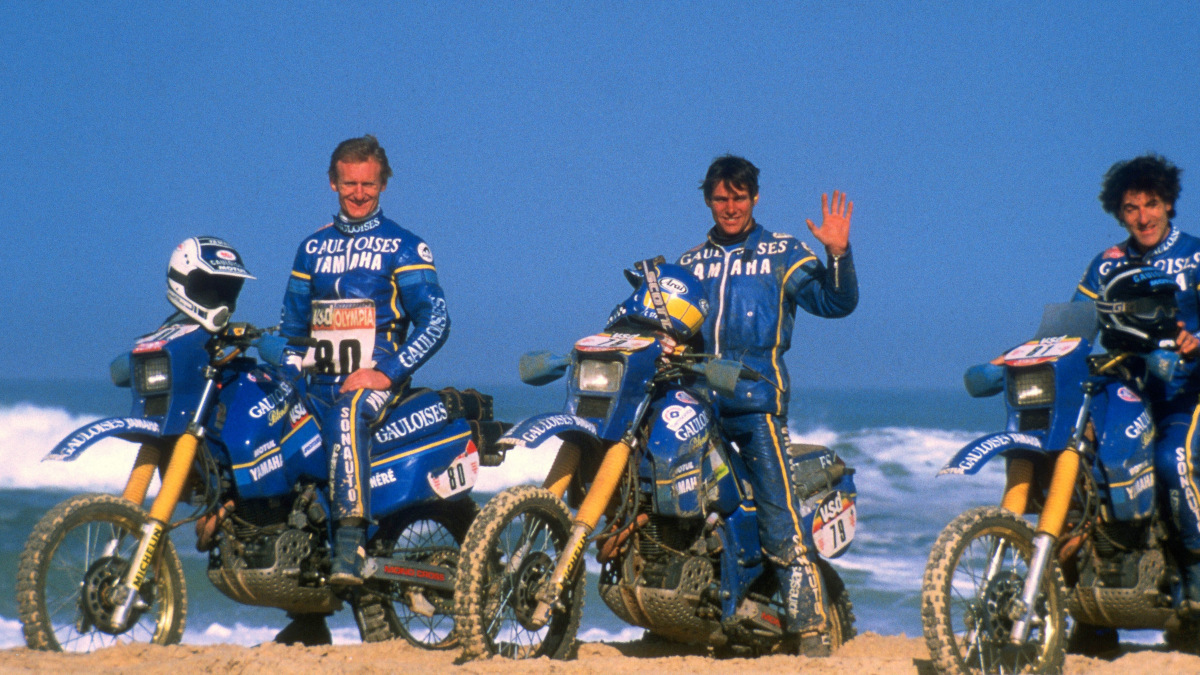
The XT600Z’s significance wasn’t limited to the motorcycle showrooms of Europe. Its engine and chassis architecture also helped underpin Yamaha’s continuing efforts to defeat BMW in the Paris–Dakar Rally. For 1985, Yamaha’s engineers developed a considerably more specialized XT600 Ténéré competition machine. Although it shared its name and basic engine heritage with the production model, it was essentially a works prototype.
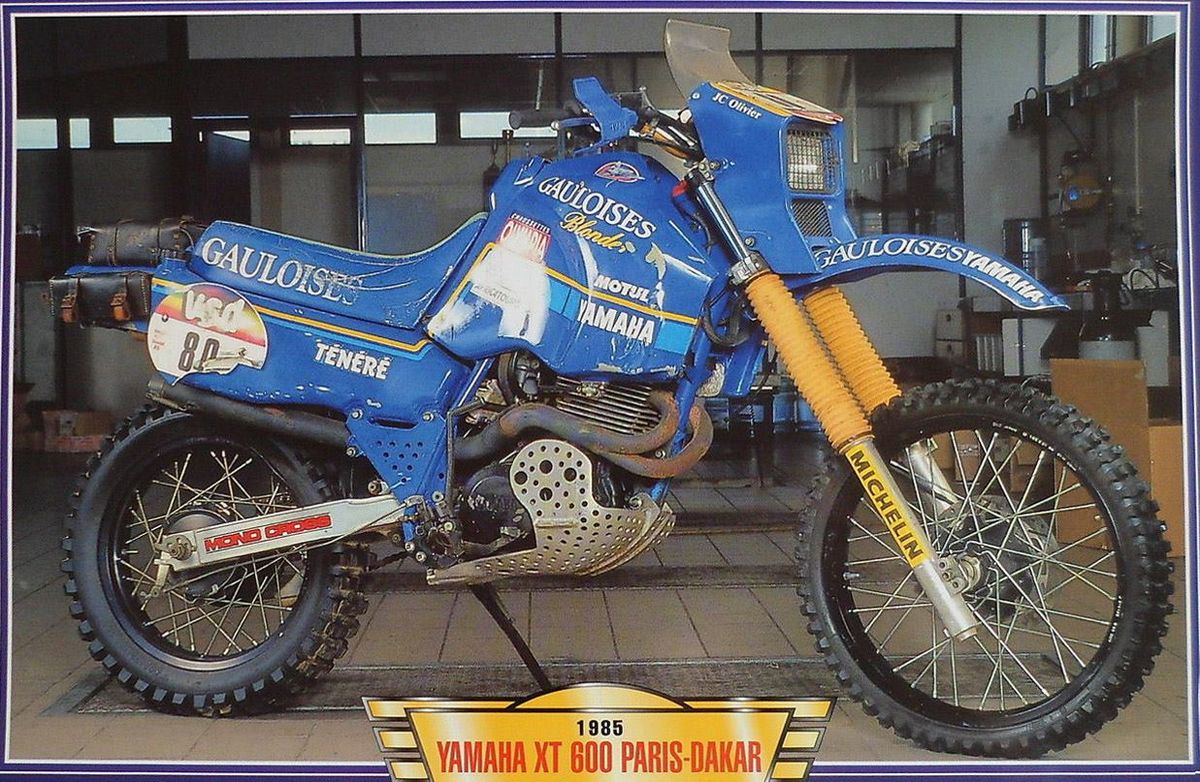
The engine had grown to 660cc, while the chassis was specifically designed to handle the extraordinary demands of racing across the Sahara. Fuel capacity increased to an astonishing 51 liters, carried in multiple tanks to improve weight distribution and rider ergonomics. Yamaha’s engineers worked to centralize the mass and make the machine easier to control with a heavy fuel load. The factory machine weighed approximately 146 kg dry.
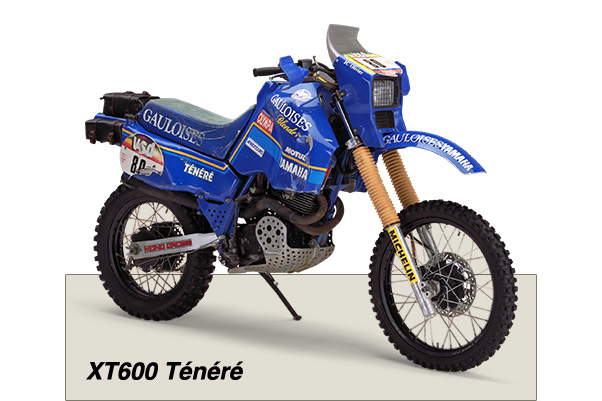
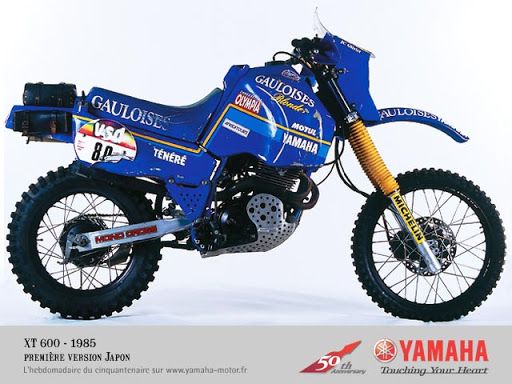
Olivier himself rode one of the Sonauto Yamaha machines, while an Italian effort operated by Belgarda fielded its own specially prepared XT600-based racers. The Italian machines were particularly interesting because they drew from several production and competition platforms, including the TT600, XT600 Ténéré, and Yamaha’s motocross models. They used reinforced frames, supplementary fuel tanks, and numerous rally-specific components.
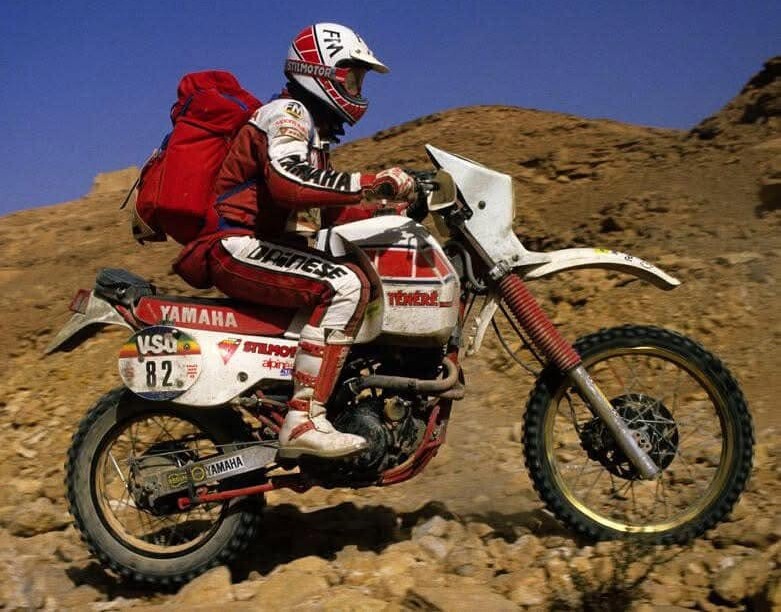
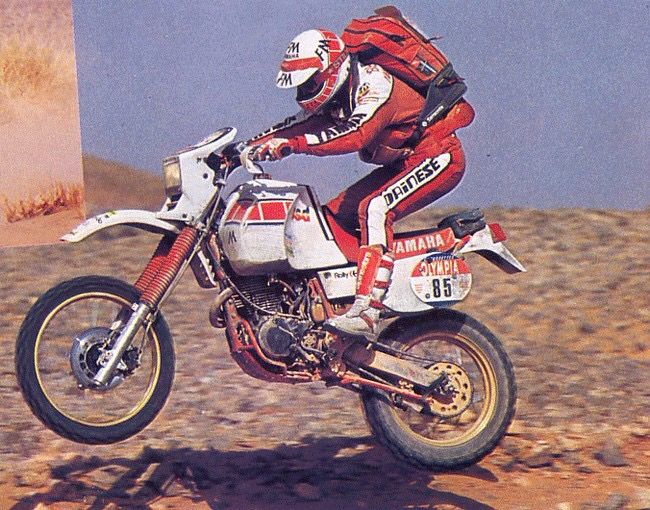
The result was one of Yamaha’s strongest Dakar performances of the decade.
1985 Paris–Dakar Motorcycle Results
| Position | Rider | Motorcycle |
|---|---|---|
| 1st | Gaston Rahier | BMW boxer twin |
| 2nd | Jean-Claude Olivier | Yamaha XT600 660cc prototype |
| 3rd | Franco Picco | Belgarda Yamaha XT600 |
| 4th | Andrea Marinoni | Belgarda Yamaha XT600 |
| 5th | Cyril Neveu | Honda |
Olivier’s runner-up finish was particularly meaningful. The man who had helped champion the Ténéré’s development had come within reach of winning the rally on a machine that embodied his vision. Picco and Marinoni completed the extraordinary Yamaha sweep of second through fourth positions.
The big single had proven itself against some of the fastest and most sophisticated desert racers in the world. It wasn’t enough to defeat Rahier’s BMW, but it demonstrated that Yamaha’s air-cooled thumper remained a serious contender.
1986: The Ultimate XT600 Dakar Machine
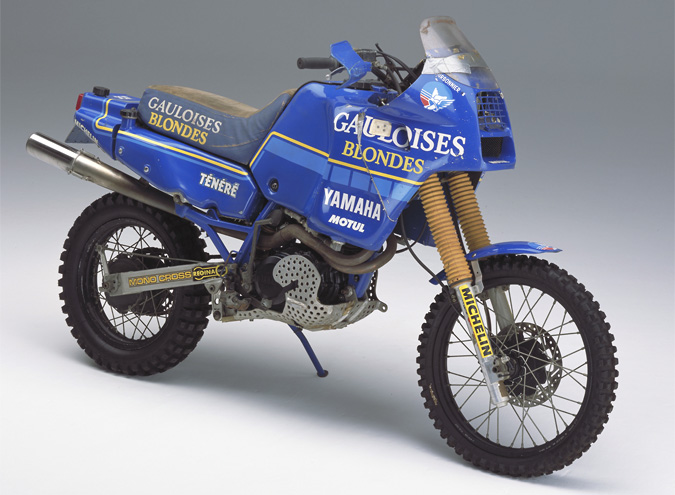
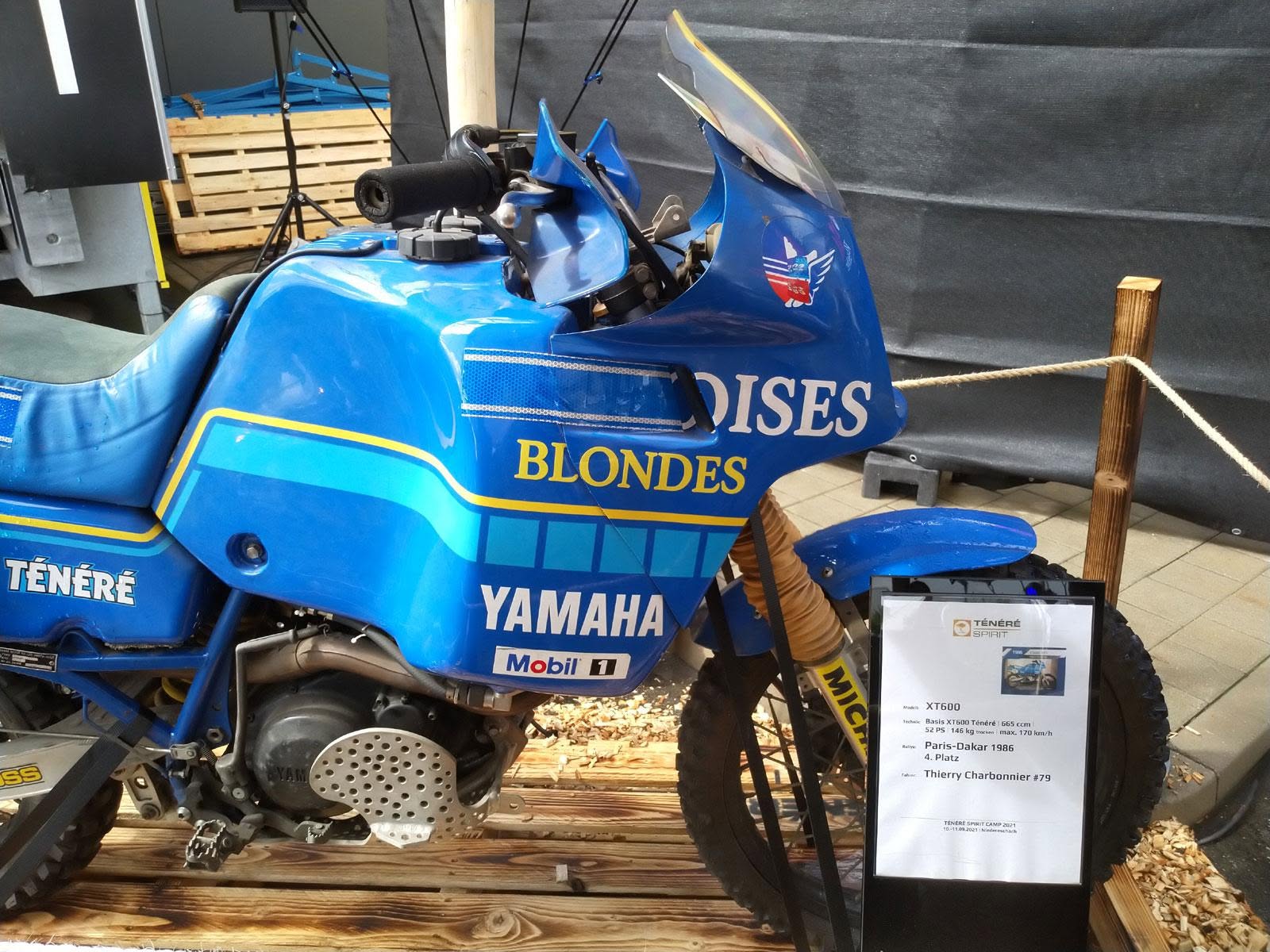
For the 1986 Paris–Dakar Rally, Yamaha refined the factory XT600 concept even further. The works machine now displaced 665cc, and its suspension incorporated developments from Yamaha’s contemporary motocross racers. Fuel capacity was approximately 52 liters, divided between a 33-liter main tank and a 19-liter rear tank.
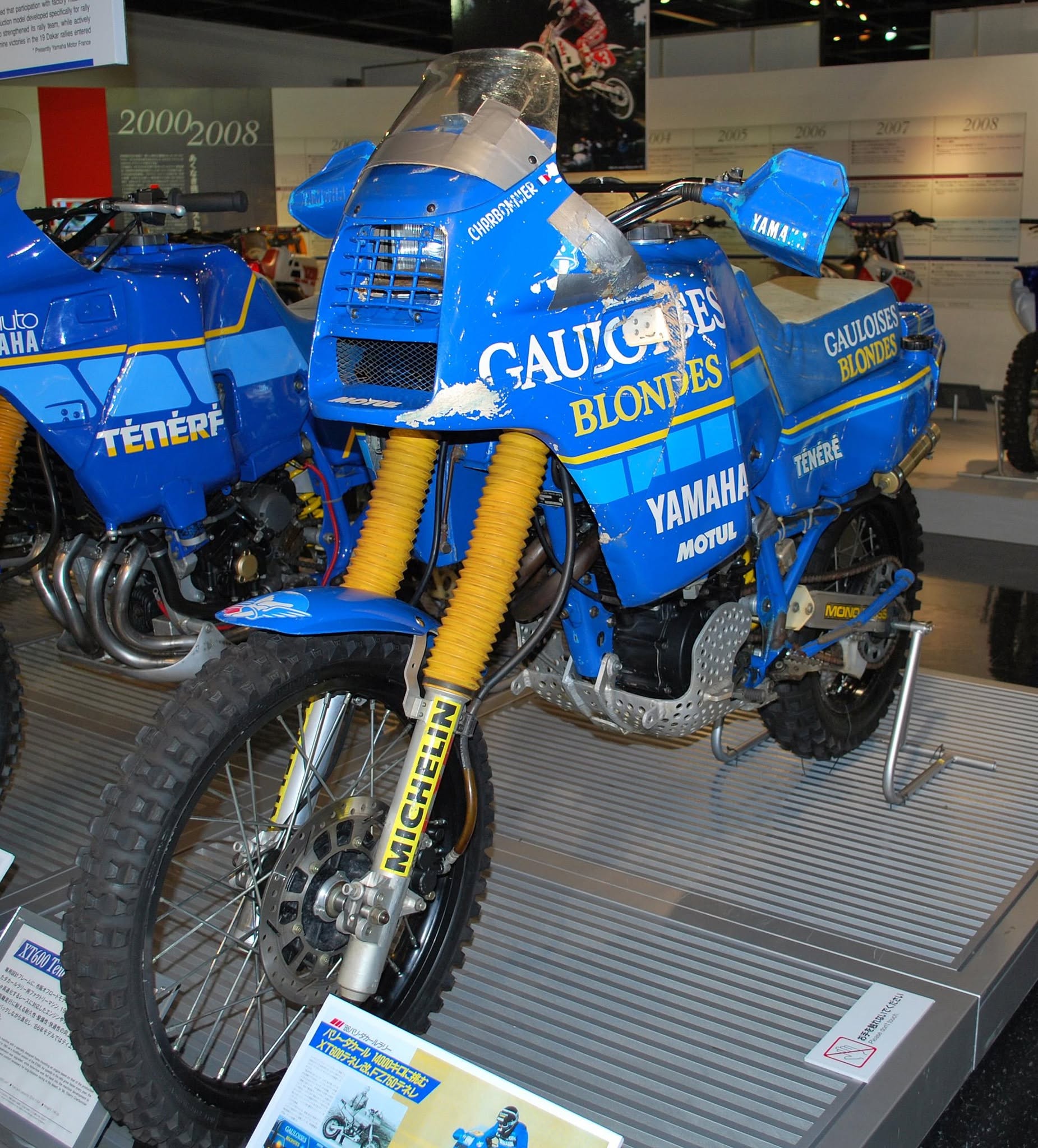
Yamaha’s engineers also paid increasing attention to aerodynamics, serviceability, and rider protection. The bikes were fitted with specialized bodywork and equipment designed specifically for racing across Africa. Ingenious details appeared on the factory machines, including engine guards that could serve as maintenance stands, tool storage integrated into supporting structures, and lighting arrangements optimized for long-distance navigation. The 1986 XT600 Ténéré factory racer weighed approximately 146 kg (322 lbs) dry — virtually unchanged from its predecessor despite the continued development.
 That year, Olivier experimented with a radically different solution to the BMW problem: a four-cylinder FZ750-powered Dakar machine, the FZ750 Ténéré. However, the additional weight and the challenges of transferring superbike performance to the desert made the experiment less successful than hoped.
The big single remained Yamaha’s most effective weapon. Thierry Charbonnier finished fourth in the 1986 Dakar aboard the 665cc XT600 Ténéré, demonstrating that the basic architecture still had considerable competitive potential.
Nevertheless, the writing was on the wall. Dakar was becoming an increasingly high-speed contest, and manufacturers were investing heavily in larger, more powerful, purpose-built machines. The era of the production-derived big single as a potential overall Dakar winner was gradually drawing to a close.
The Ténéré Evolves: 34L, 55W, 1VJ, and 3AJ
While Yamaha’s factory rally machines grew increasingly specialized, the production XT600Z continued evolving into a more capable and practical adventure motorcycle. The original 34L (1983–1984) established the formula: 595cc air-cooled single, 30-liter tank, Monocross suspension, and unmistakable desert-racer styling.
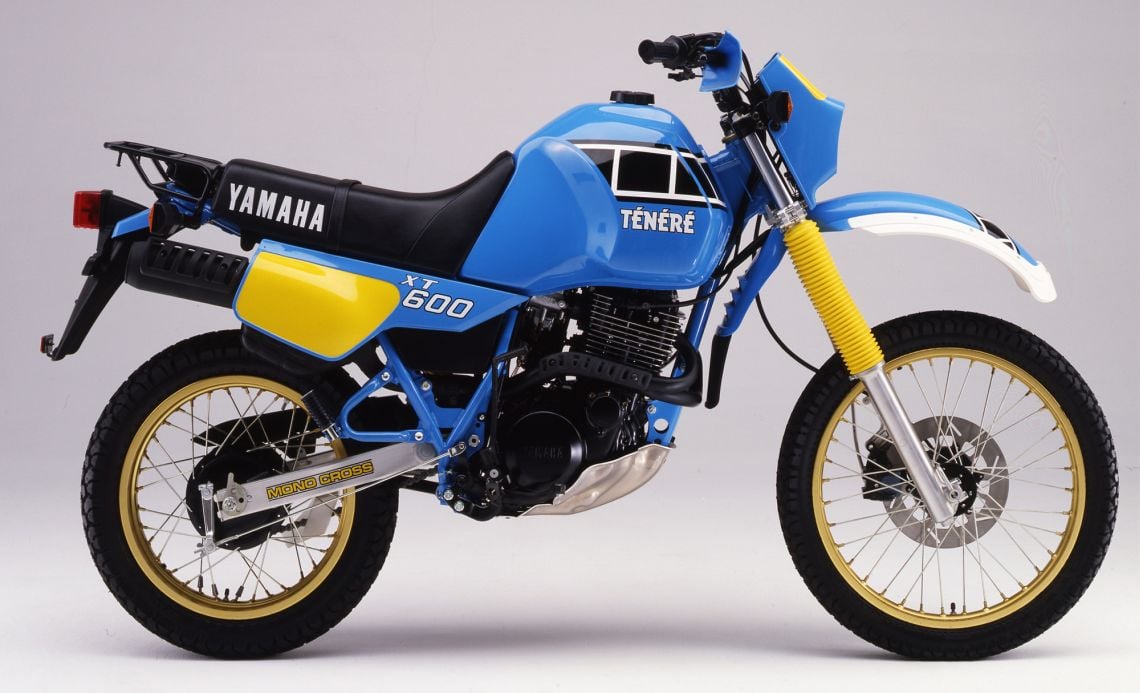
For 1985, the revised 55W received detail improvements, including changes to the front brake, wheels, seat, and other components, but retained the original model’s essential character.
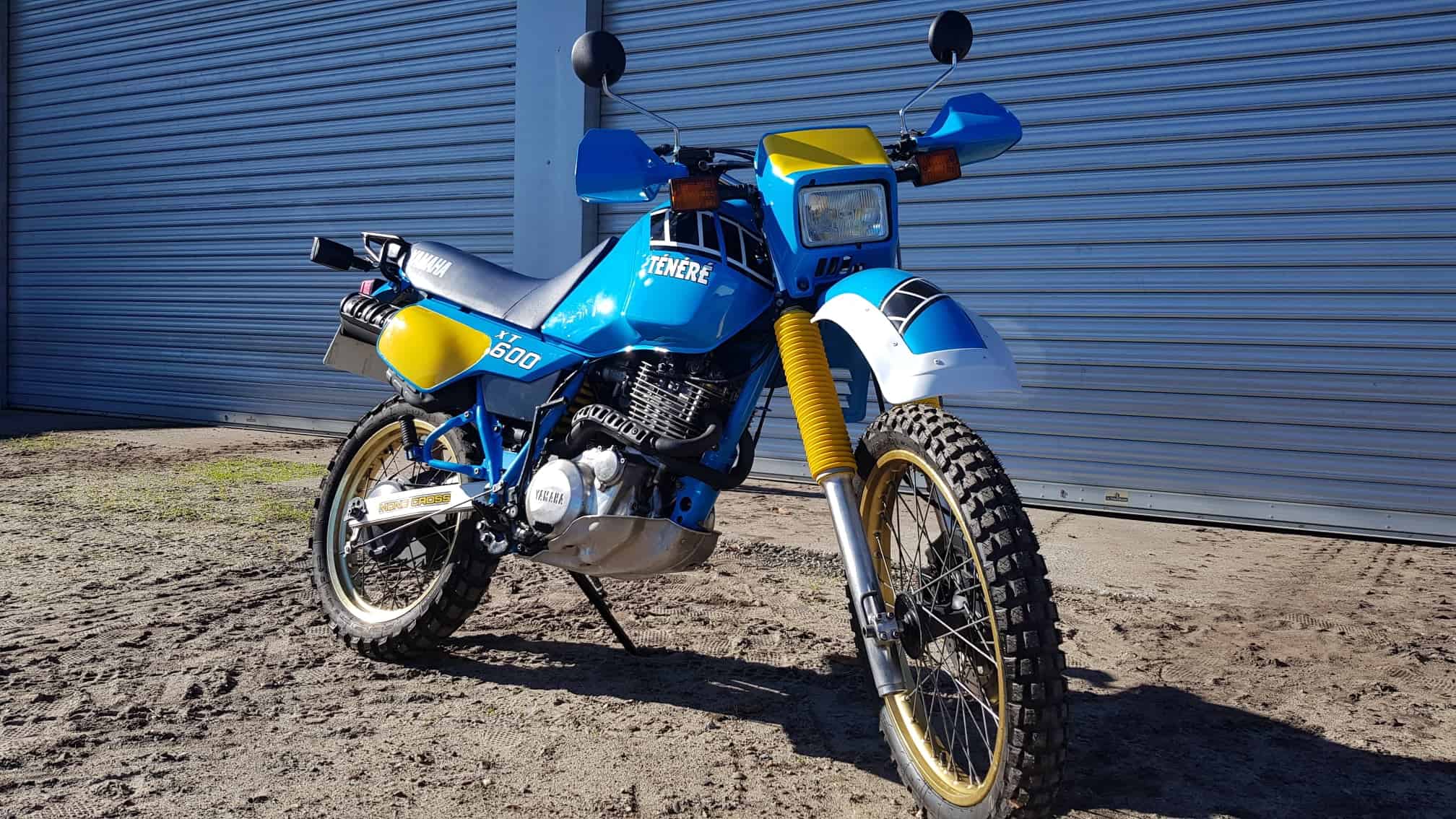
A more substantial redesign arrived for 1986 with the 1VJ. Inspired by the 1985 factory rally machines, the second-generation Ténéré adopted revised bodywork, updated suspension and carburetion, and a relocated airbox beneath the rear of the fuel tank. The fuel capacity was reduced to approximately 23 liters, but engine output increased to around 46 PS. Perhaps the most welcome change for everyday riders was the addition of electric starting.
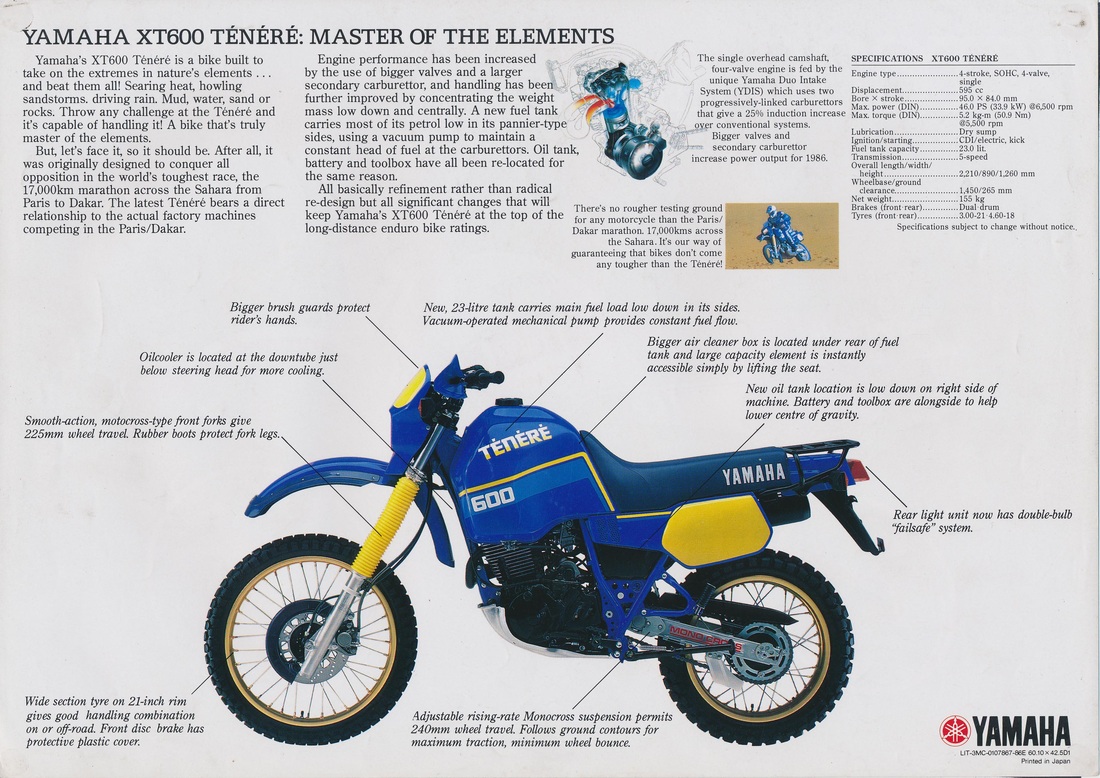 The 1VJ looked even more like a works Dakar machine, while becoming more convenient to use on the street. Then, in 1988, Yamaha introduced the 3AJ, featuring a frame-mounted fairing, twin headlights, a redesigned engine with improved cooling provisions, and a rear disc brake.
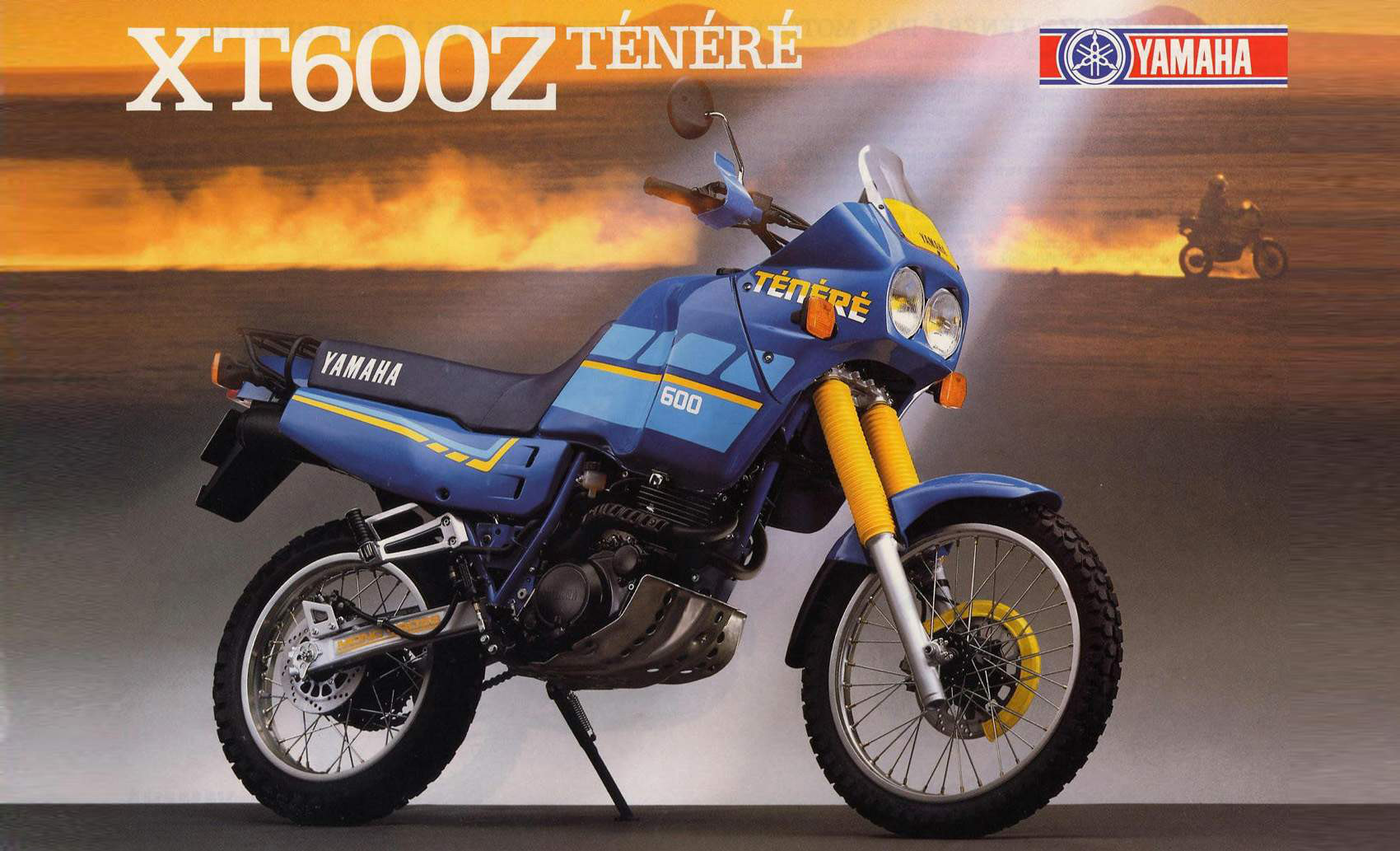
The once-minimalist Ténéré was becoming a more sophisticated long-distance machine, anticipating the increasingly road-oriented adventure motorcycles of the 1990s. Yet the essential concept remained: a robust, relatively simple single-cylinder motorcycle with enough suspension, fuel capacity, and durability to venture far beyond the pavement.
The Motorcycle That Helped Create the Adventure Class
The XT600Z’s greatest achievement may not have happened on the Dakar podium at all, but in the hands of ordinary riders. While BMW’s R80G/S had already demonstrated the appeal of a large-capacity motorcycle capable of combining road travel with off-road exploration, Yamaha approached the concept from a different direction.
The Ténéré was more closely aligned with the traditional enduro motorcycle: lighter, simpler, and visibly shaped by desert racing. Its huge fuel tank, long-travel suspension, and relatively modest weight made it particularly attractive to riders planning extended journeys through Africa and other remote regions.
It wasn’t merely a motorcycle dressed to resemble a Dakar racer. Its equipment addressed many of the same practical problems faced by competitors: limited fuel availability, rough terrain, mechanical durability, and rider fatigue. The formula proved enormously successful.
According to Yamaha, approximately 61,000 XT600 Ténérés were sold in Europe during the decade following its introduction, with more than 20,000 going to customers in France alone. Sadly, despite its popularity overseas, the original XT600Z was never officially imported into North America, where Yamaha offered related XT and TT models instead. As a result, the Ténéré has remained something of an exotic machine for American enthusiasts — familiar from photographs of European adventure riders and Paris–Dakar competitors, but rarely encountered in person.
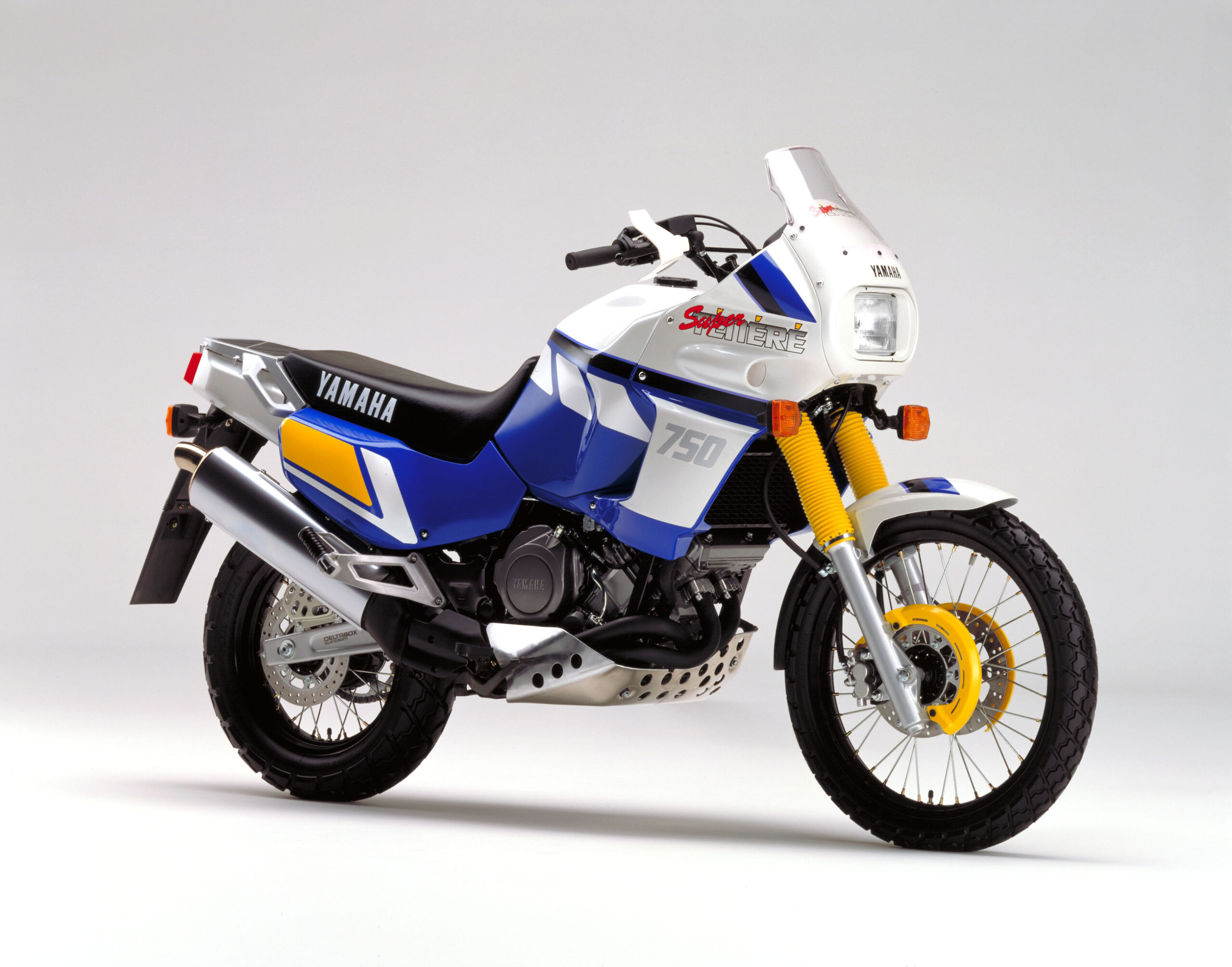 Its influence, however, was much broader than its original market. The XT600Z helped establish the adventure motorcycle as a distinct category, rather than simply an enduro bike pressed into touring service. Its descendants included the XTZ660 Ténéré, the twin-cylinder XTZ750 Super Ténéré, and eventually the modern Ténéré 700. All carried forward elements of the formula established by the original 34L.
Yamaha XT600Z Ténéré: Key Specifications
Original 1983 production model (34L); Yamaha’s period figures
| Specification | Details |
|---|---|
| Engine | 595cc air-cooled four-stroke single |
| Valve train | SOHC, four valves |
| Bore × stroke | 95 × 84 mm |
| Compression ratio | 8.5:1 |
| Carburetion | Yamaha Dual Intake System (YDIS) |
| Maximum power | 43 PS at 6500 rpm |
| Maximum torque | 49 Nm at 5500 rpm |
| Transmission | 5-speed |
| Starting | Kickstart |
| Fuel capacity | 30 liters |
| Suspension | Telescopic forks / linkage Monocross rear |
| Front brake | Hydraulic disc |
| Rear brake | Drum |
| Wheels | 21-inch front / 18-inch rear |
| Seat height | 890 mm |
| Wheelbase | 1430 mm |
| Claimed dry weight | 138 kg (304 lb) |
Specifications varied across model years and markets. Factory Dakar racers differed substantially from production machines. Photos courtesy of Yamaha Motor, Dave’s Brochures, and more.
More Dakar Legends
 Dakar Legends: Yamaha XT600Z Ténéré - The Big Single That Brought Paris–Dakar to the Streets… By the early 1980s, the Paris–Dakar Rally had become something more than a race. It was an obsession, especially in Europe, where images of motorcycles thundering […]
 2WD Dakar Legend: Yamaha WR450F 2-Trac - Remembering Yamaha x Öhlins’ Hydraulic 2WD Enduro… Every so often, a motorcycle appears that seems to point toward an entirely different future. The Yamaha WR450F 2-Trac was one of those machines. At first glance, it […]
 Dakar Legends: Gilera RC600 & RC750 Rallye - Italy’s Big Thumper in the Twin-Cylinder Era… By the late 1980s, the Paris-Dakar Rally was no longer a romantic expedition but an escalating arms race among the major manufacturers. Twin-cylinder prototypes were growing larger and […]
 Desert Bomber: BMW R80G/S Paris-Dakar Rally Bike - The Boxer That Changed the Desert Forever… In 1981, the Paris-Dakar Rally was still raw — more expedition than sport, more survival than spectacle. Riders crossed the Sahara on machines that were barely adapted from […]
 Desert Boxer: BMW R900RR Dakar Rally Bike - Dakar Legends: Last Roar of the Desert Bombers… In the late 1990s and early 2000s, BMW found itself at a turning point in rally-raid racing. The boxer twin had already written one of the most […]
 The Honda EXP-2: The Two-Stroke Desert Racer - Honda’s 400cc “Experimental 2-Stroke” Baja 1000 / Dakar Rally Bike… In the mid-1990s, as emissions regulations tightened worldwide and the future of two-stroke off-road bikes looked increasingly uncertain, Honda did something nobody expected: it built […]
 Dakar Legends: BMW F650RR Rally Bike - BMW F650RR: Grandfather of the Modern Rally Bikes… In the late 1990s, BMW quietly executed one of the most important strategic pivots in rally history. They developed and unleashed the BMW F650RR — a lean, […]
 The Four-Cylinder Dakar Bike: Yamaha FZ750 Ténéré - The Yamaha FZ750 Ténéré (0U26): Yamaha’s Radical Dakar Experiment… Before Super Ténéré, before big twins ruled the desert, before Dakar logic fully settled in, there was the sportbike-powered FZ750T. The 1986 Yamaha FZ750 Ténéré (0U26) […]
 Lucky Explorer: Cagiva Elefant Paris-Dakar Rally Bike - The Italian Powerhouse That Conquered Dakar… The Cagiva Elefant occupies a unique place in Paris-Dakar history. Where other manufacturers leaned on clinical efficiency or engineering conservatism, Cagiva brought Italian audacity to the table: massive V-twin […]
 Dakar Legends: Yamaha YZE750T Super Ténéré - The Bike That Built a Dakar Dynasty… The Yamaha YZE750T Super Ténéré is one of the most important motorcycles in rally-raid history. Purpose-built from the ground up for the Paris-Dakar Rally, it was the machine […]
 Desert Freight Train: Yamaha XTZ850R Paris-Dakar Rally Bike - The big twin that ruled the desert at the height of the Paris-Dakar era… In the early and mid-1990s, Yamaha dominated the Paris-Dakar Rally, the toughest off-road endurance race on the planet. At the heart […]
 Desert Queen: Honda NXR750 Paris-Dakar Rally Bike - Honda’s NXR750: Queen of the Desert… Few motorcycles in history can claim to have dominated the most brutal race on earth the way Honda’s NXR750 did. Built specifically to conquer the Paris-Dakar Rally, the NXR750 […]


