 The 488cc Dick Mann-Developed Two-Stroke Twin Desert Racer and Enduro…
In the late 1960s, before “adventure bike” was even a phrase, a small company in Schenectady, New York set out to build something radically different: a big-bore off-road twin aimed squarely at American desert racing and AMA competition.
It was the brainchild of OSSA’s US importer, John Taylor, who envisioned a street-legal bike capable of competing in a variety of disciplines:
“With the high degree of popularity of the 500cc competition class at that time, a Yankee in each competition class was envisioned: TT, flat track, road racing and enduro machines could be built using the low, although somewhat wide, Yankee powerplant. The engine could be built using any number of cylinder porting/crankshaft configurations, which would make it one of the most flexible basic engines ever.” –Cycle World
The result was the Yankee 500Z, a motorcycle that felt almost out of step with its time — part enduro, part scrambler, part street twin — powered by one of the most unusual engines ever fitted to a production dirt machine. It was bold. It was complicated. And it may have arrived just a little too early to find its audience.
An American Idea with Spanish Engineering
Watching the rise of desert racing and AMA competition in America, OSSA importer John Taylor envisioned a large-displacement off-road machine capable of competing in the 500cc class — something European brands had yet to fully explore. So he founded Yankee Motor Company and set out to build his dream bike, leveraging his OSSA relationships.
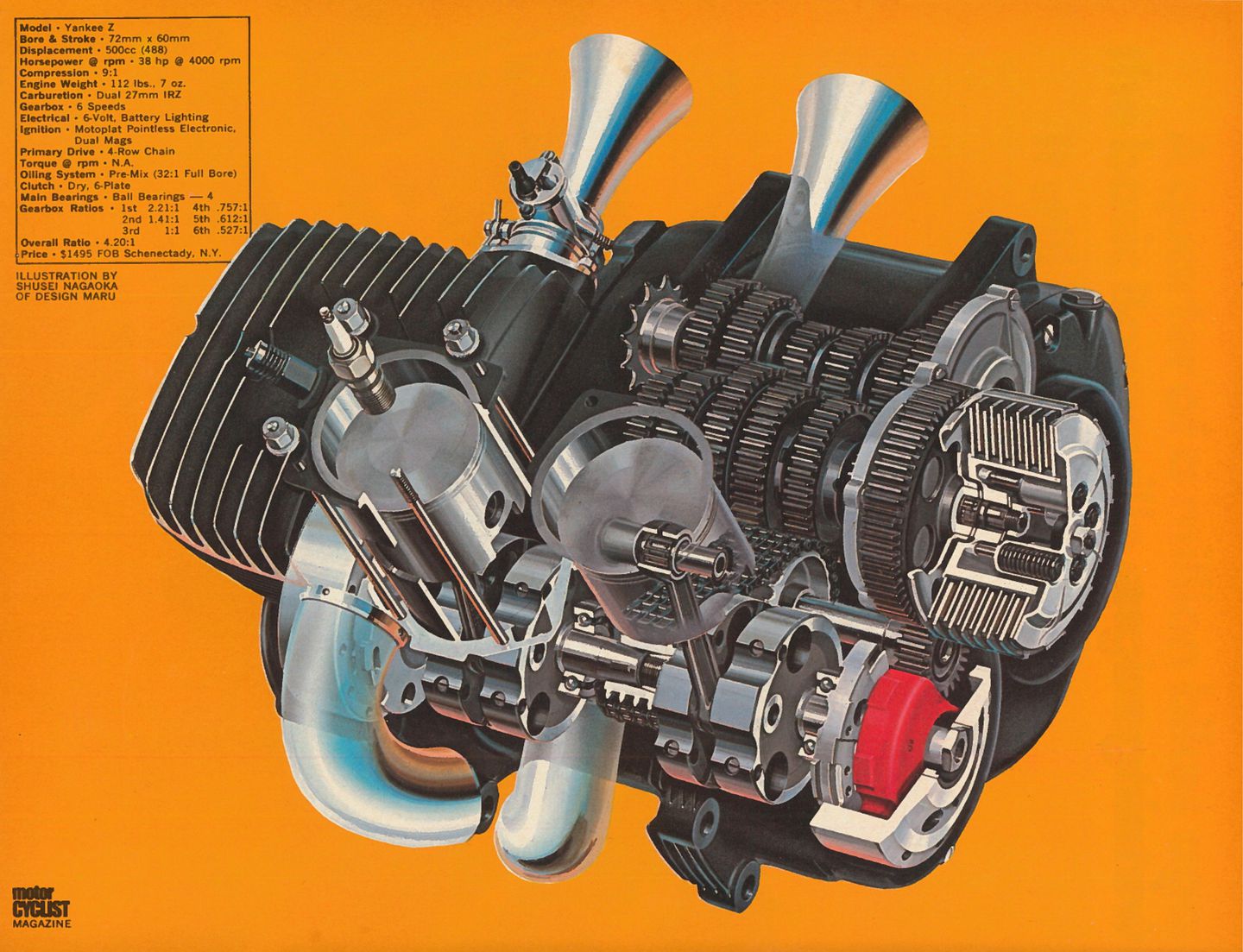
Rather than develop an engine from scratch, Taylor turned to OSSA’s chief engine designer Eduardo Giró to discuss the possibility of mating two 230cc OSSA single-cylinder engines in a shared crankcase to create a 500-class twin.
The result was a 488cc air-cooled parallel twin — unusual enough on its own, but even more distinctive thanks to its configurable firing order. Riders could alter the crank timing from a 360-degree to 180-degree configuration depending on how they wanted the engine to deliver power.
Meanwhile, Taylor enlisted AMA Grand National champion and motocross pioneer Dick Mann to help develop the chassis.
“Most of the initial development work in the chassis/handling department was performed by Dick Mann, who is considered by many to be the best all-around motorcycle rider in the United States… Drawing from past experience, Dick set out to make the Yankee more than just suitable; it was to be the best motorcycle of its size in the world.” –Cycle World
From the beginning, the project was something of a transatlantic hybrid:
- Engine: Designed in Spain by OSSA
- Frame and assembly: Completed in New York
- Chassis input: Influenced by American racer Dick Mann
The goal wasn’t just outright speed — it was versatility. Taylor envisioned a machine capable of tackling desert races, enduros, and (with minor modifications) flat track and TT competition in a single street-legal package…and created it.
“Taylor had produced his dream bike, one that you could ride across the state to compete in an enduro and ride home again. Said Cycle World, ‘John had accomplished exactly what he set out to do. He had updated the Triumph TR-5.'” –Motorcycle Classics
Built Like Nothing Else
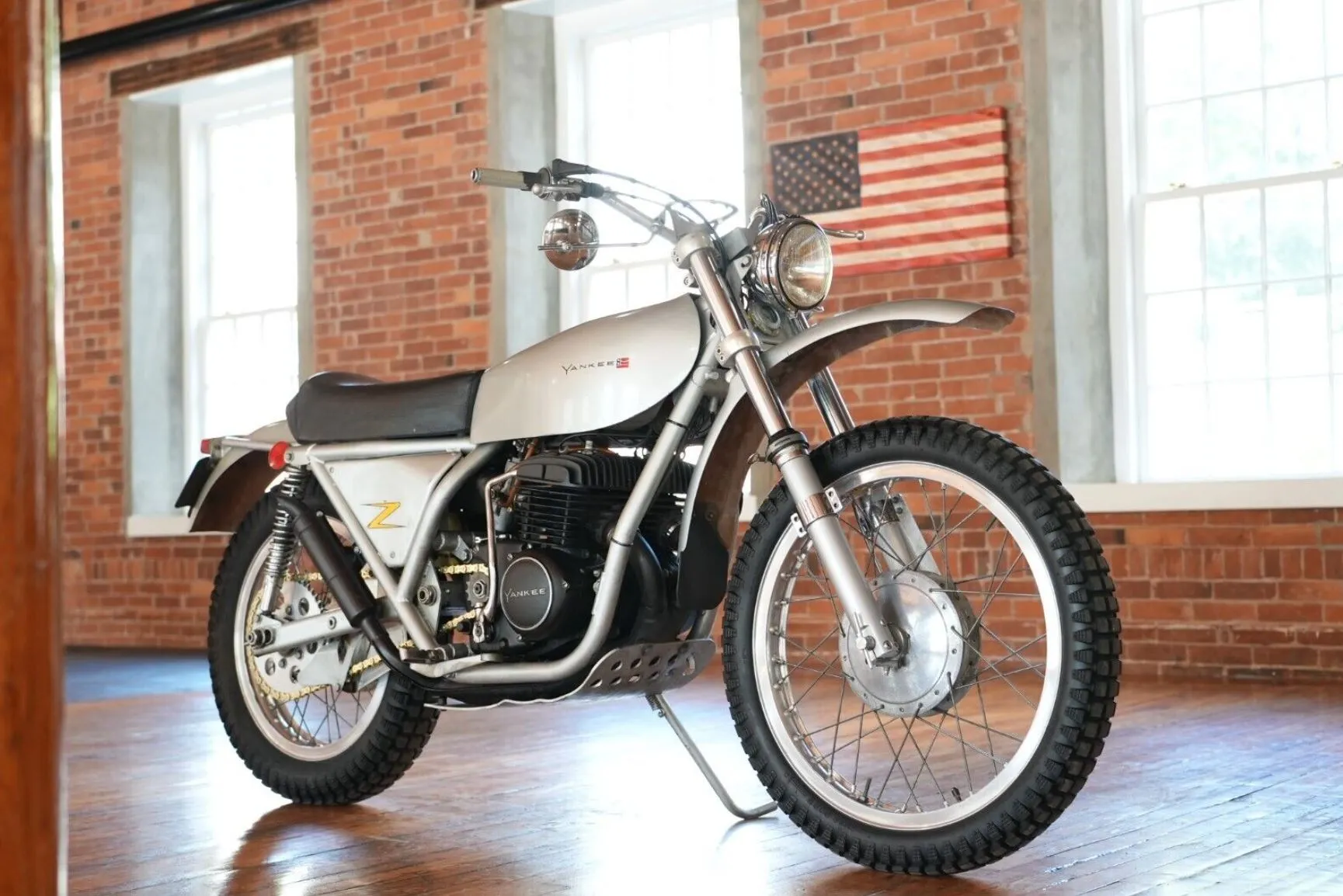
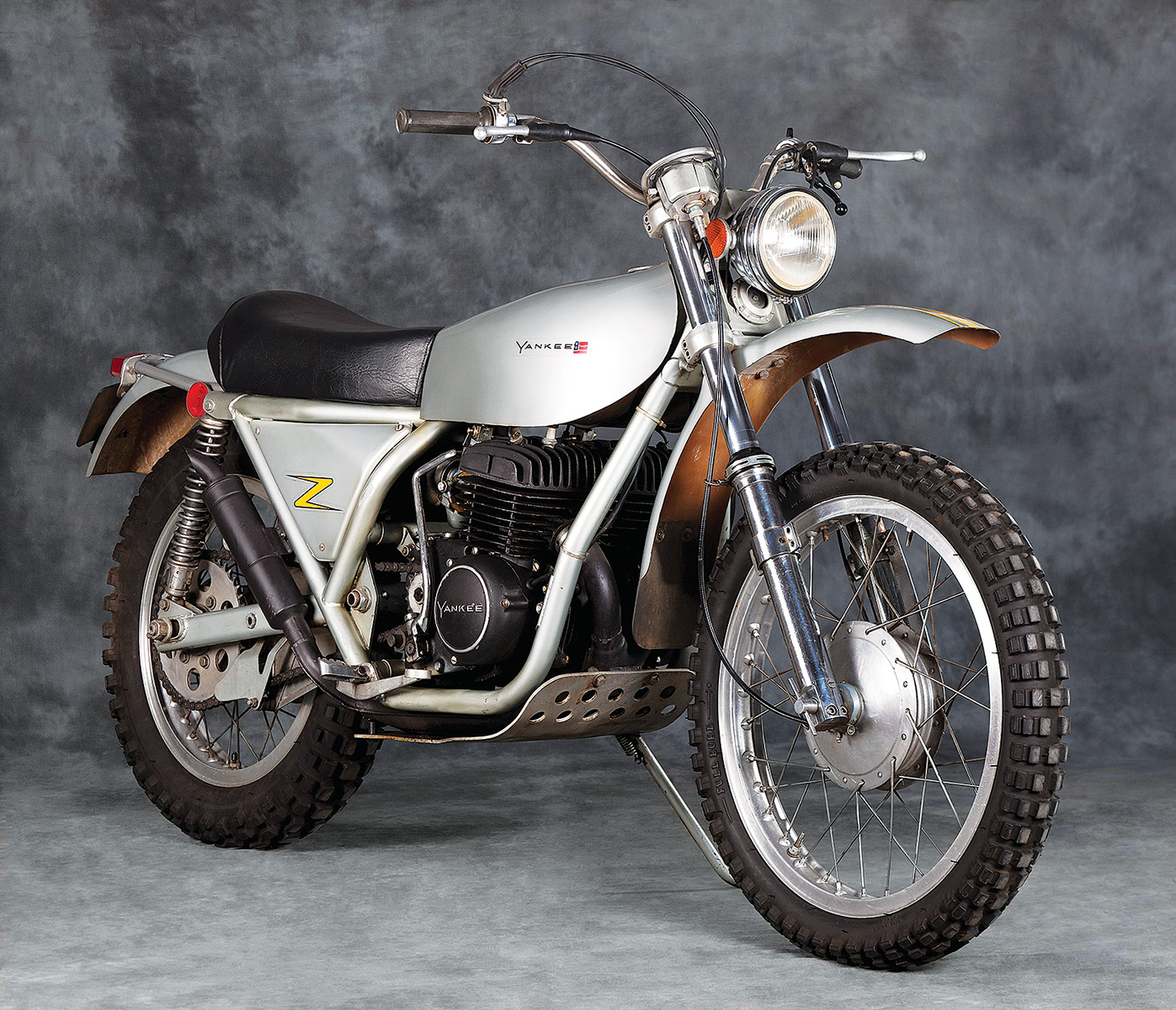
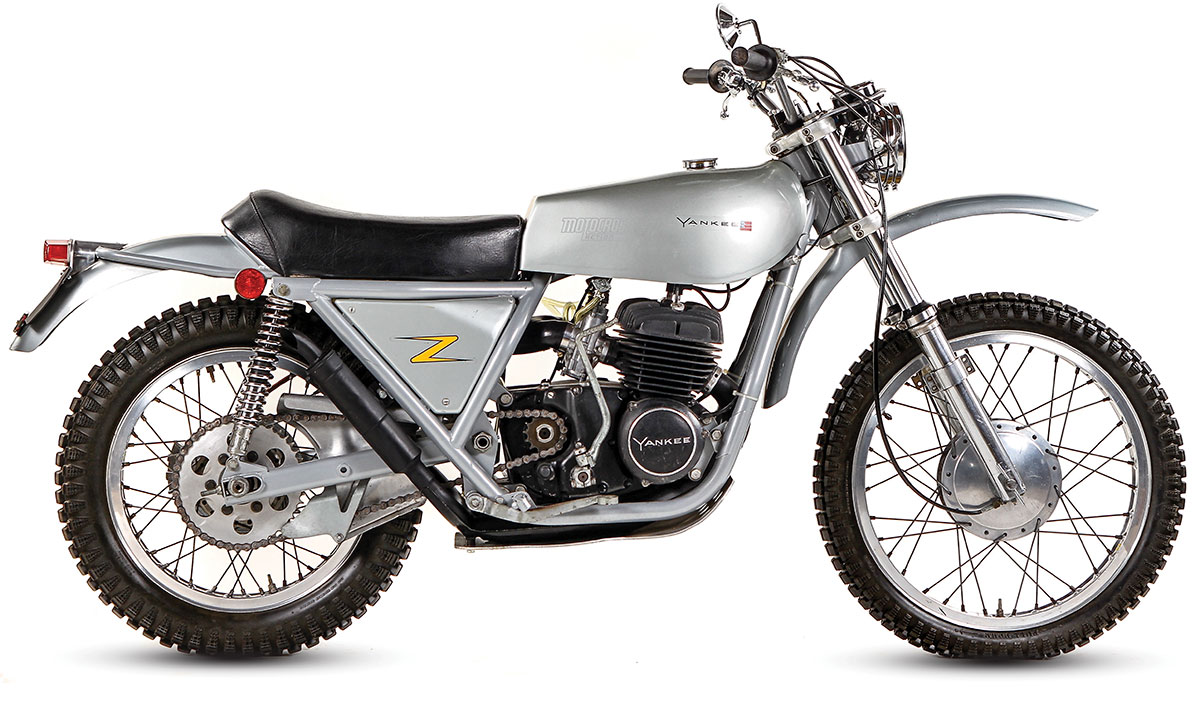
Even by early-’70s standards, the Yankee 500Z was packed with unconventional engineering choices. The 4130 chromoly frame was TIG-welded, the swingarm used oval-section tubing, and the suspension featured large-diameter forks that looked substantial compared to their contemporaries.
“Massive, beautifully constructed and rugged enough to withstand a parachute drop are terms that best describe the frame and swinging arm.” –Cycle World
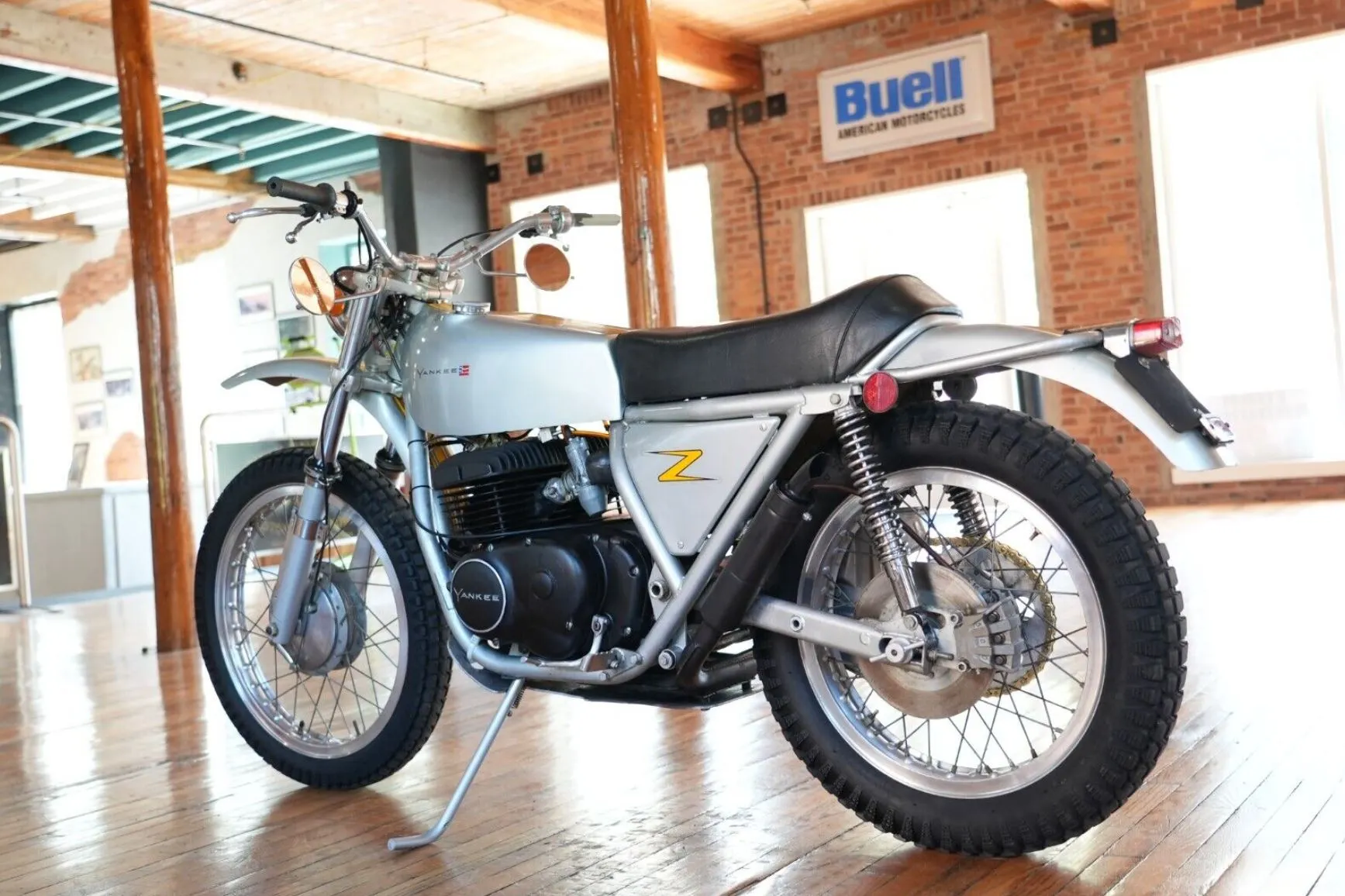
The bike is often cited among the earliest off-road motorcycles to feature a production rear disc brake — a remarkably forward-thinking choice at a time when most competitors still relied on drums. Underneath the sleek tank and long seat sat one of the most complex drivetrains of any dirt bike of the era:
- Twin-cylinder two-stroke engine
- Six-speed gearbox
- Dual ignition systems and alternators
- Multi-row primary chain driving a jackshaft
The six-speed transmission, which came from OSSA’s 250cc rotary-valve single-cylinder road racer, was praised for allowing the bike to tackle everything from low-speed trials sections to 90-mph highway blasts.
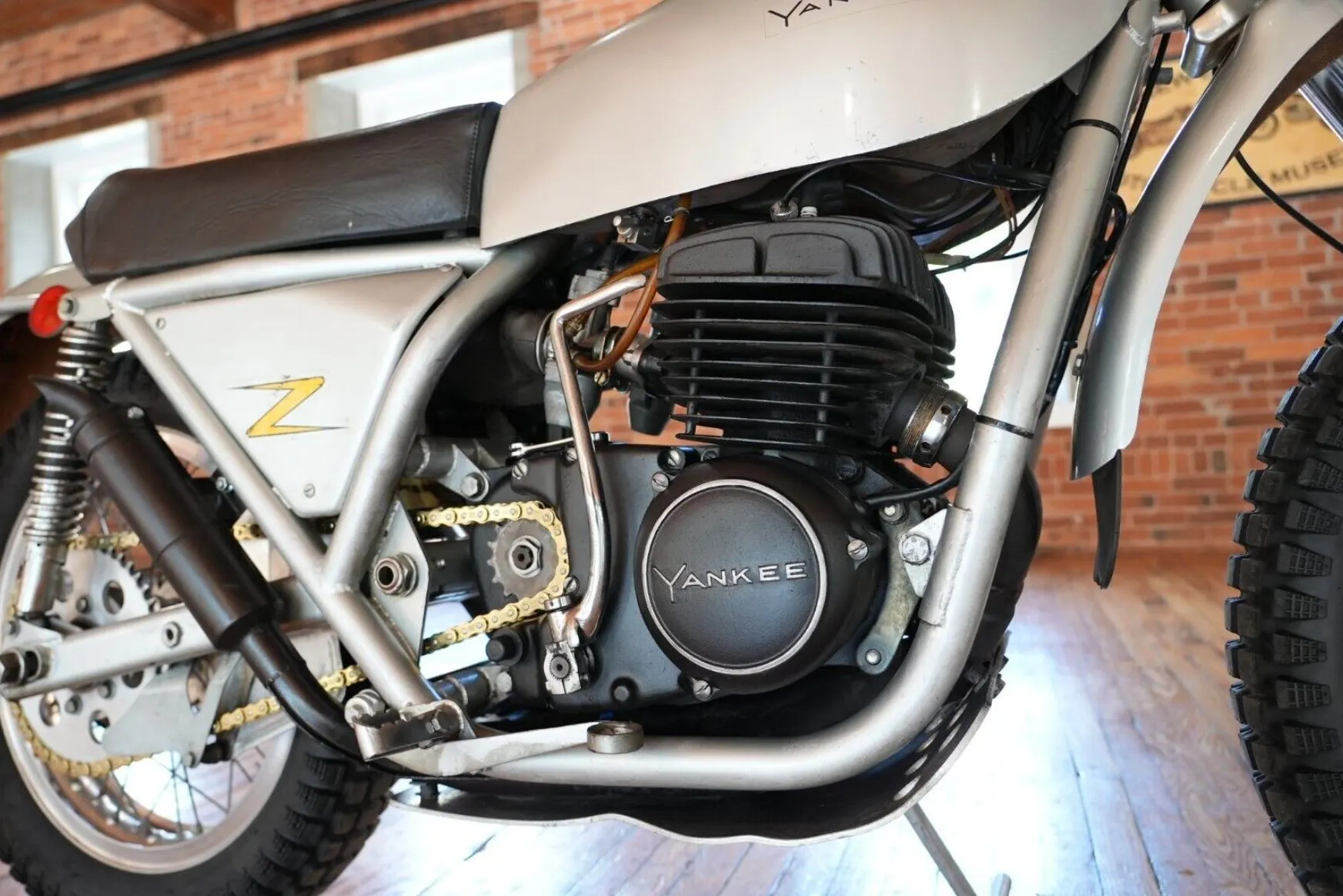
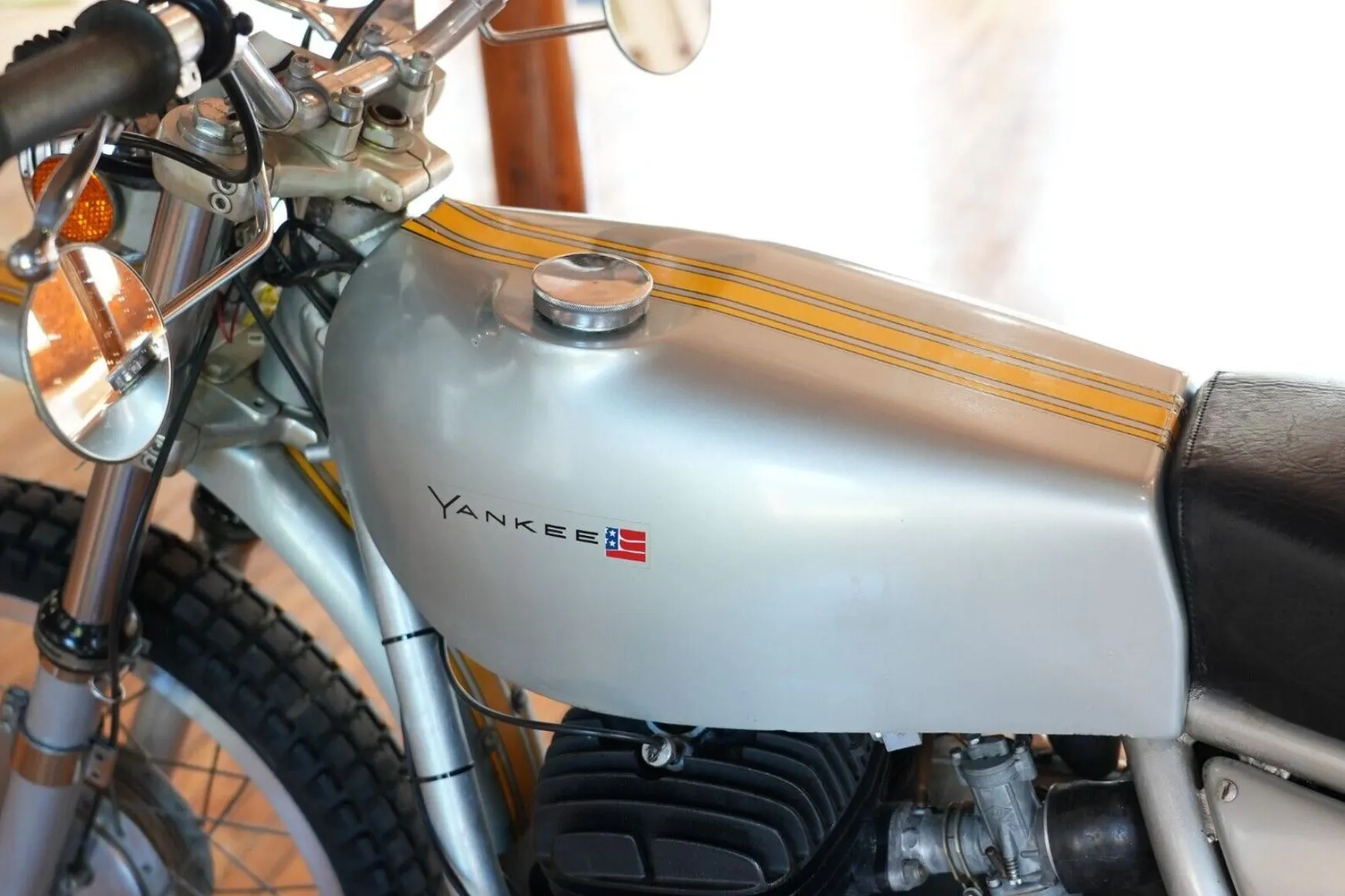
Everything was built with durability and long-distance desert use in mind…though that robustness inevitably added weight.
Adjustable Firing Order
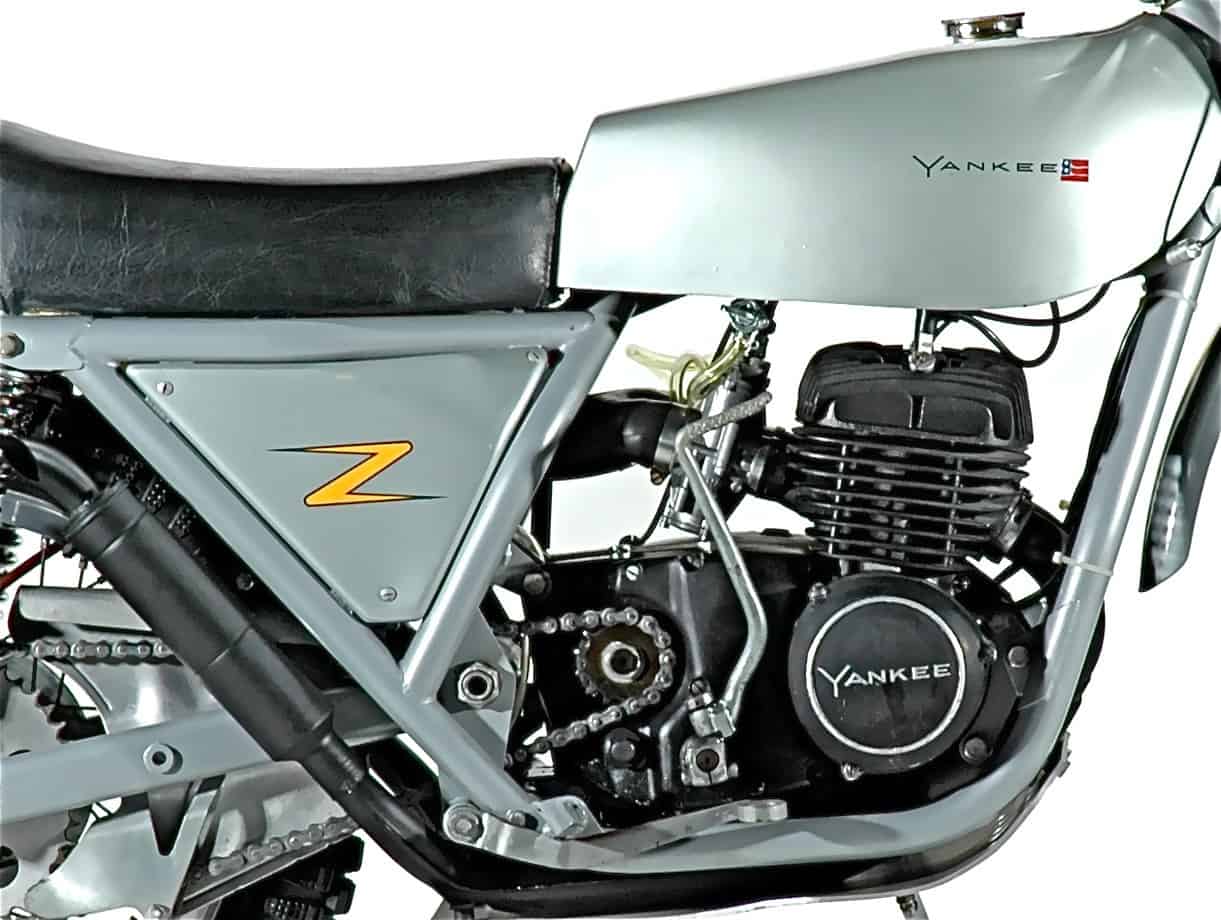 One of the most fascinating aspects of the Yankee 500Z was its configurable crankshaft timing — a feature almost unheard of on production motorcycles of the era. Because the engine was effectively two OSSA singles paired together, riders could alter the firing sequence between two distinct personalities.
360-Degree (“Twingle”) Timing:
- Both pistons rise and fall together
- Power pulses arrive together, replicating a large-displacement single
- Strong traction feel in loose terrain
- Distinctive exhaust note and vibration character
180-Degree Timing:
- Pistons move opposite each other
- Smoother power delivery
- Higher-revving character
- More road-oriented feel
“The 360° and simultaneous firing order this mill should be considered a ‘Twingle.’ The configuration was settled upon after early 180-degree tests produced a power pulse every half revolution resulting in instantaneous power. The smooth and immediate power caused the rear wheel to break loose with the slightest nudge of the throttle.” –Motorcyclist
To support the dual-ignition system, the engine used twin Motoplat electronic ignitions and separate coils for each cylinder. This flexibility allowed riders to tailor the bike for desert racing, enduro work, flat track, or even road racing — decades before adjustable ride modes became commonplace.
Fast, Heavy, and Ahead of Its Time
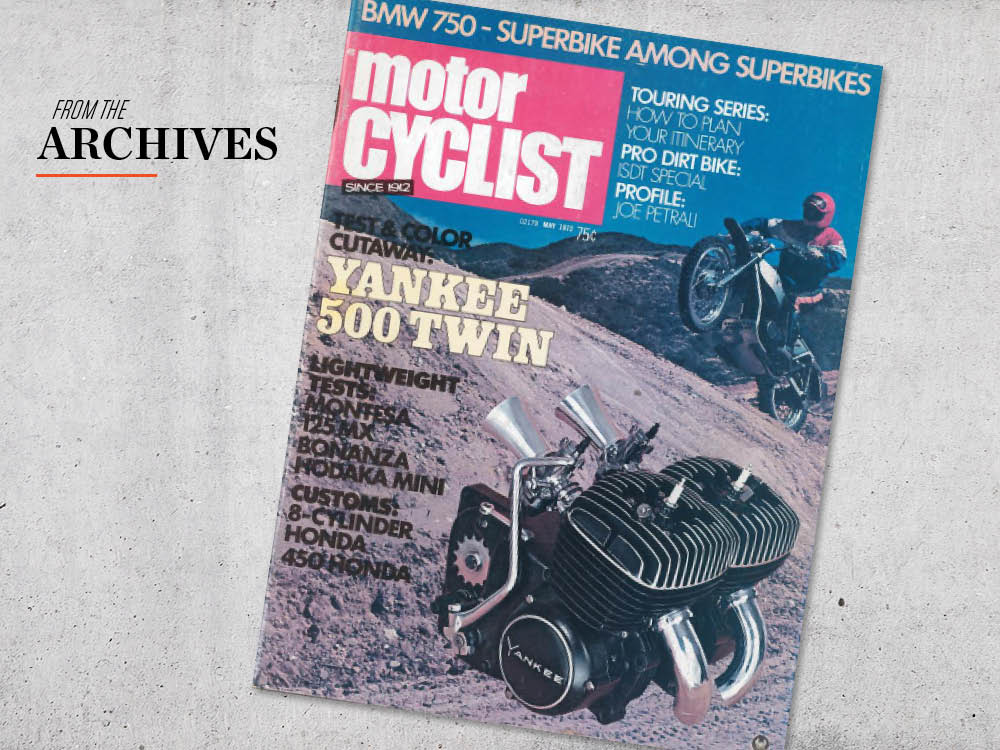 On paper, the Yankee 500Z sounded like a dream machine. Early claimed output hovered around 40 horsepower in mild tune, with period factory materials often citing 55-58 hp. In practice, however, the bike’s weight — around 158 kg (roughly 350 pounds) — made it heavier than many competitors, especially as lightweight Japanese two-strokes rapidly evolved through the early 1970s.
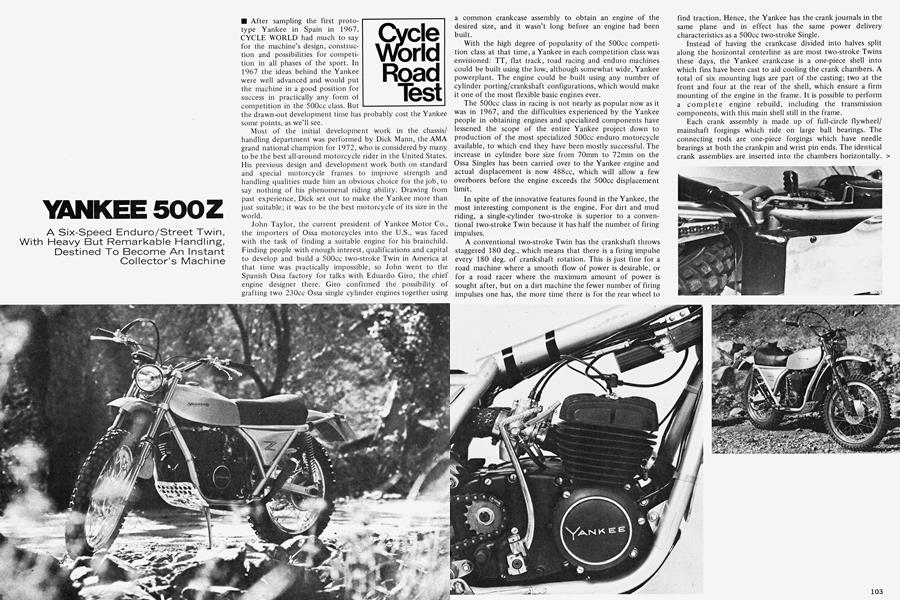
Period road tests praised its stability, high-speed composure, rugged construction, and status as an “instant collector’s item.” However, they also noted that the lengthy development process had left the 500Z entering a market that was changing almost monthly.
By the time the Yankee reached broader production, Yamaha, Suzuki, and Kawasaki were introducing lighter, more focused off-road machines at competitive prices. The Yankee suddenly felt less like the future and more like a fascinating alternative path.
Short Production Run, Lasting Legacy
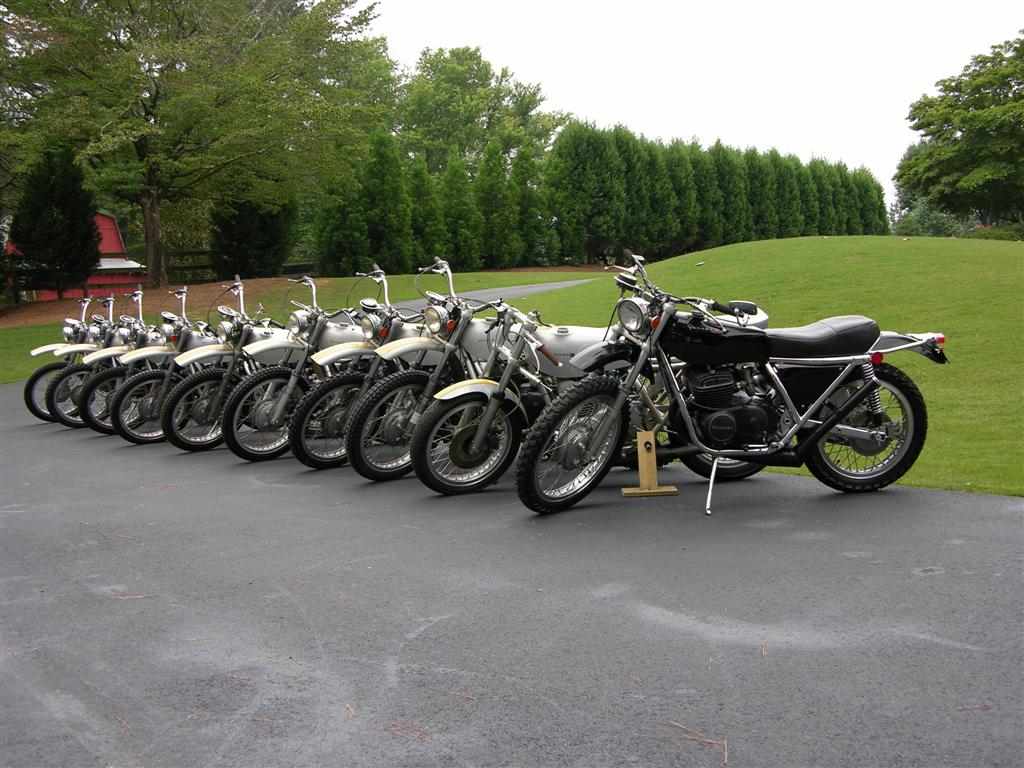 Production of the Yankee 500Z lasted only a few years, with roughly 760 units built between 1971 and 1973. Currency shifts, rising costs of imported components, and fierce competition all contributed to its short lifespan. Yet despite its commercial struggles, the Yankee carved out a unique place in motorcycle history.
“Sounds like a Top fuel dragster at the drag strip sitting there idling…” -one enthusiast
Many enthusiasts and collectors today view it as an early precursor to modern big-bore adventure machines — a rugged twin designed for long-distance off-road travel long before the category existed. And perhaps that’s the best way to understand the Yankee 500Z: not as a failed experiment, but as a motorcycle that explored an entirely different vision of what off-road performance could look like.
Yankee 500Z: Specs
Manufacturer: Yankee Motor Company (USA)
Years Produced: 1971–1973
Engine: 488cc air-cooled two-stroke parallel twin (OSSA-designed)
Power: ~40-58 claimed hp (approaching 60+ hp in full competition trim)
Carburetion: Dual carb
Transmission: 6-speed
Frame: 4130 chromoly steel
Weight: Approx. 158 kg / 348 lbs (half tank)
Brakes: Early rear disc brake application
Production Numbers: ~760 units
More Two-Strokes
 Czech Mate: Liquid-Cooled Jawa 350 Restomod - Roman Juriš fulfills a two-wheeled dream of his youth… For the latter half of the 20th century, many of us took for granted that we could acquire and ride some of the hottest, most iconic […]
 The Gromlin: 28-hp Street-Legal Two-Stroke Minibike - Dan Corkin’s home-built, 134-lb mini street tracker… Since the introduction of the Honda Grom (MSX125) in 2014, we’ve seen a resurgence in the popularity of street-legal minibikes. Honda’s “miniMOTO” lineup now includes the Monkey 125, […]
 The Good Kind of Dangerous: Full Carbon Yamaha RD350 YPVS - From Brothers Garage: “Black Widow” 300-lb Yamaha RD350 Restomod… In 1983, Yamaha released the RD350 YPVS — aka RZ350 or RD350LC II — a two-stroke giant-killer destined to become one of the most iconic and […]
 Suter MMX 500: 195-HP Two-Stroke GP Bike - 195 Horsepower, 280 Pounds, Two Strokes: The Spirit of the 500cc “Unrideables” Reborn… For a generation of motorcycle racing fans, the 500cc two-stroke Grand Prix bike represents something close to the ultimate racing motorcycle. The […]
 ATK 700 Intimidator: The 78-hp 700cc Two-Stroke Dirt Bike - 685cc, 78 Horsepower, 238 Pounds: One of the most outrageous production dirt bikes ever offered in America… There was a time when a 500cc two-stroke motocross bike was the king of the dirt. Honda’s CR500 […]
 Bimota Vdue: 500cc Two-Stroke GP Bike for the Road - Bimota’s first homegrown engine powered one of the wildest superbikes of the 1990s: a featherweight 500cc V-twin smoker with direct fuel injection, carbon bodywork, and GP aspirations… Imagine walking into a motorcycle dealership in the […]
 Street Devil: Yamaha RX-King 135 Enduro - “It’d be way cooler if it had a two-stroke engine…” Some builders focus more on the art and fabrication of a build, some the performance, and some concentrate on what’s arguably the most important part […]
 Pure Fun Survivor: Yamaha RD400 Daytona Special - Purists Beware: Tim Coughlin’s 1990s-Style RD400 Road Ripper… In 1979, with the motorcycle world hurtling fast toward four-stroke dominance, Yamaha released the Yamaha RD400F Daytona Special — a lightweight, giant-killing smoker that would be one […]
 Five-Cylinder Smoker: 1972 Kawasaki S2 415 - Up for Auction: 1972 Kawasaki S2 415 with Allen Millyard Engine… Allen Millyard has a gift for making the impossible look factory. That has always been part of his magic. Many builders can build a […]
 Veloce Ethereal: 500cc Two-Stroke Café Racer - 145-hp 500cc Two-Stroke Ethereal from Veloce Motorcycles… In the modern world, a 500cc two-stroke intended for road use seems almost unthinkable. However, that’s exactly what Oxfordshire-based Veloce Motorcycles is promising with the Ethereal — a […]
 Veloce Aperion: 280-BHP 1000cc Two-Stroke Café Racer! - Veloce Motorcycles unveils a 1000cc X8 two-stroke café racer! Built by Oxfordshire-based Veloce Motorcycles, the Aperion is a 1000cc, eight-cylinder, two-stroke naked bike — or perhaps more accurately, an engineering provocation with lights, wheels, and […]
 “Is Pepsi Okay?” Suzuki RGV250 Kevin Schwantz Tribute - Nabspeed Moto’s Kevin Schwantz Pepsi RGV Replica… The legendary Kevin Schwantz earned the title of “Wheelie King” at the 1988 Macau Grand Prix, where he shaved an incredible 7 seconds off the outright lap record […]
 Back from the Dead: 1973 Wassell Antelope - 1984sc resurrects a circa ’73 Wassell Antelope after 30 years in a basement… Today, Wassell Limited is a leading supplier of classic British motorcycle parts, but the company’s origin story traces back to one man: […]
 Seventies Smokeshow: Spondon Kawasaki H1 500 Triple - Tarty Two-Stroke: Manx Road Racer and Toolmaker Builds a 70s-Style Smoker… No street bike is as infamous as the Kawasaki Triple. For the 1969 model year, the original H1 Mach III 500 came howling and […]
 Norsaki: Norton Dominator x Kawasaki Two-Stroke Triple! - From Davmomoto: 1955 Norton Dominator Meets 1974 Kawasaki S3 Mach II… Yes, you can believe your eyes. What you see before you is a 1955 Norton Dominator with a featherbed frame mated to a 1974 […]


Another failed experiment,,just not quite ready for the masses
Read the magazine coverage in real time. Currently own a Triumph Scrambler 1200 Xc, previously owned a ‘69 XLCH-engined desert sled/enduro “bitsa”, still want a Yankee. Lord, I miss two-strokes.
Also would like a Bultaco Alpina 350, if you please.
I AM VERY MUCH PLEASE TO SEE YANKEE DESIGN & AS I AM AN ENGINEER SO I WILL WORK IN YANKEE BIKE FUTURE ENGINE DEVELOPMENT PROGRAMME.THANK YOU.
The Yankee was a failure! I was an OSSA dealer at the time. Motocross was hot! I raced an OSSA Stilletto which was badly in need of an upgrade. Taylor persuaded OSSA to devote all of their limited resources to his project, to the detriment of an upgraded 250’MX bike. I never heard of any Dick Mann influence. I sold one example of the Yankee and it was constantly at the shop for repair. If the OSSA Phantom had hit showrooms a year earlier it could have dominated. The Yankee is in the same category as the Cooper, a failed vanity project!