
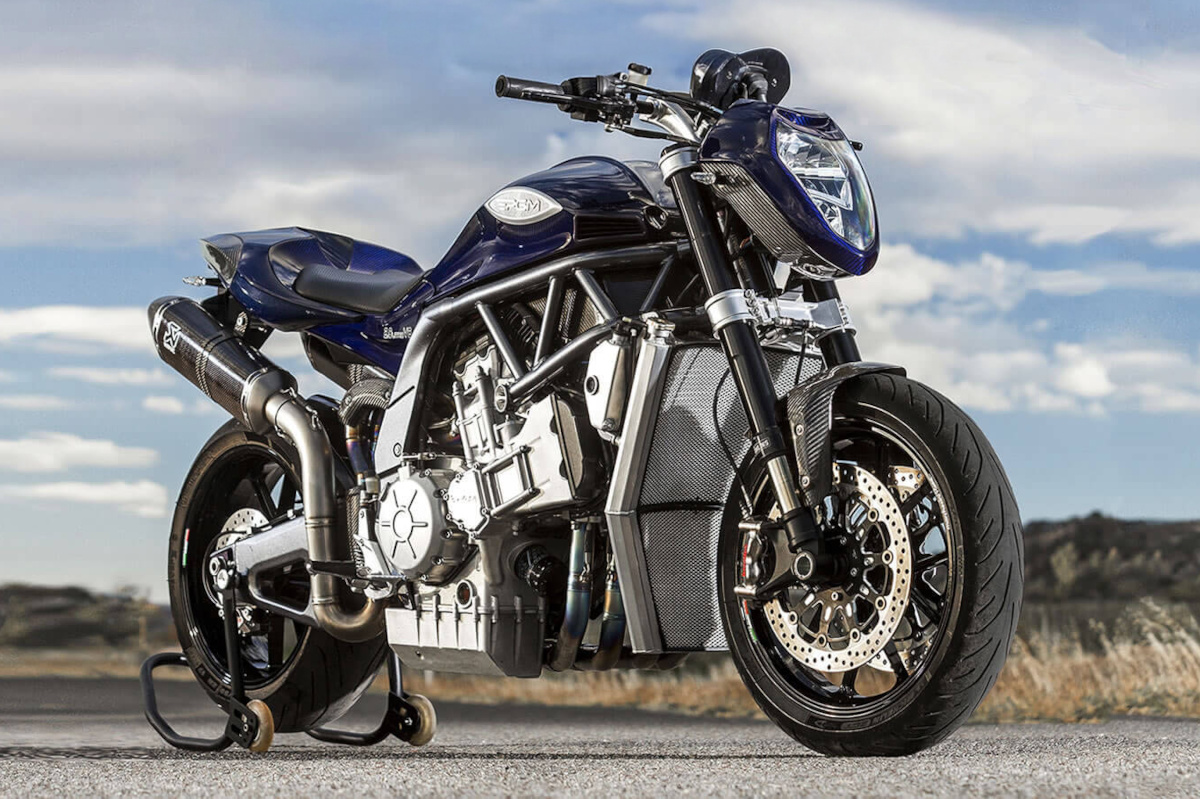
 2000cc, 334 horsepower, 534 lbs, and a V8 built from two Yamaha R1 engines…
Most V8 motorcycles begin with an automobile engine. That approach has produced everything from Boss Hoss cruisers to one-off specials, but it also brings an obvious problem: car engines tend to be very large and very heavy. Australian engineer Paul G. Maloney took a different tack. His PGM V8 would use motorcycle engine architecture from the beginning. The resulting 1996cc machine produced a claimed 334 horsepower at 12,800 rpm and 214 Nm / 158 lb-ft of torque at 9,500 rpm, yet weighed just 242 kilograms / 534 pounds fully fueled.
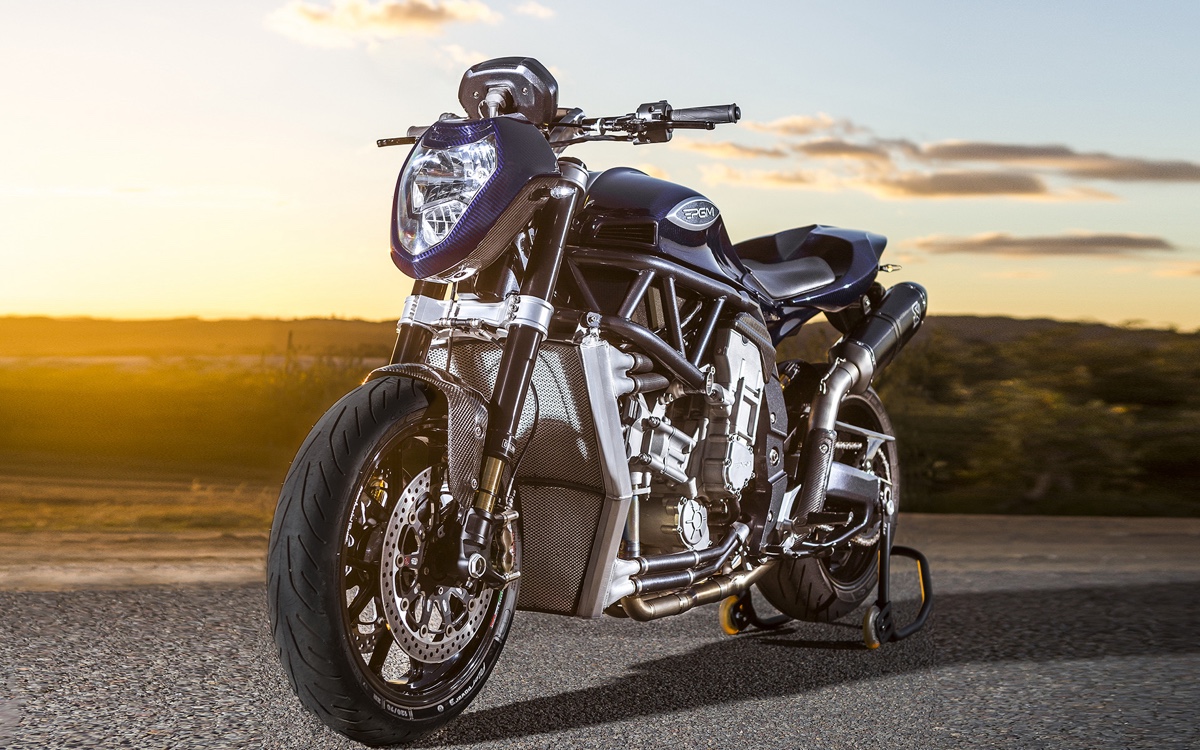
More remarkably, it wasn’t simply an engine experiment. The PGM featured Öhlins suspension, Brembo brakes, forged Marchesini wheels, carbon-fiber bodywork, ride-by-wire throttles, MoTeC electronics, and a carefully developed chassis, which turned the bike into a functioning street motorcycle rather than a V8 mounted between two wheels. Legendary journalist Alan Cathcart rode it and came away suitably impressed:
“The PGM V8 is the single most impressive piece of multi-cylinder madness I’ve ever had the privilege of riding.”
Designer: Paul G. Maloney
Maloney has the right résumé for attempting something like this. The Australian engineer spent years working in European motorcycle racing, including Superbike and MotoGP programs. Cathcart knew him from his time building factory Kawasaki Superbike and MotoGP engines, and Maloney also had extensive experience with Yamaha machinery.
For years, he’d been considering the possibility of building a V8 motorcycle engine. His first design actually used Kawasaki ZX-7RR components. The Kawasaki’s separate cylinder assemblies made it attractive for a custom crankcase, and Maloney initially drew up a 1500cc V8 around two sets of 750cc Kawasaki hardware.
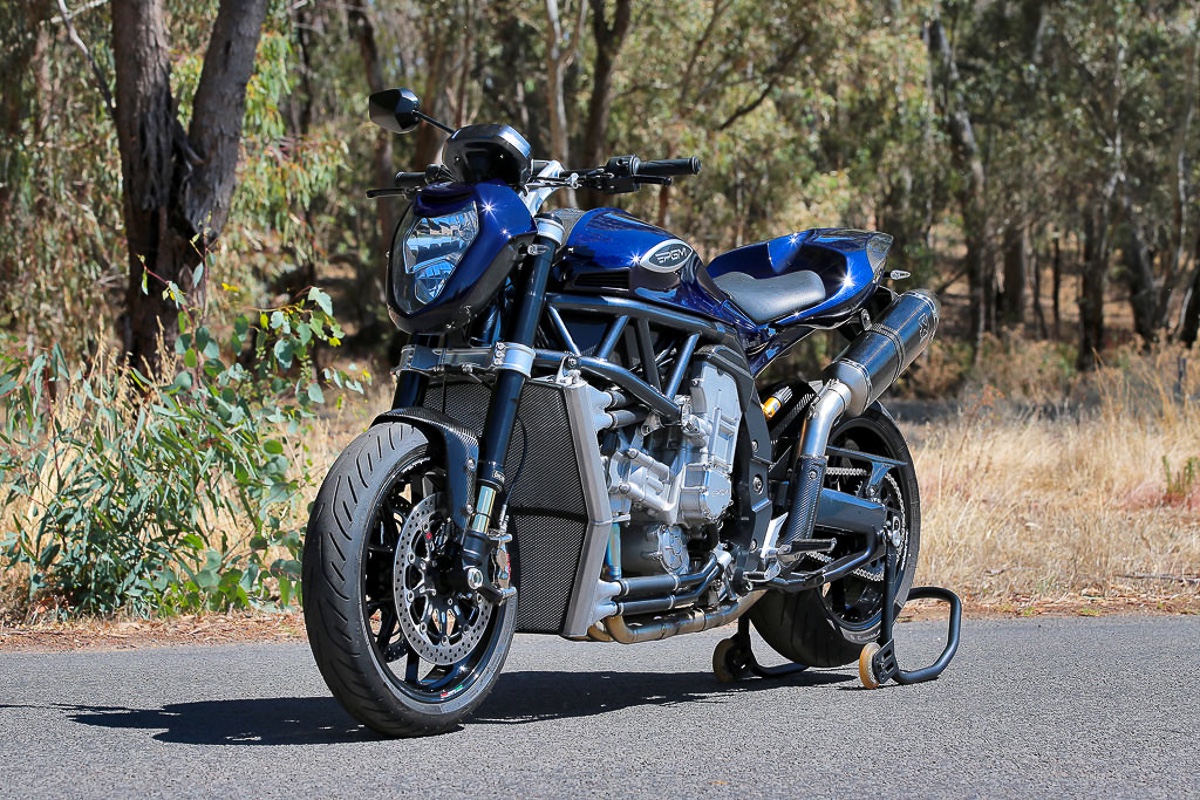
Then Yamaha changed the equation. The 2004-generation YZF-R1 used separate cylinders, and Maloney discovered that a 2.0-liter V8 using the Yamaha components would be no wider than the smaller Kawasaki-based design. Given his previous decade of experience with Yamaha machinery, the decision was made. The PGM would use R1 hardware.
Not Quite Two R1 Engines…
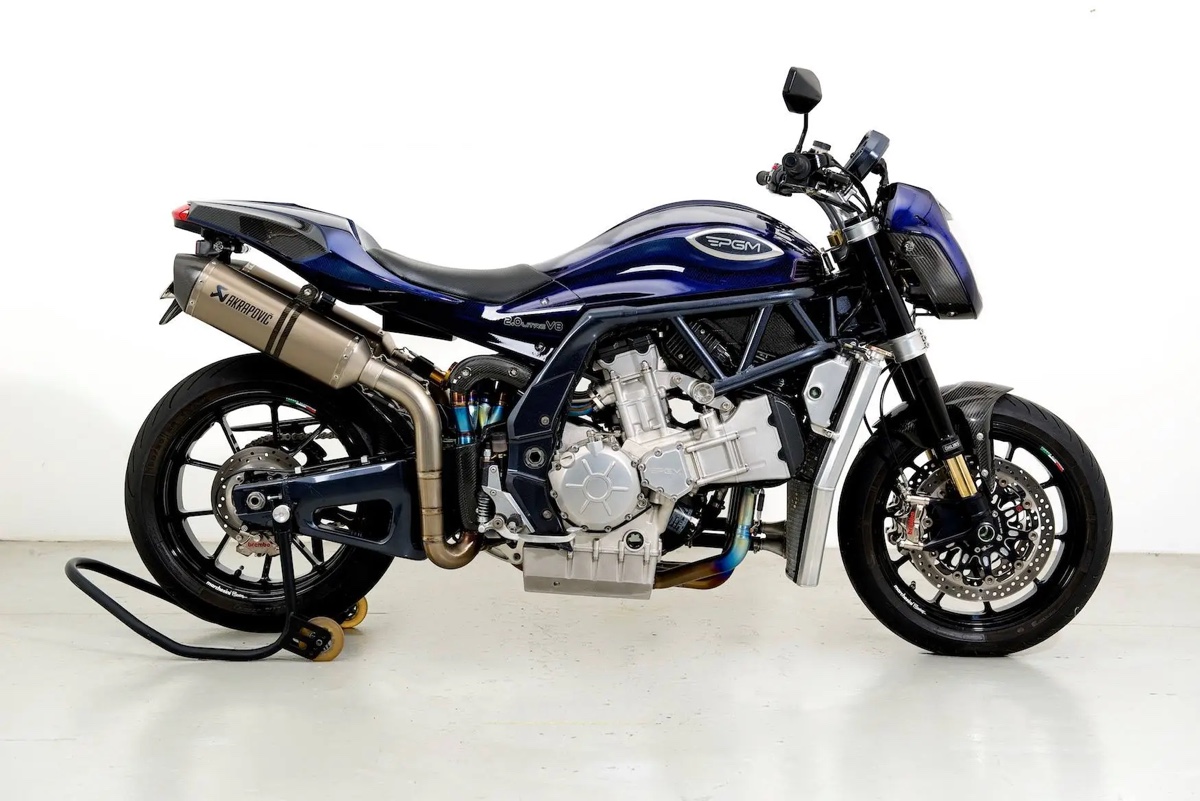
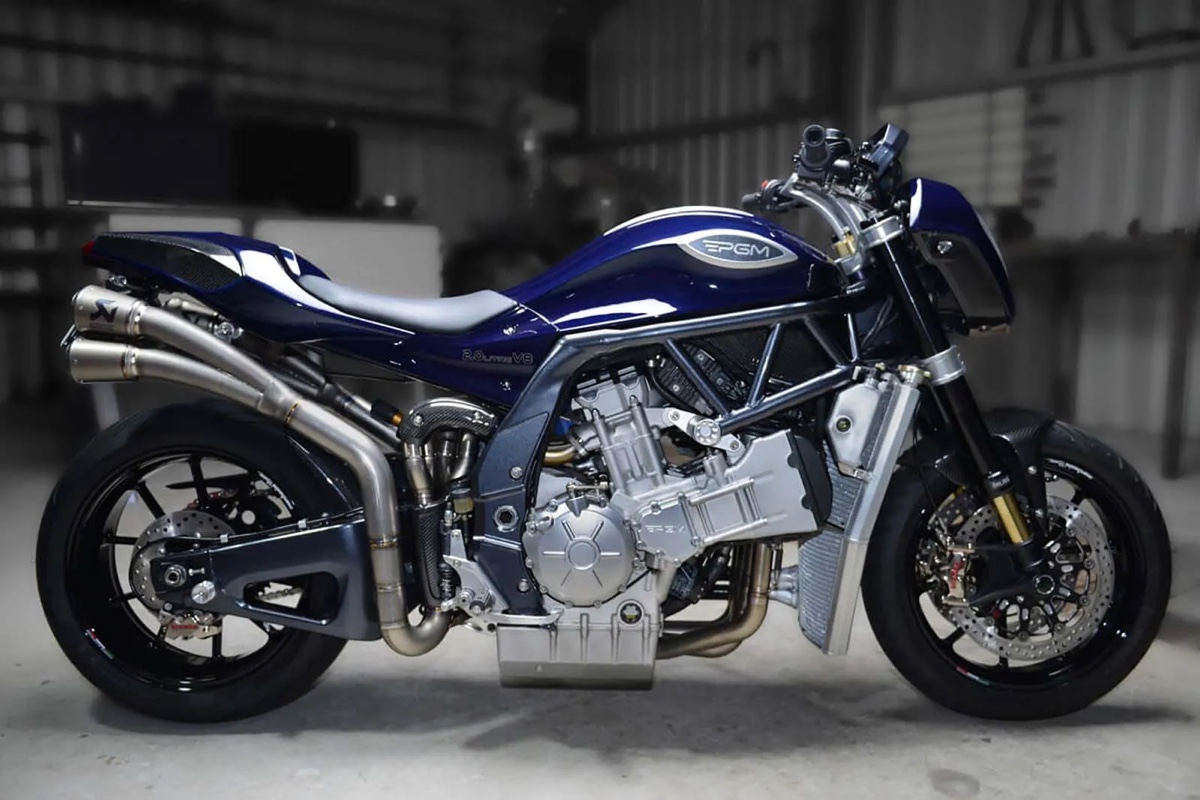
The PGM V8 is frequently described as two Yamaha R1 engines joined together. That’s an understandable shorthand, but it isn’t technically accurate. Maloney used Yamaha R1 cylinders and cylinder heads arranged as two banks at 90 degrees. The engine also retained R1 pistons and connecting rods.
The bottom end, however, was a new piece of engineering. Both cylinder banks mounted to a purpose-built common crankcase containing a one-piece flat-plane crankshaft machined from EN36 steel. The transmission likewise had to be re-engineered for the application.
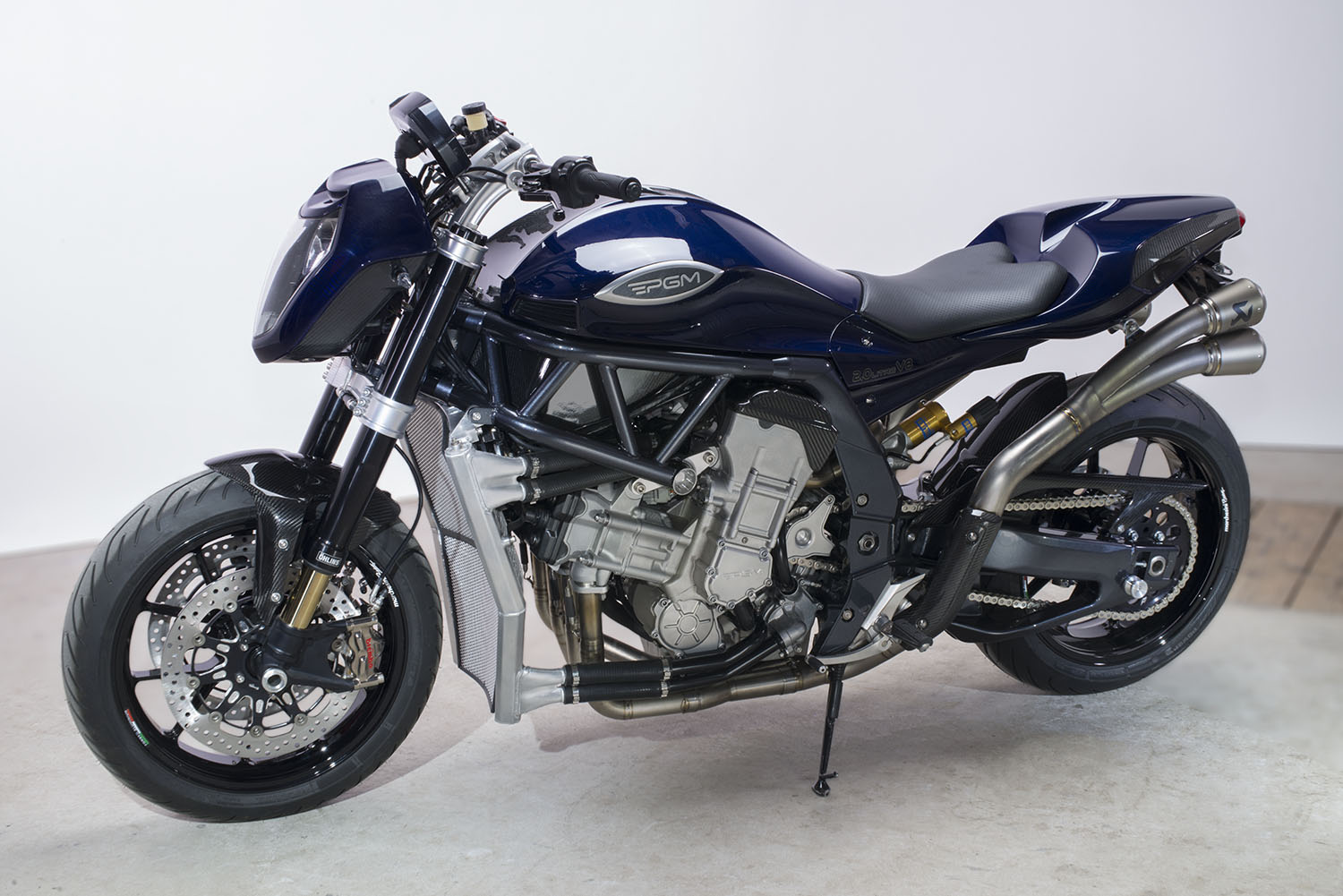
In other words, this wasn’t just a pair of complete R1 engines mechanically coupled together, but a purpose-built V8 using proven Yamaha combustion hardware. Maloney described his original concept specifically as a pair of R1 cylinder assemblies mounted on a common crankcase. Arguably, that makes the engine even more impressive.
1996cc…and 40 Valves
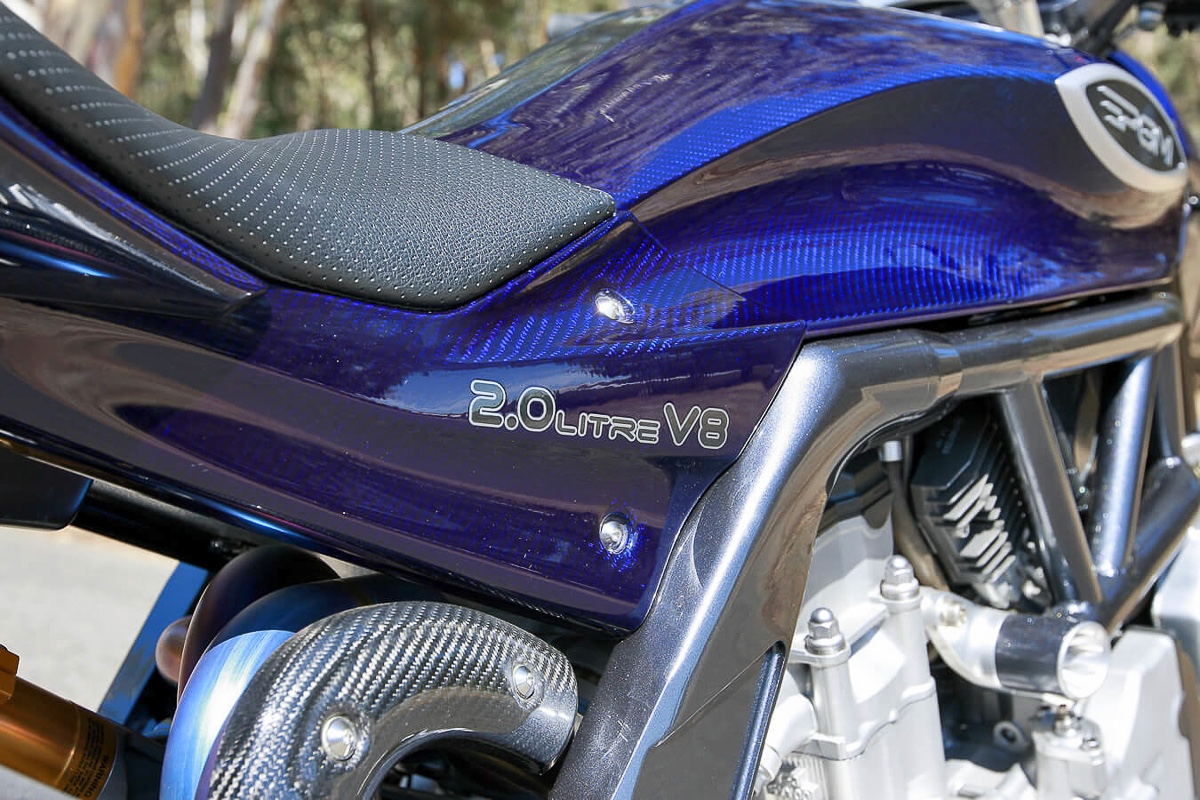
The completed engine displaced 1996cc from a 77 x 54mm bore and stroke. The Yamaha-derived cylinder heads retained five valves per cylinder, giving the V8 a total of 40 valves operated by dual overhead camshafts. Eight 45mm Mikuni drive-by-wire throttle bodies handled induction, controlled by a MoTeC M130 ECU. Compression ratio was 13:1. Each cylinder bank exhaled through its own titanium 4-2-1 exhaust system developed with Akrapovič — trick!
The flat-plane crankshaft gave the engine a very different character from the cross-plane V8s familiar from many American cars. Combined with the relatively small individual cylinders and high operating speed, the PGM sounded closer to a racing engine than a conventional big-capacity automotive V8. And it revved accordingly. Peak power arrived at 12,800 rpm!
PGM’s official specification gives output as 334 horsepower measured at the countershaft sprocket, with 214 Nm / 158 lb-ft of torque at 9,500 rpm. That means the crankshaft horsepower would be even higher!
334 Horsepower
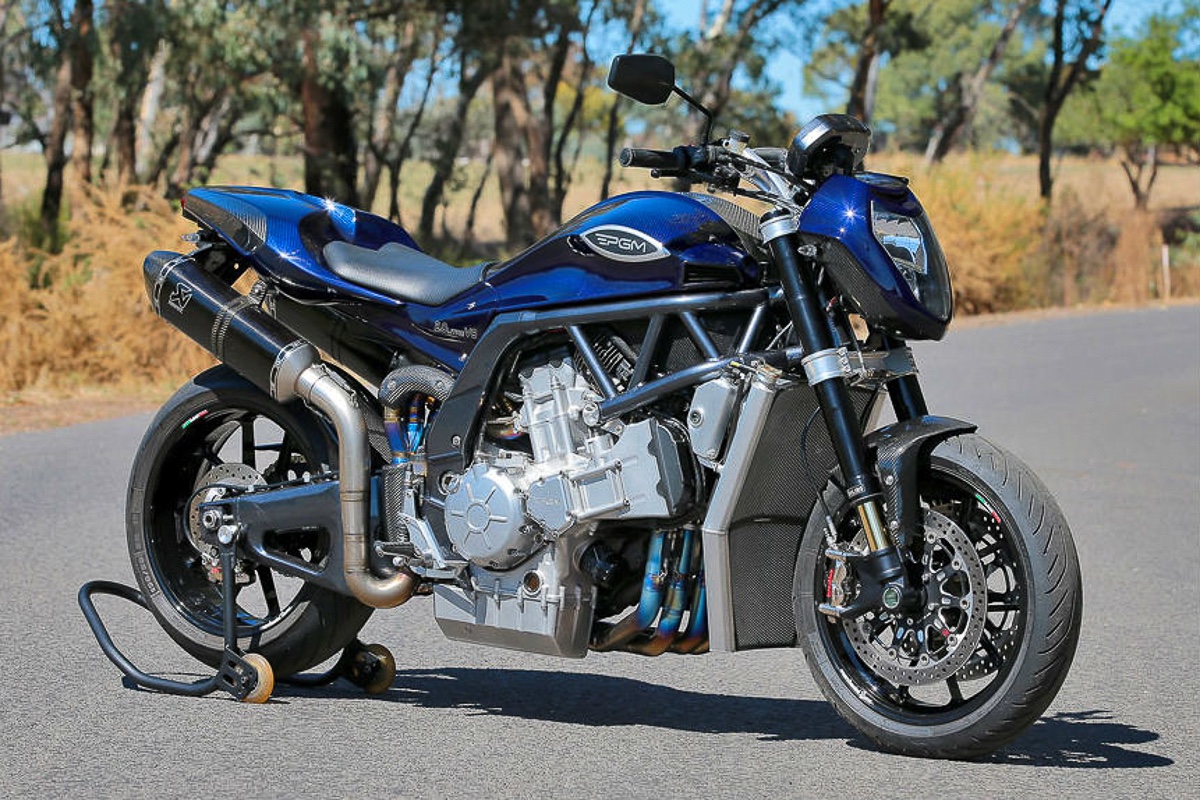
Today, forced-induction motorcycles and highly developed superbikes have made 200-plus horsepower relatively familiar, but >300 hp is still rare…and the PGM reached 334 hp without a turbocharger or supercharger.
Its advantage, of course, was sheer displacement. A modern literbike may use roughly 1000cc to produce around 200 horsepower. Maloney essentially doubled the capacity while retaining the bore dimensions, cylinder-head architecture, and high-revving character of a superbike engine. The result was not just a high peak-power number but enormous torque across the usable rev range.
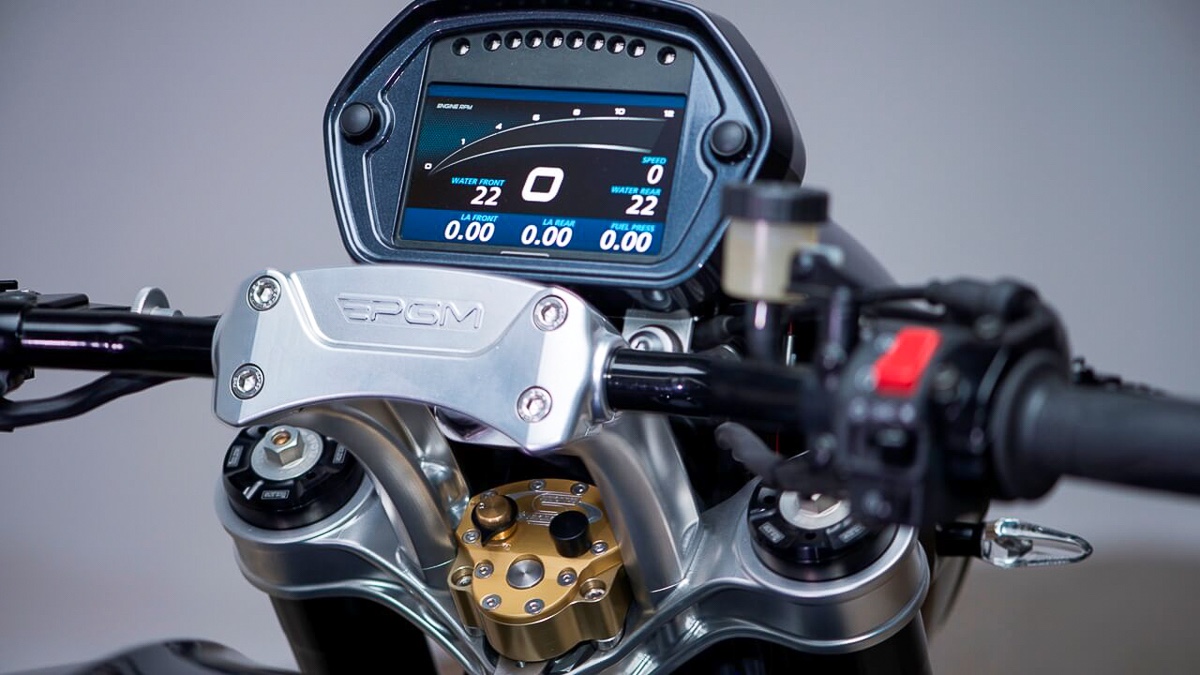
What makes the engine particularly interesting is that Maloney did not chase 334 horsepower at the expense of street manners. Cathcart reported that the PGM could comfortably travel through town in third gear at around 60 km/h / 40 mph without stumbling, protesting, or loading up. The truly serious acceleration arrived as the engine climbed beyond roughly 5000 rpm. That made the motorcycle’s performance unusually accessible… at least until the throttle was opened.
Wet Weight: 242 Kilograms / 534 Pounds
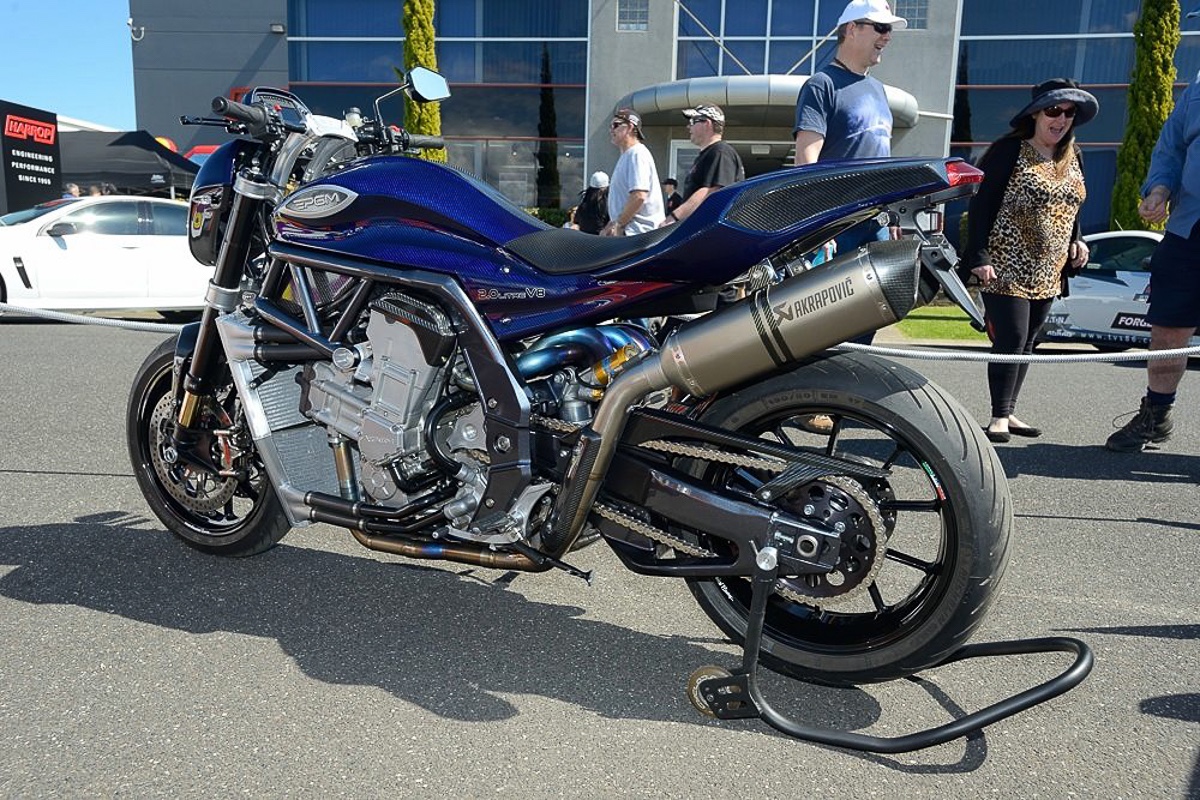
A two-liter V8 motorcycle was never going to weigh as little as a modern superbike, but the PGM’s 242kg / 534-lb wet weight is remarkably light considering the engine. Keep in mind that figure includes coolant, lubricants, and a full tank of fuel. What’s more, the motorcycle achieved a near-even 51/49 static weight distribution despite the size of the powerplant.
Maloney used a hybrid chassis architecture, with a chromoly tubular structure at the front and CNC-machined aluminum sections toward the rear. The engine forms an important part of the overall structure. Suspension came from Öhlins: a fully adjustable 48mm FGRT301 inverted fork and TTX rear shock working through a custom linkage.
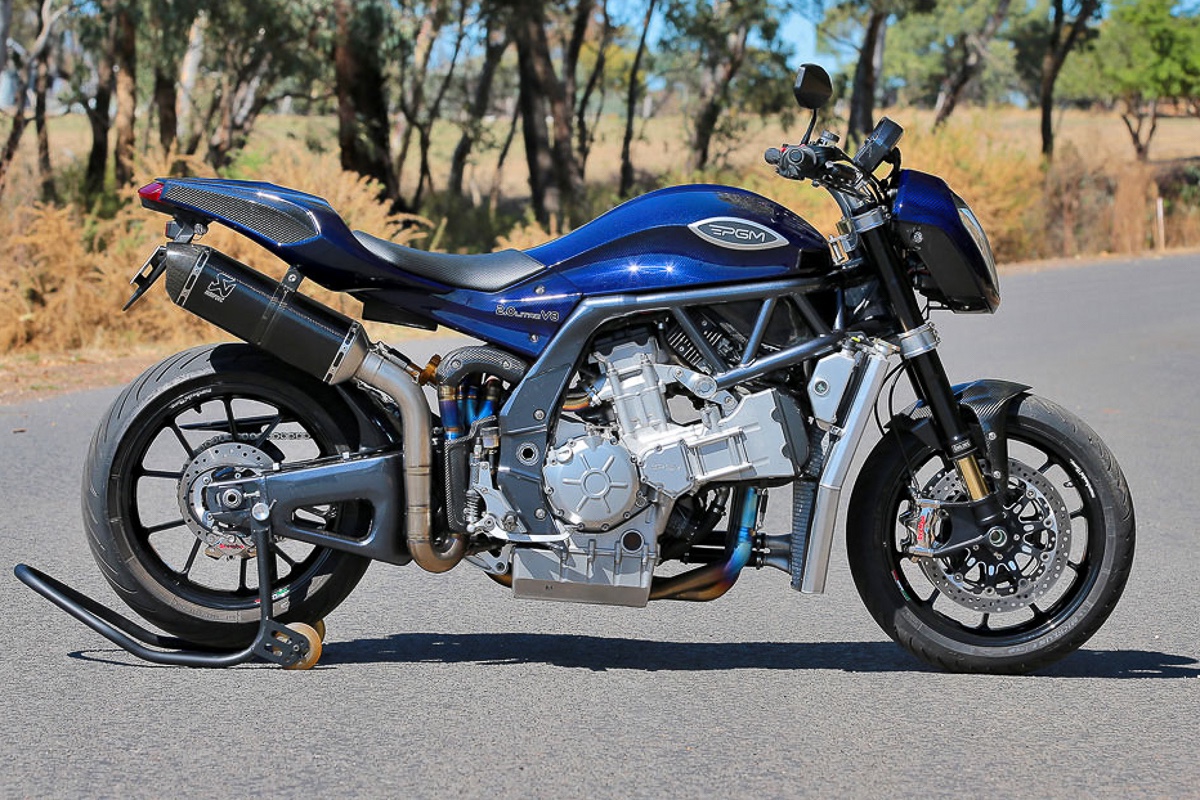
Braking hardware was equally serious, with twin 320mm front discs and Brembo GP4 calipers, backed by a 220mm rear disc. Forged 17-inch Marchesini wheels carried a 120-section front and 190-section rear tire.
Bigger Than a Superbike, Smaller Than You’d Expect
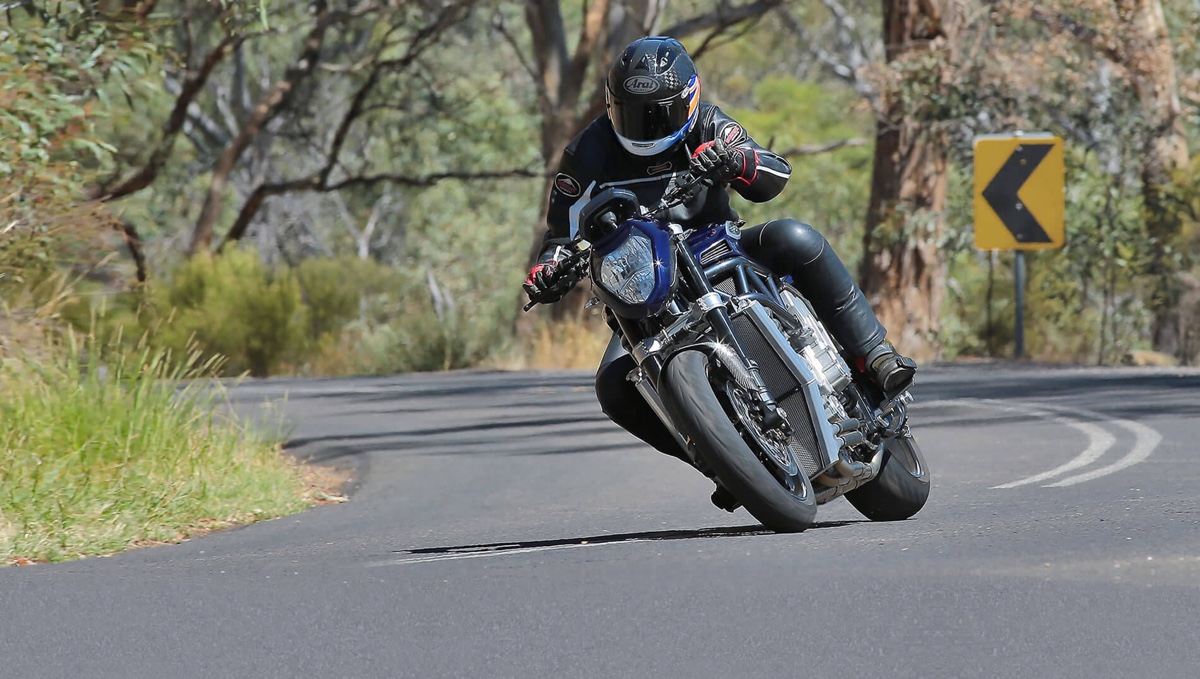
Packaging eight cylinders into a motorcycle creates obvious ergonomic problems. The PGM is wider than a normal four-cylinder sportbike, particularly around the vertically oriented rear cylinder bank, but Cathcart found it surprisingly manageable once moving.
The seat sits 840mm / 33 inches high, with the rider positioned partly above the rear bank. A carbon-fiber heat shield prevents the cylinder head from cooking the rider’s leg. Wheelbase is a long 1540mm, which helps contain the effects of 334 horsepower without turning the bike into a full-blown drag machine.
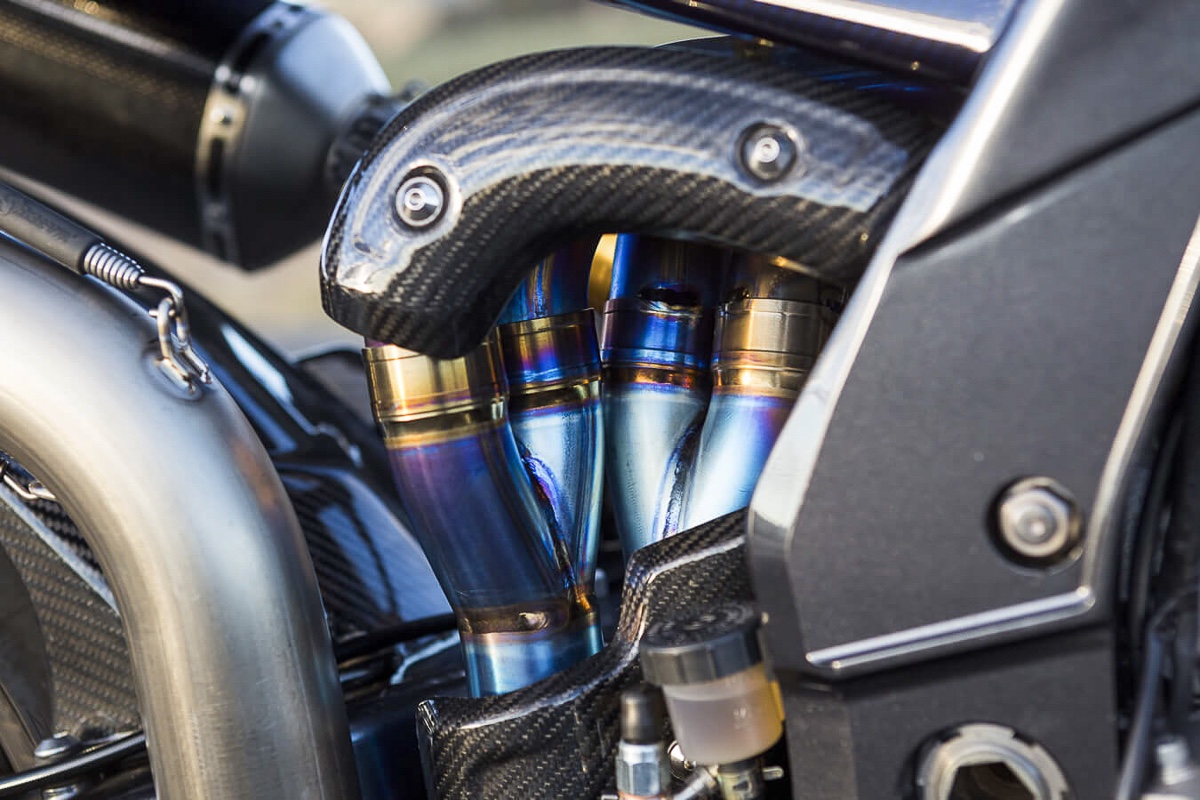
Low-speed maneuvering is where the size becomes more apparent. Cathcart found U-turns awkward and the bike physically substantial at walking speeds. Once underway, however, he found the steering and chassis far more conventional than the engine specification suggested. While it wasn’t a supersport bike, it handled much better than a V8 cruiser.
What’s 334 HP Like on the Road?
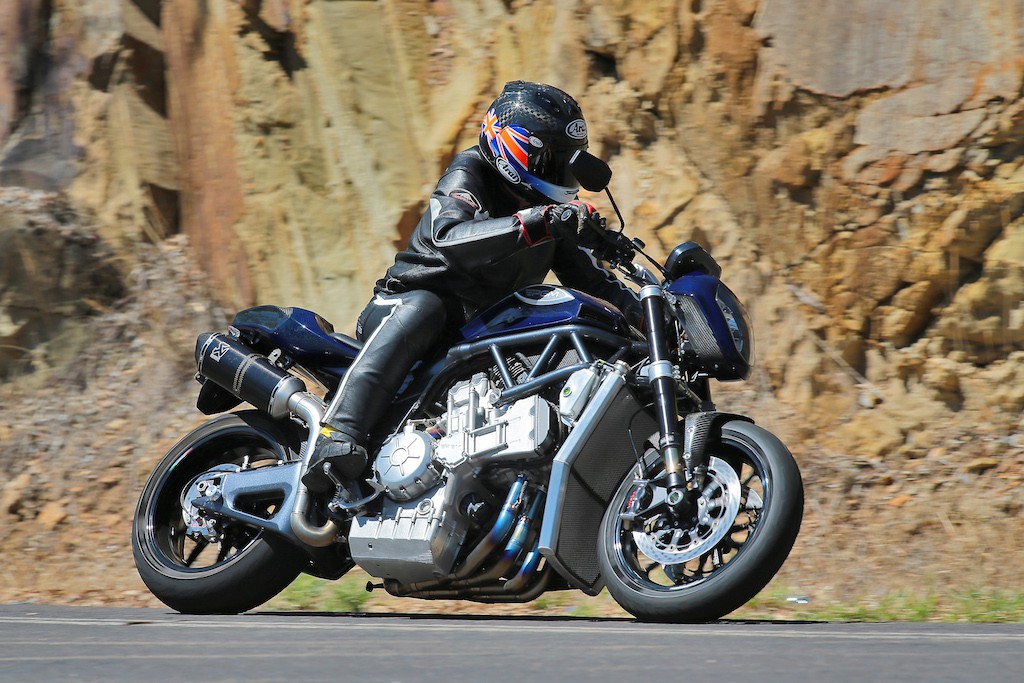
Cathcart became the first rider outside Maloney’s development group to test the PGM extensively. His most interesting observation was that the engine didn’t deliver its performance with the abruptness one might expect. Despite the enormous output, the acceleration was progressive rather than explosive. The long wheelbase, weight distribution, and linear engine response helped keep the front end under control, while the wide handlebar gave the rider useful leverage in corners.
But when the engine was allowed to rev, the scale of the performance became obvious. Cathcart described its acceleration as unlike anything else he had ridden with a license plate. What’s more, Maloney had temporarily limited the engine to 10,500 rpm for the test, as the prototype had covered only about 1500 kilometers. Peak power normally arrived another 2,300 rpm higher!
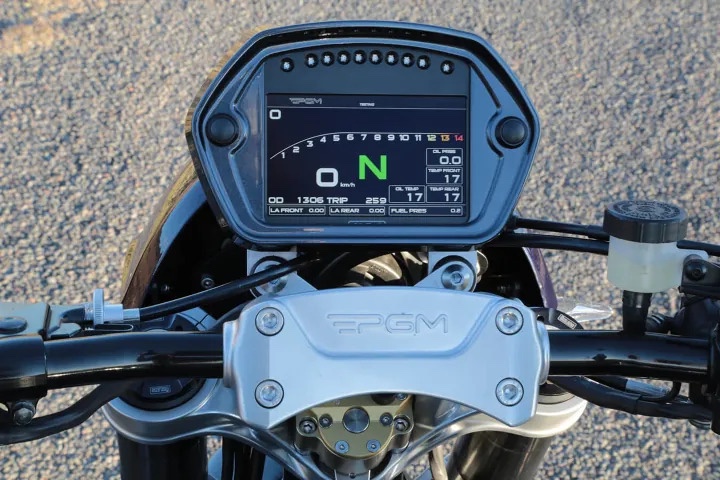
Yet perhaps the strongest praise was reserved for the overall development. The clutch was light. The six-speed transmission shifted cleanly. The engine behaved properly at low speeds. The suspension worked on real roads. Overall, the PGM behaved like a finished, well-mannered motorcycle.
Seven Years in Secret…
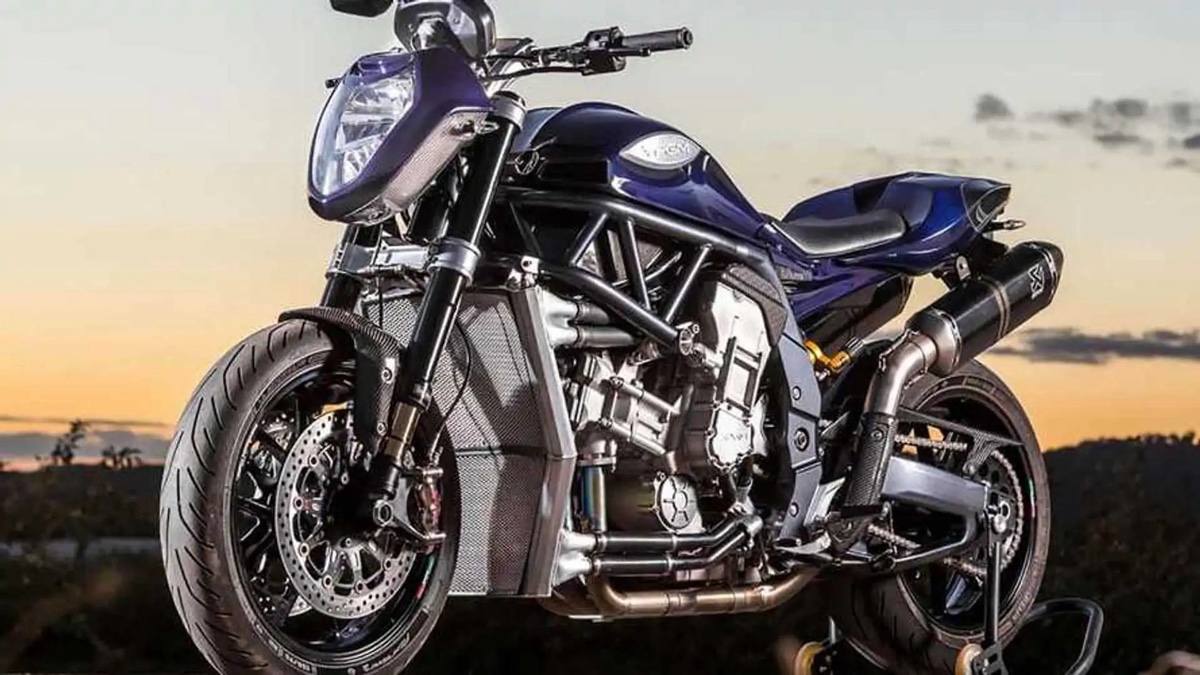
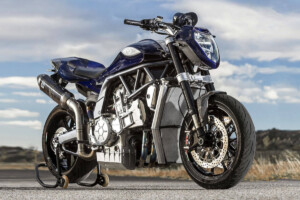
Development had taken roughly seven years. Maloney worked largely outside public view with a small group of collaborators at Maltec Performance Engineering in Victoria, Australia. When the PGM emerged publicly around 2015, it appeared remarkably complete for such a small-scale project. Designer Seanr Chhean gave the bike cohesive carbon-fiber bodywork rather than attempting to disguise the engine beneath conventional fairings. So the V8 remained the visual center of the motorcycle.
PGM subsequently offered the machine on a made-to-order basis. By 2018, the quoted starting price was approximately $180,000, with specifications customizable for individual buyers. Public production numbers are difficult to establish, as this was a hand-built, extremely low-volume machine constructed to order.
Can You Still Buy One?
Apparently, yes — or at least PGM still invites prospective customers to ask. As of 2026, Maltec Performance Engineering’s PGM V8 website remains active, displays the motorcycle’s specifications, and includes a contact form telling visitors to “start your journey” toward ownership. The site no longer publishes a current price or delivery time, so availability would need to be confirmed directly with the builder.
PGM also continues to describe the V8 as the “world’s most powerful production motorcycle.” That depends somewhat on how broadly one defines a production motorcycle — particularly with machines like the track-only Kawasaki Ninja H2R and MTT 420 RR in the conversation — but the PGM’s claim to distinction hardly depends on a superlative. Very few road motorcycles have ever combined this displacement, cylinder count, output, and relatively conventional sporting chassis.
The horsepower figure is really only part of the story. Making an enormous number on a dyno is one thing, but building a 2.0-liter V8 motorcycle that can idle through town, negotiate a back road, and still produce 334 horsepower at 12,800 rpm is quite another. By all accounts, that’s exactly what PGM produced.
PGM V8 Specifications
| Engine | Liquid-cooled 90° V8 |
| Displacement | 1,996cc |
| Bore x stroke | 77 x 54mm |
| Compression ratio | 13:1 |
| Cylinder heads | DOHC, five valves per cylinder |
| Engine basis | Yamaha YZF-R1 cylinders, heads, pistons and rods; purpose-built V8 bottom end |
| Fueling | 8 x 45mm Mikuni ride-by-wire throttle bodies |
| Engine management | MoTeC M130 |
| Claimed power | 334 hp @ 12,800 rpm at countershaft |
| Claimed torque | 214 Nm / 158 lb-ft @ 9,500 rpm at countershaft |
| Exhaust | Twin titanium 4-2-1 systems |
| Crankshaft | One-piece flat-plane |
| Transmission | Six-speed sequential |
| Clutch | Wet multi-plate |
| Frame | Chrome-moly tubular front / CNC-machined aluminum rear |
| Front suspension | Öhlins FGRT301 48mm USD fork |
| Rear suspension | Öhlins TTX shock |
| Front brakes | Twin 320mm discs, Brembo GP4 calipers |
| Wheels | Forged aluminum Marchesini |
| Wheelbase | 1,540mm |
| Seat height | 840mm |
| Fuel capacity | 16.5 liters |
| Wet weight | 242 kg / 534 lb |
| Weight distribution | 51/49 front/rear |
| Period price | From approximately US$180,000 |
More Extreme Bikes…
 334-hp PGM V8: “The World’s Most Powerful Production Motorcycle” - 2000cc, 334 horsepower, 534 lbs, and a V8 built from two Yamaha R1 engines… Most V8 motorcycles begin with an automobile engine. That approach has produced everything from Boss Hoss cruisers to one-off specials, […]
 Vyrus 987 C³ 4V: 350-lb Ducati-Powered Hub-Center Superbike - Ducati 1098R power, 350 pounds, and hub-center steering… In 2009, the Ducati 1098R already represented an extreme interpretation of the Italian V-twin superbike. Its Testastretta Evoluzione engine (actually 1198cc despite the model name) had been […]
 Münch Mammut 2000: The 260-hp Turbo Bike - Übermoto: 2000cc, Turbocharged, 260 horsepower, and 218 lb-ft of torque… At the turn of the millennium, the motorcycle world was engaged in an escalating superbike arms race. The Suzuki Hayabusa and Kawasaki ZX-12R were pushing […]
 Honda NR750: The Oval-Piston Superbike - 32-Valve, 15,000-rpm V4: Honda’s attempt to build a V8…without technically building one… In 1992, Honda put one of the strangest engines ever developed for Grand Prix racing into a road-going motorcycle. The resulting Honda NR750 […]
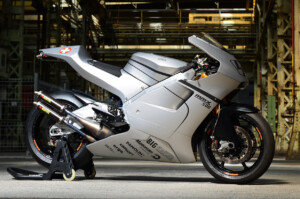 Suter MMX 500: 195-HP Two-Stroke GP Bike - 195 Horsepower, 280 Pounds, Two Strokes: The Spirit of the 500cc “Unrideables” Reborn… For a generation of motorcycle racing fans, the 500cc two-stroke Grand Prix bike represents something close to the ultimate racing motorcycle. The […]
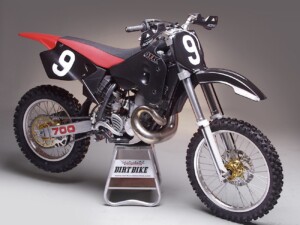 ATK 700 Intimidator: The 78-hp 700cc Two-Stroke Dirt Bike - 685cc, 78 Horsepower, 238 Pounds: One of the most outrageous production dirt bikes ever offered in America… There was a time when a 500cc two-stroke motocross bike was the king of the dirt. Honda’s CR500 […]
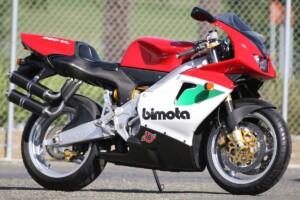 Bimota Vdue: 500cc Two-Stroke GP Bike for the Road - Bimota’s first homegrown engine powered one of the wildest superbikes of the 1990s: a featherweight 500cc V-twin smoker with direct fuel injection, carbon bodywork, and GP aspirations… Imagine walking into a motorcycle dealership in the […]
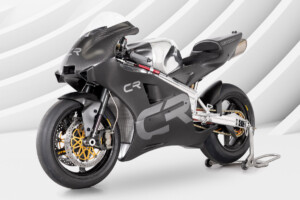 Crighton CR700W: 220-hp, 286-lb Rotary Superbike - The culmination of Brian Crighton’s four-decade obsession with rotary race bikes makes 220 horsepower from 690cc — and weighs less than a Yamaha R3… The Crighton CR700W is one of those motorcycles whose specifications make […]
 2WD Dakar Legend: Yamaha WR450F 2-Trac - Remembering Yamaha x Öhlins’ Hydraulic 2WD Enduro… Every so often, a motorcycle appears that seems to point toward an entirely different future. The Yamaha WR450F 2-Trac was one of those machines. At first glance, it […]
 Kinetic Art: Brough Superior RMB01 - Brough Superior and Watchmaker Richard Mille join forces on a work of kinetic art… One of the most striking machines at ArtRide 2026 in Biarritz, France, was the Brough Superior RMB01. Built in collaboration with […]
 Up for Auction: Allen Millyard’s 500-hp Viper V10 Motorcycle! - The 8000cc, 500-bhp Millyard Viper V10 crosses the auction block this month… There are custom motorcycles, and then there’s the Millyard Viper V10. Built by legendary British engineer Allen Millyard, this 8000cc V10-powered road-legal motorcycle […]
 Veloce Ethereal: 500cc Two-Stroke Café Racer - 145-hp 500cc Two-Stroke Ethereal from Veloce Motorcycles… In the modern world, a 500cc two-stroke intended for road use seems almost unthinkable. However, that’s exactly what Oxfordshire-based Veloce Motorcycles is promising with the Ethereal — a […]
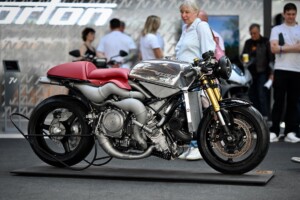 Veloce Aperion: 280-BHP 1000cc Two-Stroke Café Racer! - Veloce Motorcycles unveils a 1000cc X8 two-stroke café racer! Built by Oxfordshire-based Veloce Motorcycles, the Aperion is a 1000cc, eight-cylinder, two-stroke naked bike — or perhaps more accurately, an engineering provocation with lights, wheels, and […]


